Most of us regard the Constitution as the foundation of American democracy. How, then, are we to understand the restrictions that it imposes on legislatures and voters? Why, for example, does the Constitution allow unelected judges to exercise so much power? And why is this centuries-old document so difficult to amend? In short, how can we call ourselves a democracy when we are bound by an entrenched, and sometimes counter-majoritarian, constitution?
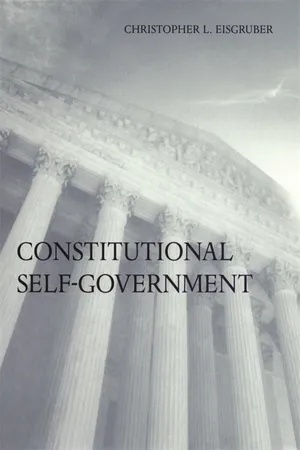
In Constitutional Self-Government, Christopher Eisgruber focuses directly on the Constitution's seemingly undemocratic features. Whereas other scholars have tried to reconcile these features with majority rule, or simply acknowledged them as necessary limits on democracy, Eisgruber argues that constitutionalism is best regarded not as a constraint upon self-government, but as a crucial ingredient in a complex, non-majoritarian form of democracy. In an original and provocative argument, he contends that legislatures and elections provide only an incomplete representation of the people, and he claims that the Supreme Court should be regarded as another of the institutions able to speak for Americans about justice. At a pivotal moment of worldwide interest in judicial review and renewed national controversy over the Supreme Court's role in politics, Constitutional Self-Government ingeniously locates the Constitution's value in its capacity to sustain an array of institutions that render self-government meaningful for a large and diverse people.
- 273 pages
- English
- PDF
- Available on iOS & Android
eBook - PDF
Constitutional Self-Government
About this book
Information
Publisher
Harvard University PressYear
2009Print ISBN
9780674025400
9780674006089
eBook ISBN
9780674034464
Table of contents
- Contents
- Introduction
- 1 The Democratic Functions of Inflexible Constitutions
- 2 Judicial Review and Democratic Legitimacy
- 3 Judicial Review and Democratic Flourishing
- 4 Text and History in Hard Cases
- 5 Liberty, Strategy, and Tradition
- 6 Judicial Maintenance of Political Institutions
- Conclusion
- Notes
- Index
Trusted by 375,005 students
Access to over 1.5 million titles for a fair monthly price.
Study more efficiently using our study tools.
Frequently asked questions
Yes, you can cancel anytime from the Subscription tab in your account settings on the Perlego website. Your subscription will stay active until the end of your current billing period. Learn how to cancel your subscription
No, books cannot be downloaded as external files, such as PDFs, for use outside of Perlego. However, you can download books within the Perlego app for offline reading on mobile or tablet. Learn how to download books offline
Perlego offers two plans: Essential and Complete
- Essential is ideal for learners and professionals who enjoy exploring a wide range of subjects. Access the Essential Library with 800,000+ trusted titles and best-sellers across business, personal growth, and the humanities. Includes unlimited reading time and Standard Read Aloud voice.
- Complete: Perfect for advanced learners and researchers needing full, unrestricted access. Unlock 1.5M+ books across hundreds of subjects, including academic and specialized titles. The Complete Plan also includes advanced features like Premium Read Aloud and Research Assistant.
We are an online textbook subscription service, where you can get access to an entire online library for less than the price of a single book per month. With over 1.5 million books across 990+ topics, we’ve got you covered! Learn about our mission
Look out for the read-aloud symbol on your next book to see if you can listen to it. The read-aloud tool reads text aloud for you, highlighting the text as it is being read. You can pause it, speed it up and slow it down. Learn more about Read Aloud
Yes! You can use the Perlego app on both iOS and Android devices to read anytime, anywhere — even offline. Perfect for commutes or when you’re on the go.
Please note we cannot support devices running on iOS 13 and Android 7 or earlier. Learn more about using the app
Please note we cannot support devices running on iOS 13 and Android 7 or earlier. Learn more about using the app
Yes, you can access Constitutional Self-Government by Christopher L. Eisgruber,Christopher L. EISGRUBER in PDF and/or ePUB format, as well as other popular books in Law & Law Theory & Practice. We have over 1.5 million books available in our catalogue for you to explore.