Alchemy can't be science--common sense tells us as much. But perhaps common sense is not the best measure of what science is, or was. In this book, Bruce Moran looks past contemporary assumptions and prejudices to determine what alchemists were actually doing in the context of early modern science. Examining the ways alchemy and chemistry were studied and practiced between 1400 and 1700, he shows how these approaches influenced their respective practitioners' ideas about nature and shaped their inquiries into the workings of the natural world. His work sets up a dialogue between what historians have usually presented as separate spheres; here we see how alchemists and early chemists exchanged ideas and methods and in fact shared a territory between their two disciplines.
Distilling Knowledge suggests that scientific revolution may wear a different appearance in different cultural contexts. The metaphor of the Scientific Revolution, Moran argues, can be expanded to make sense of alchemy and other so-called pseudo-sciences--by including a new framework in which "process can count as an object, in which making leads to learning, and in which the messiness of conflict leads to discernment." Seen on its own terms, alchemy can stand within the bounds of demonstrative science.
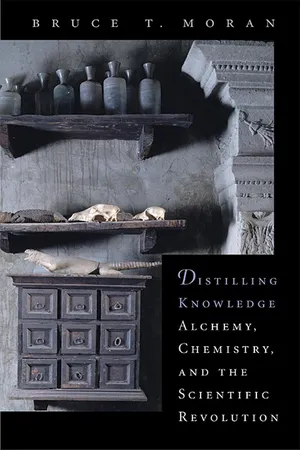
eBook - PDF
Distilling Knowledge
Alchemy, Chemistry, and the Scientific Revolution
- 221 pages
- English
- PDF
- Available on iOS & Android
eBook - PDF
About this book
Information
Publisher
Harvard University PressYear
2009Print ISBN
9780674022492
9780674014954
eBook ISBN
9780674041226
Table of contents
- Contents
- Introduction
- 1. Doing Alchemy
- 2. “That Pleasing Novelty”:Alchemy in Artisan and Daily Life
- 3. Paracelsus and the “Paracelsians”:Natural Relationships and Separation as Creation
- 4. Sites of Learning and the Language of Chemistry
- 5. Alchemy, Chemistry, and the Technology of Knowing
- 6. The Reality of Relationship
- Conclusion:Varieties of Experience in Reading the Book of Nature
- References
- Index
Trusted by 375,005 students
Access to over 1.5 million titles for a fair monthly price.
Study more efficiently using our study tools.
Frequently asked questions
Yes, you can cancel anytime from the Subscription tab in your account settings on the Perlego website. Your subscription will stay active until the end of your current billing period. Learn how to cancel your subscription
No, books cannot be downloaded as external files, such as PDFs, for use outside of Perlego. However, you can download books within the Perlego app for offline reading on mobile or tablet. Learn how to download books offline
Perlego offers two plans: Essential and Complete
- Essential is ideal for learners and professionals who enjoy exploring a wide range of subjects. Access the Essential Library with 800,000+ trusted titles and best-sellers across business, personal growth, and the humanities. Includes unlimited reading time and Standard Read Aloud voice.
- Complete: Perfect for advanced learners and researchers needing full, unrestricted access. Unlock 1.5M+ books across hundreds of subjects, including academic and specialized titles. The Complete Plan also includes advanced features like Premium Read Aloud and Research Assistant.
We are an online textbook subscription service, where you can get access to an entire online library for less than the price of a single book per month. With over 1.5 million books across 990+ topics, we’ve got you covered! Learn about our mission
Look out for the read-aloud symbol on your next book to see if you can listen to it. The read-aloud tool reads text aloud for you, highlighting the text as it is being read. You can pause it, speed it up and slow it down. Learn more about Read Aloud
Yes! You can use the Perlego app on both iOS and Android devices to read anytime, anywhere — even offline. Perfect for commutes or when you’re on the go.
Please note we cannot support devices running on iOS 13 and Android 7 or earlier. Learn more about using the app
Please note we cannot support devices running on iOS 13 and Android 7 or earlier. Learn more about using the app
Yes, you can access Distilling Knowledge by Bruce T. Moran,Bruce T. MORAN in PDF and/or ePUB format, as well as other popular books in History & Science History. We have over 1.5 million books available in our catalogue for you to explore.