In the wake of the black civil rights movement, other disadvantaged groups of Americans began to make headway--Latinos, women, Asian Americans, and the disabled found themselves the beneficiaries of new laws and policies--and by the early 1970s a minority rights revolution was well underway. In the first book to take a broad perspective on this wide-ranging and far-reaching phenomenon, John D. Skrentny exposes the connections between the diverse actions and circumstances that contributed to this revolution--and that forever changed the face of American politics.
Though protest and lobbying played a role in bringing about new laws and regulations--touching everything from wheelchair access to women's athletics to bilingual education--what Skrentny describes was not primarily a bottom-up story of radical confrontation. Rather, elites often led the way, and some of the most prominent advocates for expanding civil rights were the conservative Republicans who later emerged as these policies' most vociferous opponents. This book traces the minority rights revolution back to its roots not only in the black civil rights movement but in the aftermath of World War II, in which a world consensus on equal rights emerged from the Allies' triumph over the oppressive regimes of Nazi Germany and Imperial Japan, and then the Soviet Union. It also contrasts failed minority rights development for white ethnics and gays/lesbians with groups the government successfully categorized with African Americans. Investigating these links, Skrentny is able to present the world as America's leaders saw it; and so, to show how and why familiar figures--such as Lyndon Johnson, Richard Nixon, and, remarkably enough, conservatives like Senator Barry Goldwater and Robert Bork--created and advanced policies that have made the country more egalitarian but left it perhaps as divided as ever.
- 490 pages
- English
- PDF
- Available on iOS & Android
eBook - PDF
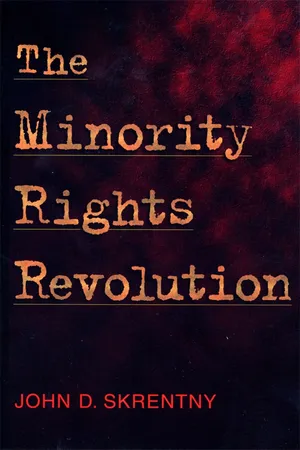
The Minority Rights Revolution
About this book
Information
Table of contents
- CONTENTS
- 1 Introduction: How War and the Black Civil Rights Movement Changed America
- 2 “This Is War and This Is a War Measure”: Racial Equality Becomes National Security
- 3 National Security and Equal Rights: Limits and Qualifications
- 4 “We Were Advancing the Really Revolutionary View of Discrimination”: Designating Official Minorities for Affirmative Action in Employment
- 5 “In View of the Existence of the Other Significant Minorities”: The Expansion of Affirmative Action for Minority Capitalists
- 6 “Race Is a Very Relevant Personal Characteristic”: Affirmative Admissions, Diversity, and the Supreme Court
- 7 “Learn, Amigo, Learn!”: Bilingual Education and Language Rights in the Schools
- 8 “I Agree with You about the Inherent Absurdity”: Title IX and Women’s Equality in Education
- 9 White Males and the Limits of the Minority Rights Revolution: The Disabled, White Ethnics, and Gays
- 10 Conclusion: The Rare American Epiphany
- Notes
- Index
Trusted by 375,005 students
Access to over 1.5 million titles for a fair monthly price.
Study more efficiently using our study tools.
Frequently asked questions
Yes, you can cancel anytime from the Subscription tab in your account settings on the Perlego website. Your subscription will stay active until the end of your current billing period. Learn how to cancel your subscription
No, books cannot be downloaded as external files, such as PDFs, for use outside of Perlego. However, you can download books within the Perlego app for offline reading on mobile or tablet. Learn how to download books offline
Perlego offers two plans: Essential and Complete
- Essential is ideal for learners and professionals who enjoy exploring a wide range of subjects. Access the Essential Library with 800,000+ trusted titles and best-sellers across business, personal growth, and the humanities. Includes unlimited reading time and Standard Read Aloud voice.
- Complete: Perfect for advanced learners and researchers needing full, unrestricted access. Unlock 1.5M+ books across hundreds of subjects, including academic and specialized titles. The Complete Plan also includes advanced features like Premium Read Aloud and Research Assistant.
We are an online textbook subscription service, where you can get access to an entire online library for less than the price of a single book per month. With over 1.5 million books across 990+ topics, we’ve got you covered! Learn about our mission
Look out for the read-aloud symbol on your next book to see if you can listen to it. The read-aloud tool reads text aloud for you, highlighting the text as it is being read. You can pause it, speed it up and slow it down. Learn more about Read Aloud
Yes! You can use the Perlego app on both iOS and Android devices to read anytime, anywhere — even offline. Perfect for commutes or when you’re on the go.
Please note we cannot support devices running on iOS 13 and Android 7 or earlier. Learn more about using the app
Please note we cannot support devices running on iOS 13 and Android 7 or earlier. Learn more about using the app
Yes, you can access The Minority Rights Revolution by John D. Skrentny,John David Skrentny in PDF and/or ePUB format, as well as other popular books in History & North American History. We have over 1.5 million books available in our catalogue for you to explore.