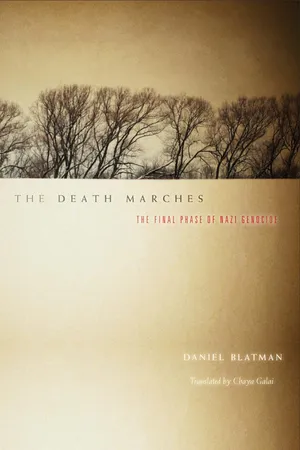
From January 1945, in the last months of the Third Reich, about 250,000 inmates of concentration camps perished on death marches and in countless incidents of mass slaughter. They were murdered with merciless brutality by their SS guards, by army and police units, and often by gangs of civilians as they passed through German and Austrian towns and villages. Even in the bloody annals of the Nazi regime, this final death blow was unique in character and scope.
In this first comprehensive attempt to answer the questions raised by this final murderous rampage, the author draws on the testimonies of victims, perpetrators, and bystanders. Hunting through archives throughout the world, Daniel Blatman sets out to explain—to the extent that is possible—the effort invested by mankind's most lethal regime in liquidating the remnants of the enemies of the "Aryan race" before it abandoned the stage of history. What were the characteristics of this last Nazi genocide? How was it linked to the earlier stages, the slaughter of millions in concentration camps? How did the prevailing chaos help to create the conditions that made the final murderous rampage possible?
In its exploration of a topic nearly neglected in the current history of the Shoah, this book offers unusual insight into the workings, and the unraveling, of the Nazi regime. It combines micro-historical accounts of representative massacres with an overall analysis of the collapse of the Third Reich, helping us to understand a seemingly inexplicable chapter in history.
- 593 pages
- English
- PDF
- Available on iOS & Android
eBook - PDF
About this book
Information
Table of contents
- Cover
- Title Page
- Copyright
- Dedication
- Contents
- Abbreviations
- Introduction
- Part I. The System Disintegrates
- Part II. Criminal Communities
- Conclusion
- Notes
- Bibliography
- Acknowledgments
- Index
Trusted by 375,005 students
Access to over 1.5 million titles for a fair monthly price.
Study more efficiently using our study tools.
Frequently asked questions
Yes, you can cancel anytime from the Subscription tab in your account settings on the Perlego website. Your subscription will stay active until the end of your current billing period. Learn how to cancel your subscription
No, books cannot be downloaded as external files, such as PDFs, for use outside of Perlego. However, you can download books within the Perlego app for offline reading on mobile or tablet. Learn how to download books offline
We are an online textbook subscription service, where you can get access to an entire online library for less than the price of a single book per month. With over 1.5 million books across 990+ topics, we’ve got you covered! Learn about our mission
Look out for the read-aloud symbol on your next book to see if you can listen to it. The read-aloud tool reads text aloud for you, highlighting the text as it is being read. You can pause it, speed it up and slow it down. Learn more about Read Aloud
Yes! You can use the Perlego app on both iOS and Android devices to read anytime, anywhere — even offline. Perfect for commutes or when you’re on the go.
Please note we cannot support devices running on iOS 13 and Android 7 or earlier. Learn more about using the app
Please note we cannot support devices running on iOS 13 and Android 7 or earlier. Learn more about using the app
Yes, you can access The Death Marches by Daniel Blatman, Chaya Galai in PDF and/or ePUB format, as well as other popular books in History & German History. We have over 1.5 million books available in our catalogue for you to explore.