In 1961 South Korea was mired in poverty. By 1979 it had a powerful industrial economy and a vibrant civil society in the making, which would lead to a democratic breakthrough eight years later. The transformation took place during the years of Park Chung Hee's presidency. Park seized power in a coup in 1961 and ruled as a virtual dictator until his assassination in October 1979. He is credited with modernizing South Korea, but at a huge political and social cost.
South Korea's political landscape under Park defies easy categorization. The state was predatory yet technocratic, reform-minded yet quick to crack down on dissidents in the name of political order. The nation was balanced uneasily between opposition forces calling for democratic reforms and the Park government's obsession with economic growth. The chaebol (a powerful conglomerate of multinationals based in South Korea) received massive government support to pioneer new growth industries, even as a nationwide campaign of economic shock therapy-interest hikes, devaluation, and wage cuts-met strong public resistance and caused considerable hardship.
This landmark volume examines South Korea's era of development as a study in the complex politics of modernization. Drawing on an extraordinary range of sources in both English and Korean, these essays recover and contextualize many of the ambiguities in South Korea's trajectory from poverty to a sustainable high rate of economic growth.
eBook - PDF
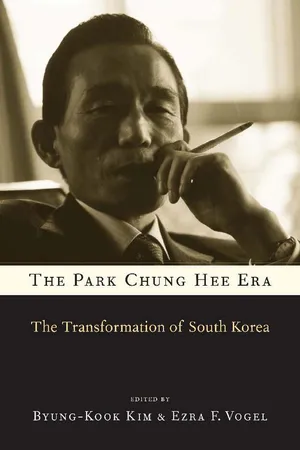
The Park Chung Hee Era
The Transformation of South Korea
- 753 pages
- English
- PDF
- Available on iOS & Android
eBook - PDF
About this book
Information
Publisher
Harvard University PressYear
2011Print ISBN
9780674072312
9780674058200
eBook ISBN
9780674061064
Topic
StoriaSubtopic
Economia dello sviluppoTable of contents
- Contents
- Introduction
- Part One - Born in a Crisis
- Part Two - Politics
- Part Three - Economy and Society
- Part Four - International Relations
- Part Five - Comparative Perspective
- Conclusion: The Post-Park Era
- Notes
- Acknowledgments
- List of Contributors
- Index of Persons
Trusted by 375,005 students
Access to over 1.5 million titles for a fair monthly price.
Study more efficiently using our study tools.
Frequently asked questions
Yes, you can cancel anytime from the Subscription tab in your account settings on the Perlego website. Your subscription will stay active until the end of your current billing period. Learn how to cancel your subscription
No, books cannot be downloaded as external files, such as PDFs, for use outside of Perlego. However, you can download books within the Perlego app for offline reading on mobile or tablet. Learn how to download books offline
We are an online textbook subscription service, where you can get access to an entire online library for less than the price of a single book per month. With over 1.5 million books across 990+ topics, we’ve got you covered! Learn about our mission
Look out for the read-aloud symbol on your next book to see if you can listen to it. The read-aloud tool reads text aloud for you, highlighting the text as it is being read. You can pause it, speed it up and slow it down. Learn more about Read Aloud
Yes! You can use the Perlego app on both iOS and Android devices to read anytime, anywhere — even offline. Perfect for commutes or when you’re on the go.
Please note we cannot support devices running on iOS 13 and Android 7 or earlier. Learn more about using the app
Please note we cannot support devices running on iOS 13 and Android 7 or earlier. Learn more about using the app
Yes, you can access The Park Chung Hee Era by Byung-Kook Kim, Ezra F. Vogel, Ezra F. Vogel in PDF and/or ePUB format, as well as other popular books in Storia & Economia dello sviluppo. We have over 1.5 million books available in our catalogue for you to explore.