Modern Manufacturing Processes
eBook - ePub

Modern Manufacturing Processes

  1. English
  2. ePUB (mobile friendly)
  3. Available on iOS & Android
eBook - ePub

Modern Manufacturing Processes

About this book

Provides an in-depth understanding of the fundamentals of a wide range of state-of-the-art materials manufacturing processes

Modern manufacturing is at the core of industrial production from base materials to semi-finished goods and final products. Over the last decade, a variety of innovative methods have been developed that allow for manufacturing processes that are more versatile, less energy-consuming, and more environmentally friendly. This book provides readers with everything they need to know about the many manufacturing processes of today.

Presented in three parts, Modern Manufacturing Processes starts by covering advanced manufacturing forming processes such as sheet forming, powder forming, and injection molding. The second part deals with thermal and energy-assisted manufacturing processes, including warm and hot hydrostamping. It also covers high speed forming (electromagnetic, electrohydraulic, and explosive forming). The third part reviews advanced material removal process like advanced grinding, electro-discharge machining, micro milling, and laser machining. It also looks at high speed and hard machining and examines advances in material modeling for manufacturing analysis and simulation.

  • Offers a comprehensive overview of advanced materials manufacturing processes
  • Provides practice-oriented information to help readers find the right manufacturing methods for the intended applications
  • Highly relevant for material scientists and engineers in industry

Modern Manufacturing Processes is an ideal book for practitioners and researchers in materials and mechanical engineering.
Frequently asked questions

Yes, you can cancel anytime from the Subscription tab in your account settings on the Perlego website. Your subscription will stay active until the end of your current billing period. Learn how to cancel your subscription.
No, books cannot be downloaded as external files, such as PDFs, for use outside of Perlego. However, you can download books within the Perlego app for offline reading on mobile or tablet. Learn more here.
Perlego offers two plans: Essential and Complete
  • Essential is ideal for learners and professionals who enjoy exploring a wide range of subjects. Access the Essential Library with 800,000+ trusted titles and best-sellers across business, personal growth, and the humanities. Includes unlimited reading time and Standard Read Aloud voice.
  • Complete: Perfect for advanced learners and researchers needing full, unrestricted access. Unlock 1.4M+ books across hundreds of subjects, including academic and specialized titles. The Complete Plan also includes advanced features like Premium Read Aloud and Research Assistant.
Both plans are available with monthly, semester, or annual billing cycles.
We are an online textbook subscription service, where you can get access to an entire online library for less than the price of a single book per month. With over 1 million books across 1000+ topics, we’ve got you covered! Learn more here.
Look out for the read-aloud symbol on your next book to see if you can listen to it. The read-aloud tool reads text aloud for you, highlighting the text as it is being read. You can pause it, speed it up and slow it down. Learn more here.
Yes! You can use the Perlego app on both iOS or Android devices to read anytime, anywhere — even offline. Perfect for commutes or when you’re on the go.
Please note we cannot support devices running on iOS 13 and Android 7 or earlier. Learn more about using the app.
Yes, you can access Modern Manufacturing Processes by Muammer Koç, Tugrul Özel in PDF and/or ePUB format, as well as other popular books in Technology & Engineering & Materials Science. We have over one million books available in our catalogue for you to explore.

Information

Part I
Advanced Forming Processes

1
Advances in Stamping

Ilyas Kacar1, and Fahrettin Ozturk2, 3
1Department of Mechatronics Engineering, Nigde Omer Halisdemir University, Nigde, Turkey
2Department of Mechanical Engineering, Ankara Yıldırım Beyazıt University, Ankara, Turkey
3Strategy and Technology Management, Turkish Aerospace Industries Inc., Ankara, Turkey

1.1 Introduction

Stamping is the general name of sheet metal pressing to produce sheet metal parts from sheet metal blanks. Millions of sheet metal parts are produced by stamping operations. Complex shaped parts can easily be produced at low cost. Increased production demands, competitive markets, and government regulations force the sheet metal companies to do research and make innovations in order to produces high quality products at low cost. The main research areas are failure prediction, design and control of a variable blankholder force (VBHF), active drawbeads, and the segmented die design to provide the controllability and flexibility of stamping processes.
The stamping processes are widely used in the automotive, aerospace, and appliance industries due to its high volume productivity, low manufacturing costs, and high strength to weight ratios of their final products. Controllability and flexibility are most important variables for manufacturing techniques. Perfection in stamped parts is important to avoid assembly problems. Tearing, wrinkling, and springback are considered as major problems to affect the quality of the final part. There have been lots of studies on how parameters affect the material flow and elastic‐plastic deformation.
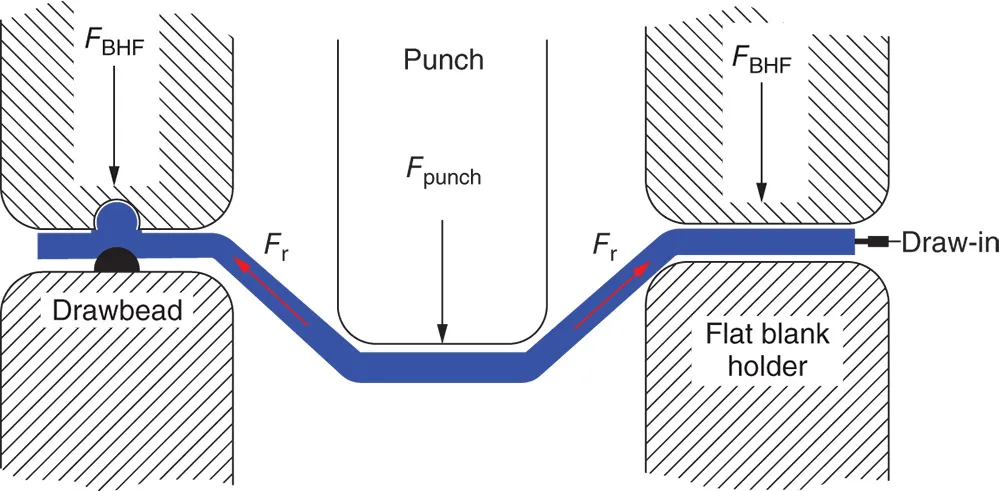
In a typical sheet metal stamping operation, energy exerted on the press machine's punch is transferred to sheet metal through a set of tooling for plastic deformation on the sheet metal. Blankholders and drawbeads restrain the sheet metal flow into the die cavity as seen in Figure 1.1. All new developments about sheet metal forming are focused on the control of material flow. Blank holders, active drawbeads, flexible dies, and VBHF techniques are used to provide regulated material flow during deformation by controlling material flow locally.
Schematic illustration of a typical sheet metal stamping operation, where energy exerted on the press machine’s punch is transferred to sheet metal through a set of tooling for plastic deformation on the sheet metal.
Figure 1.1 Schematic of a stamping process.
In this chapter, first of all, whole process and its parameters are explained briefly. Advanced manufacturing techniques on three‐dimensional sheet metal stampings such as blank holders, active drawbeads, flexible dies and punches with multi point force, and VBHF techniques are explained in detail.

1.1.1 Blankholder and Drawbeads

Three main tools in the sheet metal stamping process are the punch, the die, and the blankholder (or binder). A workpiece from sheet metal (or blank) is clamped between the die and blankholder then is deformed by the punch. In sheet metal stamping, the quality of the final product depends on the control of the metal flow significantly. Blankholders are aimed to produce blankholder force (BHF) (or binder hold down force [BHDF]) to control material flow. BHF is the main factor affecting the occurrence of failure modes such as wrinkling and tearing in sheet metal parts. While the insufficient BHF leads to wrinkling, the excessive BHF causes tearing and eventually splitting of the sheet blank. The BHF should be sufficient to eliminate or reduce the mentioned defects on stamped parts. Drawbeads are mounted on blankholder for much more constrain to control material flow, satisfy the desired force, and prevent wrinkling. They play an important role in stamping operations as a main actor to control the sheet metal, flowing into the die cavity, in the forming of nonsymmetric, complex or irregular shaped parts especially large automotive panels. The cover panel, the trunk lid or roof of an automotive body commonly consist of complex 3D surfaces. When these surfaces are being deformed, defects such as wrinkles, fractures, and surface distortion may be encountered owing to nonuniform material flow. The BHF and drawbeads are used to eliminate these defects. The restraining force level should increase in the forming of nonsymmetric or complex parts so that metal flows slowly and uniformly. A drawbead is often used to change the restraining force regionally and to control uncertain material flow that may lead to failures such as wrinkling, tearing, fractures, surface distortion, and springback. These failures stem from excessive or insufficient restraining of blank.
Drawbeads typically cause localized tensile stresses along the blank periphery. A drawbead behaves as a boundary condition technically at applied regions on sheet blank by constraining sheet metal's flow and tightly holding the sheet partially and forcing metal to flow around itself. These constrains generate local restrain force from friction between sheet and tooling interface. The regulation of the whole deformation process can be ensured by these types of local manipulations, especially during a production run.
A drawbead consists of two comp...

Table of contents

  1. Cover
  2. Table of Contents
  3. Foreword
  4. Part I: Advanced Forming Processes
  5. Part II: Thermal and Energy-assisted Manufacturing Processes
  6. Part III: Advanced Material Removal Processes
  7. Index
  8. End User License Agreement