Bridges the gap between the chemistry of small molecule neuromodulators and the complex pattern of neurodegenerative disorders
Written by an experienced neurochemist, this book focuses on the main actors involved in neurodegenerative disorders at a molecular level, and places special emphasis on structural aspects and modes of action. Drawing on recent data on enzyme structure, mode of action, and inhibitor design, it describes?from a biochemical point of view?the six most important neurotransmitter systems and their constituent enzymes and receptors. Misfolding and aggregation of proteins within the brain is also covered. In addition, the book surveys a wide range of proven and prospective therapeutic agents that modulate key processes in the brain, from their chemical synthesis to their mode of action in model systems as well as in the patient.
Chemical Biology of Neurodegeneration: A Molecular Approach is presented in two parts. The first introduces the neurotransmitter systems and provides a general explanation of the synapse and a description of the main structures involved in neurotransmission that can be considered therapeutic targets for disorders of the central nervous system. The second part presents molecular and chemical aspects directly involved or affected in neurodegeneration, including the metabolism of neurotransmitters, enzymes processing neurotransmitters, protein misfolding, and therapeutic agents.
-Uses an interdisciplinary approach to bridge the gap between the basic biochemical events in a nerve cell and their neurological effects on the brain
-Places emphasis on the chemistry of small molecule modulators that are potential lead molecules for new drugs
-Covers six key neurotransmitter systems and their enzymes and receptors?dopaminergic, noradrenergic, serotonergic, cholinergic, GABAergic, and glutamatergic
Chemical Biology of Neurodegeneration: A Molecular Approach is a key resource for medicinal chemists, neurobiologists, neurochemists, biochemists, molecular biologists, and neurophysiologists.
- English
- ePUB (mobile friendly)
- Available on iOS & Android
eBook - ePub
About this book
Information
Part I
Neurotransmitter Systems
1
The Dopaminergic System
1.1 Introduction
The dopaminergic system can be defined as a group of nerve cells (dopaminergic neurons) mainly located in the midbrain that extend their axons to different sections of the forebrain. Five pathways of dopaminergic system are identified [1] (Figure 1.1): (i) Nigrostriatal, going from the substantia nigra to dorsal striatum, involved in facilitating movements, (ii) Mesocortical, going to the frontal lobes, particularly the prefrontal cortex, involved in modulating cognitive function, (iii) Mesolimbic, innervating the ventral striatum (nucleus accumbens), involved in emotions and reward, (iv) Tuberoinfundibular, located in the arcuate nucleus of the hypothalamus and controlling prolactin secretion from the anterior pituitary gland, and (v) Thalamic, described in primates. It innervates the thalamus, and its function is not well known although it is involved in sleep and arousal mechanisms.
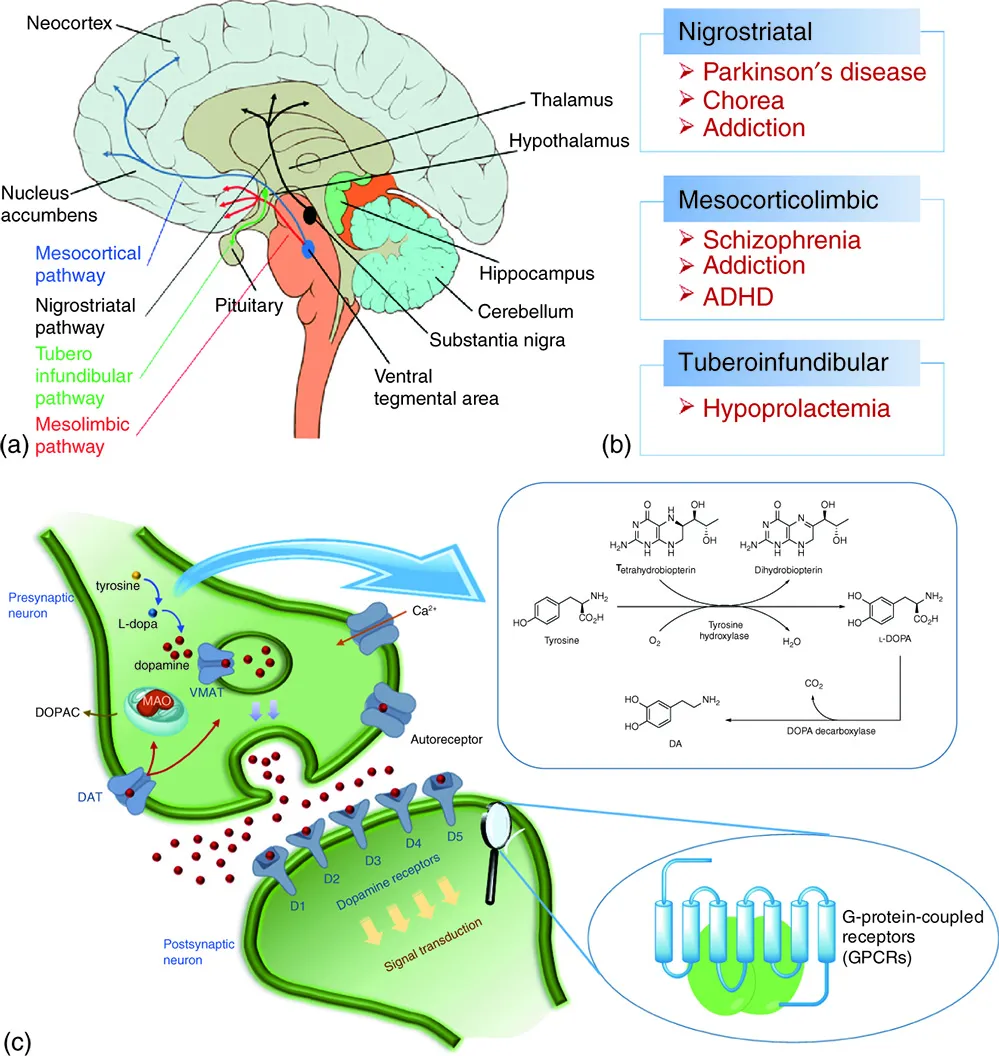
Figure 1.1 The dopaminergic system. (a) Pathways of dopaminergic system (only the four identified in humans are shown). (b) Neurological disorders associated with the pathways. (c) Dopaminergic synapse. Dopamine (DA) is synthesized from tyrosine inside the dopaminergic neuron. After packaging in vesicles by VMAT, DA is released into the synapse. DA is recognized by dopamine receptors that produce the signal. The excess of DA is removed from the synaptic area by DAT and reintroduced in the neuron for being reused or catabolized by mitochondrial MAO. VMAT: vesicular monoamine transporter; DAT: dopamine transporter; D1–D5: dopamine receptors; MAO: monoamine oxidase; DOPAC: 3,4‐dihydroxyphenylacetic acid.
The central dopaminergic neurons can be divided into ascending, descending, and local neuron systems [2] and are directly implicated in Parkinson's disease (PD) [3] and related complications such as depression, [4] schizophrenia [5], and several neuroendocrine disorders. Depending on the affected pathway, a different neurological disorder can arise. The most known, affecting 2% of population, is PD resulting from the death of neurons in the substantia nigra (nigrostriatal pathway) [6, 7] and, consequently, causing movement disorders such as shaking, rigidity, slowness, and difficulty with walking. Chorea and addiction are also related to nigrostriatal pathway. Schizophrenia is related to mesocorticolimbic projection; in particular, mesocortical and mesolimbic pathways are related to positive and negative symptoms of the pathology, respectively. The mesocorticolimbic pathways are also linked to addiction and attention‐deficit hyperactivity disorder (ADHD). Finally, the tuberoinfundibular pathway is affected in hypoprolactinemia.
At a molecular level, the main actors of the dopaminergic system are the neurotransmitter dopamine (4‐(2‐aminoethyl)benzene‐1,2‐diol; DA) and dopamine receptors (DRs). DA is biosynthesized from the amino acid tyrosine by the action of tyrosine hydroxylase, which forms dihydroxyphenylalanine (DOPA) that is decarboxylated by DOPA decarboxylase to yield DA (Figure 1.1).
The DRs play a crucial role in DA signaling since they are responsible for the signal transduction. In fact, their drug‐mediated stimulation can compensate the lack of DA in the first stages of neurodisorders such as PD [8, 9]. DRs are part of the catecholamine‐binding family of G‐protein‐coupled receptors [10]. The superfamily of receptors are membrane proteins for which several computational predictions of their structures have been reported [11]. Recently, some X‐ray structures have been resolved, but none are related to dopamine receptors [12, 13]. Biological aspects of DRs related to selective drugs, modulation of signaling, and trafficking have been collected in a volume edited by Neve in 2010 [14]. The treatise also includes links between DRs and neurodisorders such as schizophrenia, PD, and other neuropsychiatric disorders.
Once DA is synthesized inside dopaminergic neurons, it is packed into synaptic vesicles by a vesicular monoamine transporter (VMAT) and then released at nerve terminals into the synapse (Figure 1.1). The released DA binds to DRs to produce a signal in the postsynaptic neuron. However, DRs are widely expressed away from dopamine synapses; hence it is not evident how dopamine synapses are i...
Table of contents
- Cover
- Table of Contents
- Preface
- Part I: Neurotransmitter Systems
- Part I: Metabolism and Proteins
- Index
- End User License Agreement
Trusted by 375,005 students
Access to over 1.5 million titles for a fair monthly price.
Study more efficiently using our study tools.
Frequently asked questions
Yes, you can cancel anytime from the Subscription tab in your account settings on the Perlego website. Your subscription will stay active until the end of your current billing period. Learn how to cancel your subscription
No, books cannot be downloaded as external files, such as PDFs, for use outside of Perlego. However, you can download books within the Perlego app for offline reading on mobile or tablet. Learn how to download books offline
Perlego offers two plans: Essential and Complete
- Essential is ideal for learners and professionals who enjoy exploring a wide range of subjects. Access the Essential Library with 800,000+ trusted titles and best-sellers across business, personal growth, and the humanities. Includes unlimited reading time and Standard Read Aloud voice.
- Complete: Perfect for advanced learners and researchers needing full, unrestricted access. Unlock 1.5M+ books across hundreds of subjects, including academic and specialized titles. The Complete Plan also includes advanced features like Premium Read Aloud and Research Assistant.
We are an online textbook subscription service, where you can get access to an entire online library for less than the price of a single book per month. With over 1.5 million books across 990+ topics, we’ve got you covered! Learn about our mission
Look out for the read-aloud symbol on your next book to see if you can listen to it. The read-aloud tool reads text aloud for you, highlighting the text as it is being read. You can pause it, speed it up and slow it down. Learn more about Read Aloud
Yes! You can use the Perlego app on both iOS and Android devices to read anytime, anywhere — even offline. Perfect for commutes or when you’re on the go.
Please note we cannot support devices running on iOS 13 and Android 7 or earlier. Learn more about using the app
Please note we cannot support devices running on iOS 13 and Android 7 or earlier. Learn more about using the app
Yes, you can access Chemical Biology of Neurodegeneration by Pedro Merino in PDF and/or ePUB format, as well as other popular books in Biological Sciences & Biochemistry. We have over 1.5 million books available in our catalogue for you to explore.