In order to survive in their market and differentiate themselves from the competition, small- and medium-sized enterprises (SMEs), which represent more than 90% of companies worldwide, need to be creative and innovative.
This book presents a conceptual framework for thinking about innovation and creativity in SMEs. It takes into account their strategic relation to their environment and the economic, technological and social changes that they face. Their ability to enhance their creativity with new ideas and to legitimize them during their implementation is also taken into account
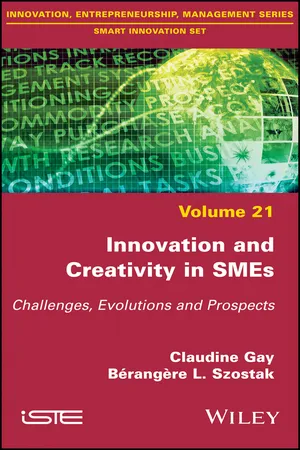
eBook - ePub
Innovation and Creativity in SMEs
Challenges, Evolutions and Prospects
- English
- ePUB (mobile friendly)
- Available on iOS & Android
eBook - ePub
Innovation and Creativity in SMEs
Challenges, Evolutions and Prospects
About this book
Information
1
External Environment of an SME: From Determinism to Strategic Innovation
1.1. Introduction
Regardless of their size, companies are constantly confronted with changes in their external environment. These changes concern their macro environment, on which they have no direct influence and at multiple levels (political, technological, economic, social, societal, ecological, etc.). They also concern their direct environment, mainly industry actors, which constitutes the reference framework for analyzing the company’s business and participating in defining its competitive space.
In principle, these changes are a source of opportunities as well as threats, and can put existing companies at risk. By changing the rules of the competitive game, the sources of profitability in a sector, changing market size, customer expectations, or even encouraging the creation of alternative offers, these changes can then lead to a crisis. They also allow new entrants into a market and radically change the rules of the game. The digital revolution, for example, has proved to have immense potential for many start-ups to enter into a multitude of markets at a fast pace. This then leads to players that were previously firmly established becoming destabilized.
Faced with changes in their environment, particularly those that closely affect their sector of activity, companies are expected to react. These can be operational adjustments, or even a race to achieve operational efficiency, through management methods such as total quality or lean management. But this usually requires real strategic changes (Porter 1996). However, these developments are sometimes of such magnitude that companies find it difficult to react. Lack of resources, growing uncertainty, radical changes in the rules of the competitive game… there are many reasons to prefer the status quo to change. Indeed, when the pace of change accelerates, creating splits and discontinuities (Dumoulin and Simon 2005), or when the intensity of change increases, to the point of creating a sectoral crisis, business decisions can be inhibited, caught between “dangerous action which produces understanding” and “safe inaction which produces confusion” (Weick 1988, p. 305).
Whether they are simply evolving from a temporary crisis or a profound change, SMEs in particular are questioning their resilience and scope for action. It must be noted that, in literature, the relationship between SMEs and their environment is above all marked by a certain level of ignorance (Guilhon 1998). While the relationship attracted some interest in the 1980s and 1990s, marked by major structural changes, it is still subject to a certain contradiction that is still insufficiently explored (Gueguen 2004). Indeed, the relationship of SMEs with their environment is characterized at an academic level, both by a certain level of fragility (Julien and Marchesnay 1988; Marchesnay 1992; Silvestre and Goujet 1996; Torrès 1999) and a certain level of flexibility, if not agility (Torrès 1999; Marchesnay 2001; Barzi 2011). The analysis of company practice confirms this contradiction highlighted by researchers. For example, Duquesnois et al. (2010) studied the French wine sector in Languedoc-Roussillon. A sector in crisis since the 2000s, it has suffered a decline in consumption in some countries, seen the development of international competition and the absence of global supply regulation. In this context, SMEs are mostly affected, particularly in terms of competitive pressure. However, they note that it is ultimately the smallest companies that have been the least affected compared to medium- and largesized ones. The authors explain this result in particular by the ability of these companies to focus on seeking a limited number of competitive advantages. Some SMEs therefore seem less fragile than others.
Although characterized by specific features (Torrès 2015), the SME’s relationship with its environment therefore seems to be in line with traditional opposition in research in strategic management. For example, between the deterministic approach, which overvalues the role of the environment, and the voluntarist approach, which reduces its importance in favor of strategic intention and choices (Astley and Van de Ven 1983; Hrebiniak and Joyce 1985; Gueguen 2001; Saïas and Métais 2001; Roy 2004). However, various studies developed since the early 2000s suggest a middle path, capable of taking into account both the effects of a rapidly changing environment and the complexity of the dynamics linked to strategic choices. Whether it is a question of new approaches to competition (Roy 2004) or business design theory (Slywostzky 1996; Slywostzky et al. 2002), also referred to as strategic configuration (Saïas and Métais 2001), these studies consider companies’ strategic actions, capable of shaping their environment by redefining the rules of the game. This can also transform their competitive space. These works provide a better understanding of why disruptive or breakthrough strategies are currently being developed. From this perspective, strategic innovation (Markides 1997) appears to be the most important form of innovation and the business model (see section 1.4.2) is the main issue.
This first chapter wishes to question the current capacity of SMEs to operate in a rapidly changing environment. It does so by presenting the evolution of the conceptual framework of the company’s relationship with its environment. The objective is to have a relevant framework to enable the SME to react as effectively as possible. To do this, we distinguish three major approaches to this relationship. For the first, we return to the origins of the strategy. In other words, we discuss “what and how” the role of the environment in business performance can be a central issue in business strategy research, even if company size is not taken into account. While in these traditional approaches the environment is deterministic, its perception evolved in the 1990s, notably under the influence of the Resource Based View (RBV), to attribute companies’ more proactive strategic behavior; this is the second approach to the SME’s relationship with its environment. Faced with this traditional opposition between determinism and voluntarism, a third approach has emerged; it consists of taking into account the complexity of competitive dynamics. This makes it possible to analyze the development of strategic breakthrough innovations, which are increasingly common in hypercompetitive environments. In each of these three approaches, the specific nature of the relationship between SMEs and their environment will be considered.
1.2. The classic approach of the firm’s environment: a deterministic relationship (also) affecting the SME
From the very first models of business strategy analysis, the relationship between the company and its environment has been based on a deterministic perspective.
Whether they are the very first models of strategic formulation (Learned et al. 1965), strategic planning school (Ansoff 1987; 1989) or the positioning school (Porter 1981), the company’s performance comes from its ability to understand and adapt to its environment. Strategy is defined from the outset as “the logic which guides the process by which an organization adapts to its external environment” (Ansoff 1987, p. 501). This approach to strategy involves adapting to the environment (section 1.2.1) and implementing business intelligence (section 1.2.2).
1.2.1. Adapting to the environment
It is the large enterprise that is mainly targeted by traditional approaches to strategy, the SME being only a special case, a miniature one, on which to apply the vision and tools of strategic management.
In these studies, the environment is understood as an exogenous factor that is imposed on the company. The company has no choice but to try to predict and adapt to the future (Aurégan et al. 2008). To do this, the company uses analytical tools that allow it to take clear strategic directions. Also, the company’s strategy is affected by an environmental determinism (Gueguen 2001): it adapts to the environment, seeking to obtain the “fit”, in other words the best balance of the strategy with the environment. The SWOT model is an emblematic tool of this approach. It positions the company in its environment in terms of balance. However, taking into account the changes in the organization’s strengths and weaknesses has made it possible to (re)think this adequacy over time with the use of scenarios (Saïas et Métais 2001). Michael Porter’s Five (+1) Forces Model and the Boston Consulting Group’s Advantage Matrix are also emblematic: they enable us to understand the environment’s influence on business using an analysis of a sector’s competitive structure.
Through this prism, the SME is generally not perceived as having a specific relationship with its environment; at best the constraint is considered amplified (Guilhon 1998). Thus, at the SME level, the environmental determinism of the classical approach borders on “environmental fatalism” (Gueguen 2001, p. 10). The phenomenon worsens in a hostile environment; in this case, SMEs appear to be even more dependent on their environment than large enterprises, due to “their limited resource bases and relative inabilities to survive the consequences of poor managemerial decisions” (Covin and Slevin 1989, p. 75). In doing so, the classic paradigm of strategy has reinforced the idea that SMEs are the equivalent of large enterprises with weaknesses and shortcomings that aggravate their fragility in their environment.
Despite the reductive nature of companies’ relationships with their environment in traditional approaches, these approaches stress that one of the conditions for their sustainability is the development of increased vigilance, which has been based, since the 1990s, on the development of monitoring tools. Going beyond the mere collection and management of information, monitoring is de facto a real “continuous and largely iterative activity aimed at actively monitoring the technological, commercial and environment, etc. in order to anticipate future change” (AFNOR 1998)1. In particular, strategic intelligence aims to collect and analyze relevant information about the company’s environment and enables it to make appropriate strategic decisions. It does not only concern large enterprises: the SME manager must also be attentive to their environment (Lafaye 2018).
When it comes to listening to the environment, the champions seem to be start-ups. Creating a company with high potential requires strong innovation to legitimize the arrival of a new player in an often saturated competitive environment. Also, at the beginning of start-up creation, “listening” to the environment tends to take place. This is done by the manager who is generally considered a visionary. This listening sheds light on business opportunity, with a “good” idea leading to satisfying a need that has not (or badly) been satisfied so far, or to solving a problem that has not (or badly) been solved before. However, this good idea is far from being enough to make a good start-up entrepreneur, any more than an SME. T...
Table of contents
- Cover
- Table of Contents
- Foreword by Wim Vanhaverbeke
- Foreword by Gaëtan de Sainte Marie
- Acknowledgements
- Introduction
- 1 External Environment of an SME: From Determinism to Strategic Innovation
- 2 Stimulating the Innovative Capabilities of SMEs in an Ever-Changing World
- 3 Innovation and Creative Slack in SMEs
- 4 Innovation and Social Construction of a New Idea in SMEs
- Conclusion
- References
- Index
- End User License Agreement
Trusted by 375,005 students
Access to over 1.5 million titles for a fair monthly price.
Study more efficiently using our study tools.
Frequently asked questions
Yes, you can cancel anytime from the Subscription tab in your account settings on the Perlego website. Your subscription will stay active until the end of your current billing period. Learn how to cancel your subscription
No, books cannot be downloaded as external files, such as PDFs, for use outside of Perlego. However, you can download books within the Perlego app for offline reading on mobile or tablet. Learn how to download books offline
Perlego offers two plans: Essential and Complete
- Essential is ideal for learners and professionals who enjoy exploring a wide range of subjects. Access the Essential Library with 800,000+ trusted titles and best-sellers across business, personal growth, and the humanities. Includes unlimited reading time and Standard Read Aloud voice.
- Complete: Perfect for advanced learners and researchers needing full, unrestricted access. Unlock 1.5M+ books across hundreds of subjects, including academic and specialized titles. The Complete Plan also includes advanced features like Premium Read Aloud and Research Assistant.
We are an online textbook subscription service, where you can get access to an entire online library for less than the price of a single book per month. With over 1.5 million books across 990+ topics, we’ve got you covered! Learn about our mission
Look out for the read-aloud symbol on your next book to see if you can listen to it. The read-aloud tool reads text aloud for you, highlighting the text as it is being read. You can pause it, speed it up and slow it down. Learn more about Read Aloud
Yes! You can use the Perlego app on both iOS and Android devices to read anytime, anywhere — even offline. Perfect for commutes or when you’re on the go.
Please note we cannot support devices running on iOS 13 and Android 7 or earlier. Learn more about using the app
Please note we cannot support devices running on iOS 13 and Android 7 or earlier. Learn more about using the app
Yes, you can access Innovation and Creativity in SMEs by Claudine Gay,Berangere Szostak,Berangere L. Szostak in PDF and/or ePUB format, as well as other popular books in Business & Management. We have over 1.5 million books available in our catalogue for you to explore.