A full-color guide for architects and design professionals to the selection and application of aluminum
Aluminum Surfaces, second in William Zahner's Architectural Metals Series, provides a comprehensive and authoritative treatment of aluminum applications in architecture and art. It offers architecture and design professionals the information they need to ensure proper maintenance and fabrication techniques through detailed information and full color images. It covers everything from the history of the metal and choosing the right alloy, to detailed information on a variety of surface and chemical finishes and corrosion resistance. The book also features case studies offering architecture and design professionals strategies for designing and executing successful projects using aluminum.
Aluminum Surfaces is filled with illustrative case studies that offer strategies for designing and executing successful projects using aluminum. All the books in Zahner's Architectural Metals Series offer in-depth coverage of today's most commonly used metals in architecture and art. This important book:
Contains a comprehensive guide to the use and maintenance of aluminum surfaces in architecture and art
Features full-color images of a variety of aluminum finishes, colors, textures, and forms
Includes case studies with performance data that feature strategies on how to design and execute successful projects using aluminum
Offers methods to address corrosion, before and after it occurs
Discusses the environmental impact of aluminum from the creation process through application
Explains the significance of the different alloys and the forms available to the designer
Discusses expectations when using aluminum in various exposures
For architecture professionals, metal fabricators, developers, architecture students and instructors, designers, and artists working with metals, Aluminum Surfaces offers a logical framework for the selection and application of aluminum in all aspects of architecture.
… seems to have been created with the express purpose of furnishing us with the material for our projectile.
—Jules Verne, From the Earth to the Moon
INTRODUCTION
Aluminum is the metal of design.
Widely used in architecture, furniture, transportation, and increasingly more often by artists as a sculptural material, aluminum in its various alloying forms offers the designer a vast and diverse assortment of choices. Aluminum is relatively new as a material for design but the forms it can take are incomparable.
Aluminum possesses its own nuances that give it distinctively different characteristics from those of other metals. These subtleties offer the designer and artist unique ways of working with the metal and creating intriguing and long-lasting forms and colorful surfaces that will stand the test of time in the environment we live in.
Aluminum is the most abundant metallic element on the surface of the earth, making up nearly 8% of the minerals found on the earth's surface. Unlike copper, silver, gold, and platinum—metals that can be found in their pure elemental form—aluminum, due to its atomic makeup, is only found in combinations with other substances. When the earth was formed, aluminum was a light metal and was quick to bond with other elements, in particular oxygen and silicon, the two most abundant elements on the earth's surface. The low density of aluminum allowed it to float on the surface of denser metals, such as iron and nickel. As the earth's surface cooled and formed, aluminum combined with other metals and nonmetals to make up a sizeable portion of the earth's surface.
Most abundant elements on the earth's surface
Oxygen
47%
Silicon
28%
Aluminum
8%
Iron
5%
Calcium
4%
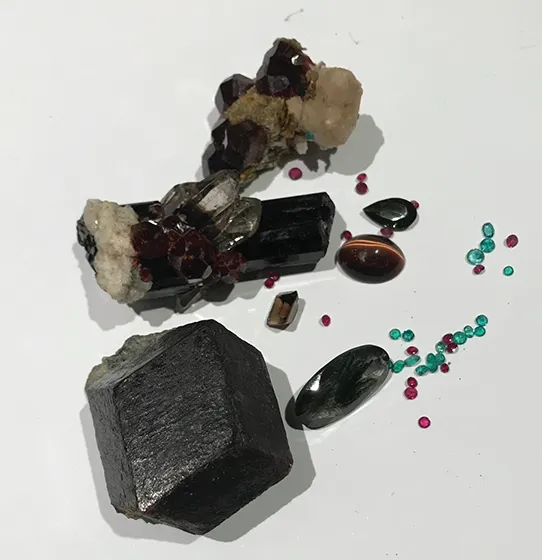
Aluminum is a common element in many minerals. Because it exists in combinations of oxides and silicates along with other metals, it would be difficult to find areas where there is no aluminum in the rocks and minerals that make up this planet. Many of the most precious gemstones contain aluminum. Topaz, ruby, tourmaline, emerald, turquoise, lapis, garnet, and even forms of jade contain aluminum in their chemical makeup (Figure 1.1).
FIGURE 1.1 Image of gemstones containing aluminum compounds.
Paradoxically, this light, soft metal when combined with only oxygen can become one of the hardest substances known to man. Corundum is simply aluminum oxide, Al2O3, yet this mineral is nearly as hard as diamond. Dark corundum, known as emery, is an abrasive used in grinding and polishing other minerals and metal surfaces. However, if impurities of other metals are included in corundum, then the mineral takes on color. Rubies get their red color from trace amounts of chromium and iron in the corundum mineral. Beautiful blue sapphire is corundum with trace amounts of titanium and iron.
Aluminum, in one mineral form or another, has been used for centuries in one of the constituents that make up clay. At one time it was referred to as “the metal of clay.” Clay consists of aluminum in combination with silicon and oxygen, as well as with other metals. These aluminosilicates, along with other substances, were the basis for pottery more than 7000 years ago. Today, the bricks we see in many of our buildings are actually composed of aluminum silicates.
Bauxite is the most widely mined ore of aluminum. Bauxite is a mixture of several aluminum minerals, along with other clay minerals. The aluminum minerals that make up a large portion of bauxite are gibbsite, boehmite, and diaspore. Each of these minerals is an oxyhydroxide of aluminum.
Gibbsite
Al(OH)3
Boehmite
AlO(OH)
Diaspore
AlO(OH)
Africa, Indonesia, and Australia are some sources of the ore known as bauxite, which is found on the surface of the earth in tropical regions around the world. The severity of the weathering processes over centuries in these tropical regions had the effect of leaching the silicates from the aluminosilicate rocks and leaving hydrated aluminum oxides behind. Bauxite is the original source of all aluminum today.
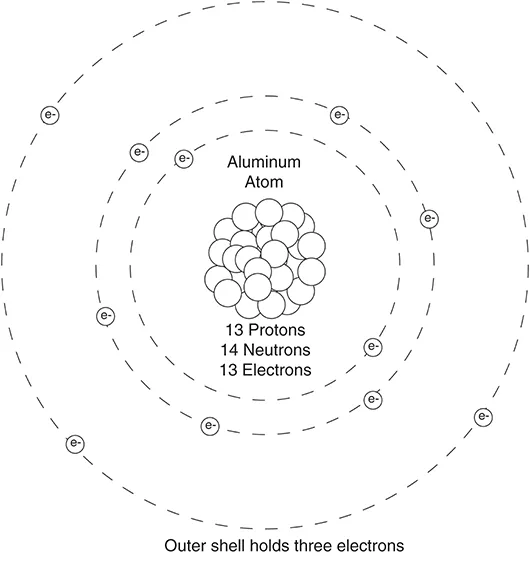
The abundance of aluminum on the earth did not make it easily available to mankind. For most of human existence, aluminum was locked away in clay and rocks. The atomic makeup of this element make it difficult to free the metal from the surrounding material (Figure 1.2).
FIGURE 1.2 Aluminum atom.
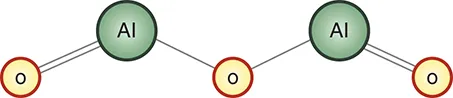
Aluminum will readily shed the three electrons that reside in its outer shell. Aluminum sheds these three electrons in order to arrive at a balanced outer shell. Metals usually have one, two, or three electrons in their outer shell, which gives them a positive valence corresponding to this electron count. Aluminum has a valence of 3+, which makes it quick to bond with other substances, such as oxygen, which has a valence of 2−. A common aluminum compound found in nature is its oxide Al2O3, which is two atoms of aluminum with a valence of 6+ and three oxygen atoms with a valence of 6−. All matter on earth seeks out a balanced charge.
Aluminum Oxide Al2O3
The three electrons are given up to oxygen atoms in this case, because aluminum has a very low ionization energy. In other words, very little energy is needed for aluminum to shed its outer three electrons. It wants to share them and usually oxygen is readily available to accept. This low ionization energy causes aluminum to rapidly form an oxide when exposed to air. When this bond with oxygen is formed it is very stable and difficult to break. This oxide, which forms on the surface of aluminum, is clear, inert, and hard. The layer resists change when confronted with corrosive substances in the normal environment. This oxide is what gives aluminum its excellent corrosion resistance.
Aluminum reactions nearly always involve the loss of three electrons, but never more than three, as removal of a fourth electron would require significant energy. It is the strong triple electron bond that aluminum makes with other substances that makes it difficult to isolate the el...
Table of contents
Cover
Table of Contents
Preface
CHAPTER 1: Introduction to Aluminum (Aluminium)
CHAPTER 2: Aluminum Alloys
CHAPTER 3: Surface Finishing
CHAPTER 4: The Aluminum Surface Finish: Meeting Expectations
CHAPTER 5: Designing with the Available Forms of Aluminum
CHAPTER 6: Fabrication
CHAPTER 7: Corrosion Characteristics
CHAPTER 8: Coping with the Unexpected
APPENDIX A: Valuable Information and Specifications for Aluminum in Art and Architecture
APPENDIX B: Tempers on Wrought Sheet, Extrusion, and Plate for Alloys Considered for Use in Art and Architecture
APPENDIX C: European Specifications Relevant to Art and Architecture
APPENDIX D: Alloy Designations for Wrought Aluminum Alloys Used in Art and Architecture
Further Reading
Index
End User License Agreement
Trusted by 375,005 students
Access to over 1.5 million titles for a fair monthly price.
Study more efficiently using our study tools.
Frequently asked questions
Yes, you can cancel anytime from the Subscription tab in your account settings on the Perlego website. Your subscription will stay active until the end of your current billing period. Learn how to cancel your subscription
No, books cannot be downloaded as external files, such as PDFs, for use outside of Perlego. However, you can download books within the Perlego app for offline reading on mobile or tablet. Learn how to download books offline
We are an online textbook subscription service, where you can get access to an entire online library for less than the price of a single book per month. With over 1.5 million books across 990+ topics, we’ve got you covered! Learn about our mission
Look out for the read-aloud symbol on your next book to see if you can listen to it. The read-aloud tool reads text aloud for you, highlighting the text as it is being read. You can pause it, speed it up and slow it down. Learn more about Read Aloud
Yes! You can use the Perlego app on both iOS and Android devices to read anytime, anywhere — even offline. Perfect for commutes or when you’re on the go. Please note we cannot support devices running on iOS 13 and Android 7 or earlier. Learn more about using the app
Yes, you can access Aluminum Surfaces by L. William Zahner in PDF and/or ePUB format, as well as other popular books in Architecture & Architecture Methods & Materials. We have over 1.5 million books available in our catalogue for you to explore.