Provides, in one handbook, comprehensive coverage of one of the hottest topics in stereoselective chemistry
Written by leading international authors in the field, this book introduces readers to C-H activation in asymmetric synthesis along with all of its facets. It presents stereoselective C-H functionalization with a broad coverage, from outer-sphere to inner-sphere C-H bond activation, and from the control of olefin geometry to the induction of point, planar and axial chirality. Moreover, methods wherein asymmetry is introduced either during the C-H activation or in a different elementary step are discussed.
Presented in two parts?asymmetric activation of C(sp3)-H bonds and stereoselective synthesis implying activation of C(sp2)-H bonds?CH-Activation for Asymmetric Synthesis showcases the diversity of stereogenic elements, which can now be constructed by C-H activation methods. Chapters in Part 1 cover: C(sp3)-H bond insertion by metal carbenoids and nitrenoids; stereoselective C-C bond and C-N bond forming reactions through C(sp3)?H bond insertion of metal nitrenoids; enantioselective intra- and intermolecular couplings; and more. Part 2 looks at: C-H activation involved in stereodiscriminant step; planar chirality; diastereoselective formation of alkenes through C(sp2)?H bond activation; amongst other methods.
-Covers one of the most rapidly developing fields in organic synthesis and catalysis -Clearly structured in two parts (activation of sp3- and activation of sp2-H bonds) -Edited by two leading experts in C-H activation in asymmetric synthesis
CH-Activation for Asymmetric Synthesis will be of high interest to chemists in academia, as well as those in the pharmaceutical and agrochemical industry.
H Bond Insertion by Metal Carbenoids and Nitrenoids
1 Stereoselective C
C Bond‐Forming Reactions Through C(sp3)
H Bond Insertion of Metal Carbenoids
Aoife M. Buckley1, Thomas A. Brouder1, Alan Ford1, and Anita R. Maguire2
1University College Cork, School of Chemistry, Analytical and Biological Chemistry Research Facility, College Road, T12K8AF Cork, Ireland
2University College Cork, School of Chemistry and School of Pharmacy, Analytical and Biological Chemistry Research Facility, Synthesis and Solid State Pharmaceutical Centre, College Road, T12K8AF Cork, Ireland
1.1 Introduction
The selective and efficient construction of complex molecules is one of the most challenging goals in organic synthesis. To access such intriguing molecules, innovative methodologies in bond formation are required compared to traditional functional group transformations. It is for this reason that selective functionalization of the ubiquitous but inert C
H bond is of great interest to the chemical community [1–4].
A challenging aspect in organic chemistry for decades has been the stereoselective carbon–carbon bond formation by activation of a C(sp3)
H bond in the synthesis of pharmaceuticals, natural products, and other industrially relevant targets. A powerful approach to achieve such useful C–H functionalization is via C(sp3)–H insertion by metal carbenoids [5–8]. Generation of the metal carbenoid can occur through a number of precursors such as diazo compounds, ylide derivatives, hydrazones, and, more recently, triazoles. In this chapter, we will exclusively discuss metal carbenoids derived from α‐diazocarbonyl compounds.
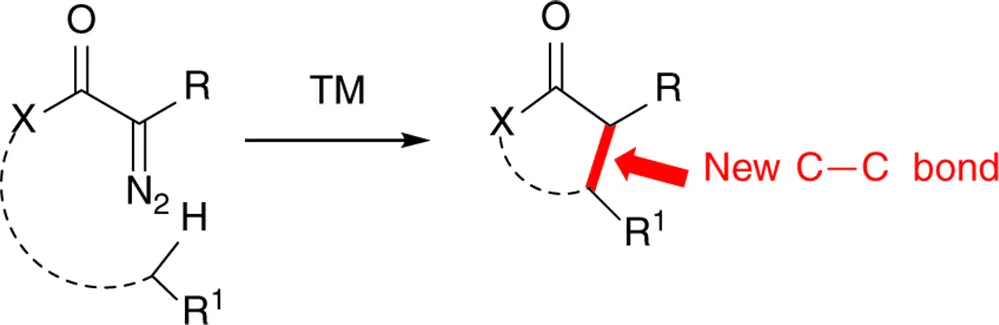
In order to take advantage of metal carbenoid‐induced C–H insertion, one must consider the reactivity of the electrophilic metal carbenoid. The synthetic utility of the free carbenes is limited by low selectivity in most reactions. In contrast, when nitrogen extrusion is facilitated by a transition metal, the resulting metal carbenoid retains the reaction scope of a free carbene while allowing highly selective transformations to occur (Figure 1.1).
Figure 1.1 Nitrogen extrusion from α‐diazocarbonyl compounds in the presence of a transition metal (TM) allows for more selective C
C bond formation through C(sp3)–H insertion.
Historically, copper was used as the transition metal source, but few examples of efficient and selective C–H insertion were reported. The key development in C–H insertion was the discovery by the Teyssié group that dirhodium(II) carboxylates catalyzed the intermolecular C–H insertion reaction of ethyl diazoacetate with alkanes [9]. Following this, Wenkert et al. [10] and Taber and Petty [11] highlighted the potential of intramolecular C–H insertion reactions of α‐diazocarbonyl compounds to lead to cyclopentanone derivatives. Importantly, it was demonstrated that C–H insertion takes place with retention of configuration at the react...
Table of contents
Cover
Table of Contents
Foreword
Part I: Asymmetric Activation of C(sp3)H Bonds
Part I.A: C(sp3)H Bond Insertion by Metal Carbenoids and Nitrenoids
Part I.B: C(sp3)‐H Activation as Stereodiscriminant Step
Part II: Stereoselective Synthesis Implying Activation of C(sp2)H Bonds
Index
End User License Agreement
Trusted by 375,005 students
Access to over 1.5 million titles for a fair monthly price.
Study more efficiently using our study tools.
Frequently asked questions
Yes, you can cancel anytime from the Subscription tab in your account settings on the Perlego website. Your subscription will stay active until the end of your current billing period. Learn how to cancel your subscription
No, books cannot be downloaded as external files, such as PDFs, for use outside of Perlego. However, you can download books within the Perlego app for offline reading on mobile or tablet. Learn how to download books offline
Perlego offers two plans: Essential and Complete
Essential is ideal for learners and professionals who enjoy exploring a wide range of subjects. Access the Essential Library with 800,000+ trusted titles and best-sellers across business, personal growth, and the humanities. Includes unlimited reading time and Standard Read Aloud voice.
Complete: Perfect for advanced learners and researchers needing full, unrestricted access. Unlock 1.5M+ books across hundreds of subjects, including academic and specialized titles. The Complete Plan also includes advanced features like Premium Read Aloud and Research Assistant.
Both plans are available with monthly, semester, or annual billing cycles.
We are an online textbook subscription service, where you can get access to an entire online library for less than the price of a single book per month. With over 1.5 million books across 990+ topics, we’ve got you covered! Learn about our mission
Look out for the read-aloud symbol on your next book to see if you can listen to it. The read-aloud tool reads text aloud for you, highlighting the text as it is being read. You can pause it, speed it up and slow it down. Learn more about Read Aloud
Yes! You can use the Perlego app on both iOS and Android devices to read anytime, anywhere — even offline. Perfect for commutes or when you’re on the go. Please note we cannot support devices running on iOS 13 and Android 7 or earlier. Learn more about using the app
Yes, you can access C-H Activation for Asymmetric Synthesis by Françoise Colobert,Joanna Wencel-Delord in PDF and/or ePUB format, as well as other popular books in Physical Sciences & Physical & Theoretical Chemistry. We have over 1.5 million books available in our catalogue for you to explore.