Presents state-of-the-art processing techniques and readily applicable knowledge on processing of polymer composites
The book presents the advancement in the field of reinforced polymer composites with emphasis on manufacturing techniques, including processing of different reinforced polymer composites, secondary processing of green composites, and post life cycle processing. It discusses the advantages and limitations of each processing method and the effect of processing parameters on the overall performance of the composites. Characterization and applications of reinforced polymer composites are also introduced.
Reinforced Polymer Composites: Processing, Characterization and Post Life Cycle Assessment starts off by providing readers with a comprehensive overview of the field. It then introduces them to the fabrication of both short fiber/filler reinforced polymer composites and laminated reinforced polymer composites. Next, it takes them through the processing of polymer-based nanocomposites; the many advances in curing methods of reinforced polymer composites; and post life cycle processing, re-processing, and disposal mechanisms of reinforced polymer composites. Numerous other chapters cover: synthetic versus natural fiber reinforced plastics; characterization techniques of reinforced plastics; friction and wear analysis of reinforced plastics; secondary processing of reinforced plastics; and applications of reinforced plastics.
-Presents the latest development in materials, processing, and characterization techniques, as well as applications of reinforced polymer composites
-Guides users in choosing the best processing methods to produce polymer composites and successfully manufacture high quality products
-Assists academics in sorting out basic research questions and helps those in industry manufacture products, such as marine, automotive, aerospace, and sport goods
Reinforced Polymer Composites: Processing, Characterization and Post Life Cycle Assessment is an important book for materials scientists, polymer chemists, chemical engineers, process engineers, and anyone involved in the chemical or plastics technology industry.
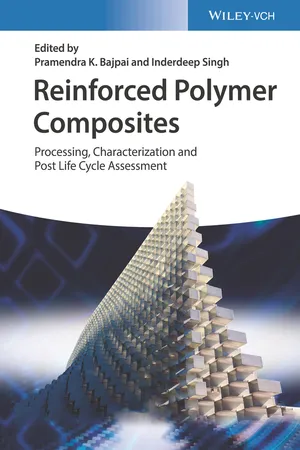
eBook - ePub
Reinforced Polymer Composites
Processing, Characterization and Post Life Cycle Assessment
- English
- ePUB (mobile friendly)
- Available on iOS & Android
eBook - ePub
Reinforced Polymer Composites
Processing, Characterization and Post Life Cycle Assessment
About this book
Information
1
Overview and Present Status of Reinforced Polymer Composites
Furkan Ahmad1, Inderdeep Singh2, and Pramendra K. Bajpai1
1 Netaji Subhas University of Technology, MPAE Division, Sector‐3, Dwarka, New Delhi, 110078, India
2 Indian Institute of Technology Roorkee, Department of Mechanical and Industrial Engineering, Roorkee, Uttarakhand, 247667, India
1.1 Introduction
Humans have been using a number of materials to improve their living standards since ages. In fact, the progress of human civilization has been classified into three categories, popularly known as the Stone Age, the Bronze Age, and the Iron Age, on the basis of materials only. Looking at the current rate of demand and consumption of plastics, it would not be wrong if somebody categorizes the present age as “The Age of Plastics” or “Plastic Age”. New materials form the foundation for new technologies and help in understanding nature. The most complex designs in the world can be of no use if suitable material is not used during the fabrication of products with that design. In actual realization of a design, the role of materials is quite indispensable. The limited availability of natural resources has forced material engineers to use materials in a more conscious manner. Therefore, material scientists and engineers are trying to optimize the use of materials in every possible field of application. In the present age, transportation industry is the biggest contributor of carbon footprints in the environment. Lower fuel consumption of automotive vehicles can lower the carbon footprints. In the quest for achieving low fuel consumption, transportation industry is leaning toward materials having high strength to weight ratio. Reinforced polymer composites (RPCs), also known as fiber reinforced polymer composites (FRPCs) are such promising materials for almost every industry looking for low weight and high strength materials [1]. The application spectrum of FRPCs has spread in almost every sector starting from engineered domestic products to the highly sensitive biomedical industry. FRPCs are not only just a replacement for conventional alloys but they also provide engineered properties. Rahmani et al. [2] fabricated the carbon/epoxy‐based FRPCs with 40 wt% of fiber. This system of FRPCs was able to achieve a tensile strength of 2500 MPa, which is quite close to the tensile strength of steel. The authors concluded that fiber orientation was the most influencing factor among other factors, namely number of laminates and resin type. The authors suggested the use of ±35° angle of plies to obtain better tensile properties along with good flexural properties. Modification in the matrix material can enhance the overall properties of FRPCs. Islam et al. [3] modified the epoxy matrix by incorporating nanoclay and multiwalled carbon nanotubes (MWCNTs). The authors found significant improvement in the static and dynamic mechanical properties of the developed carbon fiber‐based FRPCs. Cho et al. [4] enhanced the in‐plane shear strength and shear modulus of carbon fiber reinforced epoxy composites by incorporating graphite nanoplatelets in the epoxy matrix using the sonication method. Increasing the volume fraction of reinforcement can increase the mechanical properties of the developed FRPCs. Aramide et al. [5] fabricated glass fiber/epoxy‐based FRPCs with varying volume fraction of fibers from 5% to 30%. The authors found that the mechanical strength increased as the fiber volume fraction increased up to 30%. Treinyte et al. [6] fabricated poly (vinyl alcohol)‐based pots. Forestry and wood processing waste was used as filler in the matrix. The authors claimed that the manufactured pots showed 45% lower water evaporation rate in comparison to regular peat pots.
Architecture of the reinforcement also affects the mechanical performance of developed FRPCs products. A range of reinforcement architectures is available in the market such as short fiber, unidirectional prepregs, 2D and 3D woven mats, braided mats, and knitted mats. Every architecture has its own merits and demerits – 2D woven mats show better in‐plane mechanical properties but they lack in out‐of plane properties while 3D woven mats offer better out‐of‐plane properties in comparison to others [7]. Erol et al. [8] investigated the effect of yarn material and weaving pattern on the macroscopic properties of FRPCs and concluded that weave pattern greatly influenced the tensile and shear properties of the developed composites. Some authors [9] have even used 3D and 5D braided reinforcement for the development of FRPCs. The authors concluded that braided architecture affects the fracture mechanism in a significant way. Kostar et al. [10] used two‐sided co‐braided carbon and Kevlar hybrid reinforcement for the development of FRPCs and conclude...
Table of contents
- Cover
- Table of Contents
- 1 Overview and Present Status of Reinforced Polymer Composites
- 2 Fabrication of Short Fiber Reinforced Polymer Composites
- 3 Fabrication of Composite Laminates
- 4 Processing of Polymer‐Based Nanocomposites
- 5 Advances in Curing Methods of Reinforced Polymer Composites
- 6 Friction and Wear Analysis of Reinforced Polymer Composites
- 7 Characterization Techniques of Reinforced Polymer Composites
- 8 Detection of Delamination in Fiber Metal Laminates Based on Local Defect Resonance
- 9 Secondary Processing of Reinforced Polymer Composites by Conventional and Nonconventional Manufacturing Processes
- 10 Hybrid Glass Fiber Reinforced Polymer Matrix Composites: Mechanical Strength Characterization and Life Assessment
- 11 Fire Performance of Natural Fiber Reinforced Polymeric Composites
- 12 Post Life Cycle Processing of Reinforced Thermoplastic Polymer Composites
- 13 Reprocessing and Disposal Mechanisms for Fiber Reinforced Polymer Composites
- Index
- End User License Agreement
Trusted by 375,005 students
Access to over 1.5 million titles for a fair monthly price.
Study more efficiently using our study tools.
Frequently asked questions
Yes, you can cancel anytime from the Subscription tab in your account settings on the Perlego website. Your subscription will stay active until the end of your current billing period. Learn how to cancel your subscription
No, books cannot be downloaded as external files, such as PDFs, for use outside of Perlego. However, you can download books within the Perlego app for offline reading on mobile or tablet. Learn how to download books offline
Perlego offers two plans: Essential and Complete
- Essential is ideal for learners and professionals who enjoy exploring a wide range of subjects. Access the Essential Library with 800,000+ trusted titles and best-sellers across business, personal growth, and the humanities. Includes unlimited reading time and Standard Read Aloud voice.
- Complete: Perfect for advanced learners and researchers needing full, unrestricted access. Unlock 1.5M+ books across hundreds of subjects, including academic and specialized titles. The Complete Plan also includes advanced features like Premium Read Aloud and Research Assistant.
We are an online textbook subscription service, where you can get access to an entire online library for less than the price of a single book per month. With over 1.5 million books across 990+ topics, we’ve got you covered! Learn about our mission
Look out for the read-aloud symbol on your next book to see if you can listen to it. The read-aloud tool reads text aloud for you, highlighting the text as it is being read. You can pause it, speed it up and slow it down. Learn more about Read Aloud
Yes! You can use the Perlego app on both iOS and Android devices to read anytime, anywhere — even offline. Perfect for commutes or when you’re on the go.
Please note we cannot support devices running on iOS 13 and Android 7 or earlier. Learn more about using the app
Please note we cannot support devices running on iOS 13 and Android 7 or earlier. Learn more about using the app
Yes, you can access Reinforced Polymer Composites by Pramendra K. Bajpai, Inderdeep Singh, Pramendra K. Bajpai,Inderdeep Singh in PDF and/or ePUB format, as well as other popular books in Technology & Engineering & Materials Science. We have over 1.5 million books available in our catalogue for you to explore.