IN THE SUMMER of 2004, Jake “Mac” MacDonald returned to Iraq for his second deployment. His unit was tasked with restoring peace to the city of An Najaf. A cleric named Muqtada al-Sadr had taken control of the famed city. Using his death squads and fighters from the Mahdi militia, al-Sadr imposed draconian laws on the populace, intimidated local business owners, and tortured and murdered Iraqi policemen and anybody else who supported the Iraqi or US governments.
Najaf is home to the Imam Ali Mosque and is considered by Muslim Shias to be the third holiest city, ranking behind only Mecca and Medina. In order to restore peace to Najaf, it would be necessary to remove al-Sadr from power and return the mosque to the people. Knowing this, Muqtada marshalled his sizable forces inside and directly around the mosque, using one of their holiest sites to stage their attacks.
Mac’s leaders decided that it would not be good for public perception to have American forces kicking down the door of the Imam Ali Mosque. Instead, their original plan was to train the local Iraqi police and army until they were competent enough to take back their own city. For the first few weeks of their deployment, the Marines formed an uneasy truce with al-Sadr forces. Al-Sadr’s militia was concentrated in an area called the Old City around the Imam Ali Mosque. The truce was fairly straightforward: the American forces wouldn’t go into al-Sadr’s forces’ area and they wouldn’t come out of it. This truce lasted for a few brief weeks before one of the bloodiest and most violent battles of the Iraq War broke out.
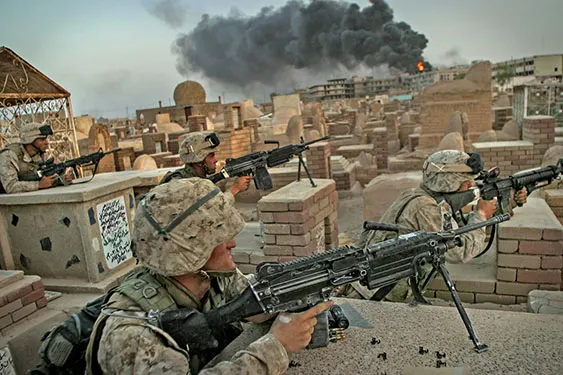
Mac was the commander for the 11th Marine Expeditionary Unit’s Light Armored Reconnaissance platoon. Essentially, he was in charge of five light armored vehicles (imagine tanks with wheels) and 31 Marines. The night before the Battle of Najaf officially started, Mac’s unit was tasked with executing a reconnaissance and surveillance mission into the Old City and the Najaf cemetery, the Wadi-us-Salaam. This is the largest cemetery in the world, covering nearly 1500 acres. To the Western eye, the cemetery bears almost no resemblance to one we would be accustomed. The layout appears haphazard, filled with meandering paths between ancient tombstones, and massive underground crypts often linked by underground tunnels. Mac’s platoon inserted into the cemetery under the cover of darkness. With their thermal optics, they could see deep into both the cemetery and the Old City. It was their mission to observe and report on any enemy activity in either area.
In the early morning hours of August 4, 2004, Mac and his Marines saw tracer fire arc across the sky on the other side of the cemetery, followed shortly thereafter by the distinctive rat-ta-tat sound of machine-gun fire. Mac and his Marines knew that there was an Iraqi police station in the area where the fire was concentrated. The intensity and volume of the machine-gun fire increased. Knowing that they were only minutes away and in a position to support the Iraqi police station, Mac called it in on the radio and offered to assist. They were told to hold their positions and continue to observe. The fighting eventually died down, only to resume an hour later with renewed ferocity. This time, in addition to the machine-gun fire, they could also see rocket-propelled grenades streaking toward the police station. Again, they called it in and offered to assist. Again, they were told to hold their position. By this time, the sun was beginning to crest the horizon. Knowing that they would no longer be able to remain unseen during daylight hours, Mac’s unit returned to their base.
The end of a mission does not signify the end of a workday, though. Before Marines even think about taking care of their personal needs (shower, food, rest), they must make sure their gear is taken care of. This means both refueling their vehicles and rearming them. They must also clean their personal weapons and make sure that the rest of their gear and equipment is ready to be used at a moment’s notice. In addition, Mac also had to debrief the Intelligence section on everything that they had seen or done during their earlier mission. At this point, Mac and his Marines had been awake for 24 hours. Mac was finally able to return to his tent to try to get some sleep. Sitting on his cot, Mac had barely begun to unlace his boots when he received a message from his radio operator.
“Pale Rider 6 wants to talk to you,” the Marine told him.
Pale Rider was the callsign for Mac’s parent unit and the designator of 6 signified that it was his boss, the battalion commander. He informed them that the Iraqi police station was being attacked again and that they would be one of the units tasked with helping the police. Mac yelled, “Mount up!” and called for his vehicle commanders. Even though some of Mac’s Marines, after being awake for more than 24 hours, had only been asleep for 30 minutes, they didn’t need any extra motivation to get going. The promise of a firefight sharpened their focus and filled them with nervous energy. Approximately half of Mac’s Marines were with him during the initial invasion of Iraq less than a year earlier. They had already seen combat and knew firsthand the chaos that it wrought. However, most of the younger Marines had only joined the Marine Corps after the invasion. This was to be their first time in combat and would be a chance to test their mettle.
A few minutes later, they rolled out of base, weapons loaded and adrenaline coursing through their veins. They reached the Iraqi police station ready to fight. The Marines looked around and saw … nothing. No machine-gun fire. No RPGs. No bad guys. They circled the area, making sure no enemy fighters were present, and then received the order to return to base. They again serviced their vehicles and cleaned their personal weapons. Again, Mac debriefed the intelligence section on what little he saw. By this point, they had been awake for nearly 30 hours. Mac returned to his tent and laid down on his cot without even bothering to take his boots off. Just as he pulled his sleeping bag over himself, Mac’s radio operator again entered the tent.
“We are going out again, Sir. The police station is being attacked.”
Mac called for his Marines to get up and get on the vehicles, but now the atmosphere was much different. Whereas the first time his Marines were primed and ready to fight, they now felt that they were being called out on a wild-goose chase that would only delay their sleep even longer. Fortunately, Mac had some great subordinate leaders and teammates who, through their words, actions, and body language, forced the Marines to take it seriously, even if they didn’t feel it themselves.
It was still quiet on the drive down to the police station. Mac then heard a single popping noise through his hearing protection. Few people may know this, but gunfire sounds different depending on which way it is going. When you pull the trigger, gun powder is ignited, there is a mini explosion, and the resulting gasses push the bullet out of the barrel. This creates a bang. A high-pitched whine followed by a bang a few seconds later means a bullet is traveling in your general direction. Due to the speed it is traveling, a bullet creates a sonic boom as it moves through the air, producing a loud cracking or snapping noise. Hearing the crack means that you are within the sonic boom. The bangs and whines blend into the other frenzied sounds of war, but the crack gets your attention—it means a bullet just missed your head.
As they drew closer to the Iraqi police station, the crack sounds increased in frequency until it sounded like popcorn popping. When Mac heard the bullets striking the side of his vehicle, he knew that it was no longer a wild-goose chase.
Very few professions require their people to be on call 24 hours a day. However, we need leaders who are prepared for anything, at any time. Mac’s Marines were some of the most honorable, courageous, and committed with whom he had ever served. However, even they needed great leadership to reach their potential and accomplish their mission, and he needed them. The Battle of Najaf was one of the most violent, hard-fought battles of the Iraq War. That the Marines were able to come away from it victorious was a reflection on their incredible talent and embodiment of the Marine Corps Core Values (Honor, Courage, and Commitment), their unit’s extremely high goals and standards, and their commitment to them. Mac and his Marines were part of a world-class culture.
They fought for 36 hours straight, having already been awake for over 30 hours, and having dealt with multiple setbacks and false alarms. They were able to do this because of that world-class culture and because they were both great teammates and great team leaders.
As previously highlighted, everyone is a hero when it is seventy degrees and sunny with a slight breeze blowing in off the coast. Unfortunately, that is not when you need them. We need great teammates and great leaders when it’s not!
Some military units are very good. And some are not. The difference is their unit’s culture and the great teammates and great team leaders that fill its ranks. We have already discussed culture and teammates and how we define and develop each. Now, we turn to defining and developing great team leaders.