Dermatology at a Glance
  1. English
  2. ePUB (mobile friendly)
  3. Available on iOS & Android
eBook - ePub

About this book

The field of Dermatology is expanding at a rapid pace — new research findings and advanced treatment technologies have amplified the need for concise and up-to-date information on this dynamic area of medicine. Dermatology at a Glance provides medical students and trainees with a clear introduction to dermatological practice. This valuable resource covers essential components of dermatology, from patient consultation and basic procedures to advanced treatments of skin disorders. Illustrated with over 300 high-quality slides and full-colour photographs, this book is an ideal reference for those seeking to interview and examine patients, identify and diagnose skin diseases, and develop treatment plans.

Now in its second edition, Dermatology at a Glance offers revised coverage of the epidemiology, pathogenesis, and presentations of various skin disorders, and examines central aspects of the British Association of Dermatologists core curriculum. New chapters on topics such as dermoscopy, diagnostic methods for lesions and rashes, cosmetic dermatology, and drug reactions reflect current research and practices.

  • Perfect for revision and quick consultation with its highly visual approach
  • Eight brand new chapters, including hidradenitis suppurativa, itch, and systemic and topical drugs
  • Accompanied by a companion site featuring self-assessment resources and an image bank

Dermatology at a Glance is an indispensable resource for medical students, dermatology specialty and primary care trainees.
Frequently asked questions

Yes, you can cancel anytime from the Subscription tab in your account settings on the Perlego website. Your subscription will stay active until the end of your current billing period. Learn how to cancel your subscription.
No, books cannot be downloaded as external files, such as PDFs, for use outside of Perlego. However, you can download books within the Perlego app for offline reading on mobile or tablet. Learn more here.
Perlego offers two plans: Essential and Complete
  • Essential is ideal for learners and professionals who enjoy exploring a wide range of subjects. Access the Essential Library with 800,000+ trusted titles and best-sellers across business, personal growth, and the humanities. Includes unlimited reading time and Standard Read Aloud voice.
  • Complete: Perfect for advanced learners and researchers needing full, unrestricted access. Unlock 1.4M+ books across hundreds of subjects, including academic and specialized titles. The Complete Plan also includes advanced features like Premium Read Aloud and Research Assistant.
Both plans are available with monthly, semester, or annual billing cycles.
We are an online textbook subscription service, where you can get access to an entire online library for less than the price of a single book per month. With over 1 million books across 1000+ topics, we’ve got you covered! Learn more here.
Look out for the read-aloud symbol on your next book to see if you can listen to it. The read-aloud tool reads text aloud for you, highlighting the text as it is being read. You can pause it, speed it up and slow it down. Learn more here.
Yes! You can use the Perlego app on both iOS or Android devices to read anytime, anywhere — even offline. Perfect for commutes or when you’re on the go.
Please note we cannot support devices running on iOS 13 and Android 7 or earlier. Learn more about using the app.
Yes, you can access Dermatology at a Glance by Mahbub M. U. Chowdhury,Ruwani P. Katugampola,Andrew Y. Finlay in PDF and/or ePUB format, as well as other popular books in Medicine & Dermatology. We have over one million books available in our catalogue for you to explore.

Information

Year
2019
Print ISBN
9781119392613
eBook ISBN
9781119392729
Edition
2
Subtopic
Dermatology

Part 1
Principles of Dermatology

Chapters

1
Evidence‐Based Dermatology

Influences on Clinical Decision‐Taking

Drug prescription statistics across Europe show that there are vast differences in drug usage in dermatology from country to country. The diseases and the science of medicine are the same, but prescribing practice is hugely influenced by local custom and experience, habit and prejudices. There must be something wrong.
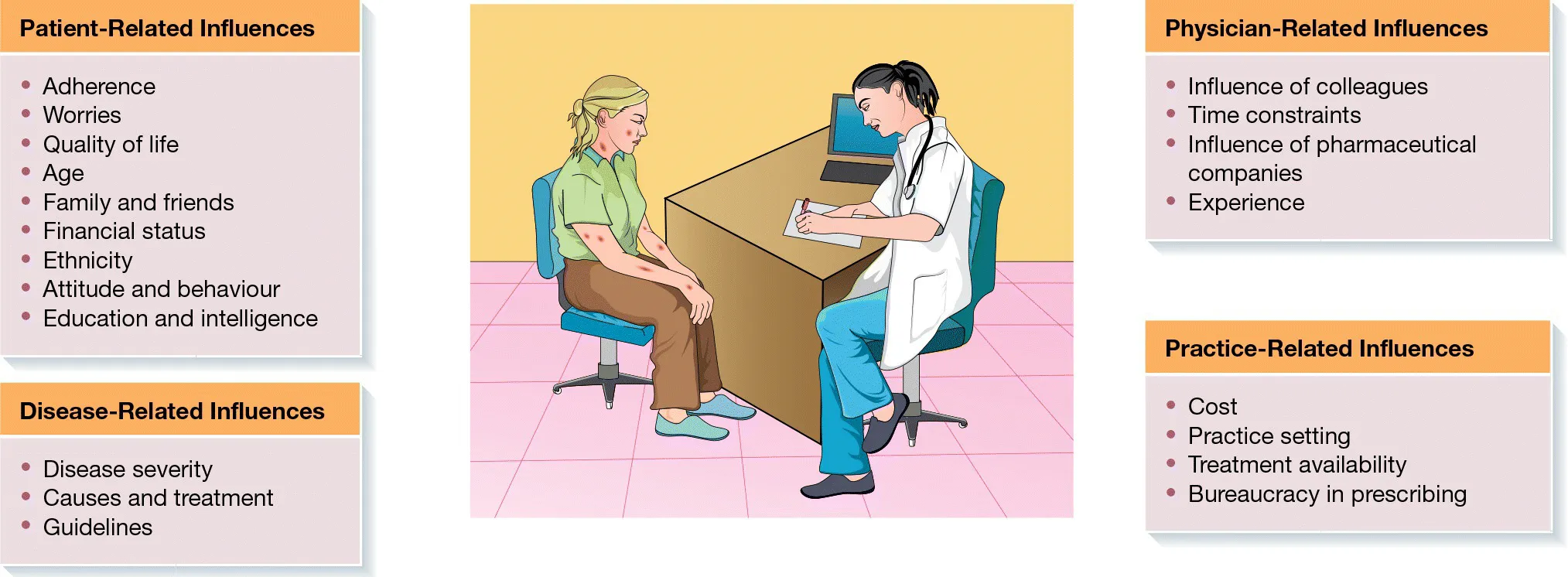
Clinical decision‐taking is very complex and a wide range of issues influence the clinician (Figure 1.1). But the foundation of high‐quality decision‐taking should be evidence‐based scientific information about the disease and its possible treatment. This information should then be tailored to the individual patient's needs, preferences, and values.
Cartoon illustration of a doctor examining a patient.
Figure 1.1 Influences on Clinical Decision‐Taking
Much of the management advice given in this book is not evidence based. Some may later be shown to be incorrect. Although the authors have tried to give evidence‐based information, this book gives their current opinions and some of their biases. So how could this be improved? How can clinical practice become based more on evidence and less on opinion?

Guidelines

It is helpful to have the well thought out views of others available in an easily digested form to guide you over therapy. Until recently, guidelines in dermatology and across the rest of medicine were usually written by a small group of self‐appointed ā€˜experts’ who reached a consensus in discussion, based on their current practice. The likelihood of bias or missing the results of recent research was obvious. However, there has been a revolution in guideline writing. The processes are now designed to be structured and open. There is a formal literature review and guidelines are based on all the available evidence. When published, the strength of evidence backing up each recommendation is given. There is an open process of wide consultation before final acceptance and publication, and a date for review is set, usually after three or four years.
If you read any guidelines, make sure that their production was rigorous and evidence based, such as the British Association of Dermatologists' (BAD) guidelines (www.bad.org.uk/healthcare‐professionals/clinical‐standards/clinical‐guidelines) or the European Dermatology Forum guidelines (www.euroderm.org).

Systematic Reviews

A systematic review is a very detailed structured literature review that aims to answer a specific research or therapy question. By having clear criteria for papers that will or will not be included and by searching very widely for all possible papers, it is possible to be confident in the results of such reviews. The study results may be combined by a process of meta‐analysis. The Cochrane Group, named after the Cardiff chest physician and epidemiologist, coordinates and publishes these reviews: the Cochrane Skin Group reviews are at http://skin.cochrane.org.

UK Clinical Trials Network

If a drug works really well, the number of patients needed to prov...

Table of contents

  1. Cover
  2. Table of Contents
  3. Preface to the Second Edition
  4. Preface to the First Edition
  5. About the Authors
  6. Foreword
  7. Acknowledgements
  8. List of Abbreviations
  9. About the Companion Website
  10. Part 1: Principles of Dermatology
  11. Part 2: The Patient Consultation
  12. Part 3: Basic Procedures
  13. Part 4: Treatments
  14. Part 5: Inflammatory Diseases
  15. Part 6: ER Dermatology
  16. Part 7: Skin Infections
  17. Part 8: Specific Sites
  18. Part 9: Specific Ages
  19. Part 10: Skin Allergy
  20. Part 11: Skin Tumours
  21. Part 12: Photodermatology
  22. Part 13: Systemic Diseases
  23. Part 14: Miscellaneous Conditions
  24. Clinical Picture Quiz
  25. Clinical Picture Quiz Answers
  26. References
  27. Index
  28. End User License Agreement