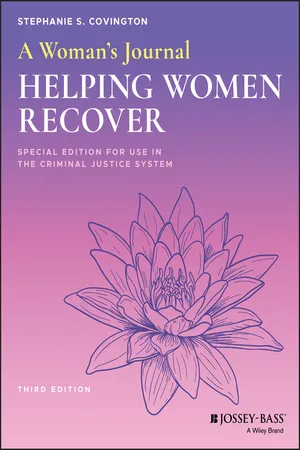
A Woman's Journal
Helping Women Recover, Special Edition for Use in the Criminal Justice System
- English
- ePUB (mobile friendly)
- Available on iOS & Android
A Woman's Journal
Helping Women Recover, Special Edition for Use in the Criminal Justice System
About this book
The latest, fully-revised and updated edition of classic and best-selling work in the field
Since it was first published in 1999, Helping Women Recover has set the standard for best practice in the field of women's treatment. Helping Women Recover is a manualized treatment intervention based on Dr. Covington's Women's Integrated Treatment (WIT) model—offering a program developed to meet the unique needs of women addicted to alcohol, other drugs, and those with co-occurring disorders. Included in SAMHSA's National Registry of Evidence-based Programs and Practices, The Helping Women Recover program offers counselors, mental health professionals, and program administrators the tools they need to implement a gender-responsive, trauma-informed treatment program in group settings or with individual women in criminal justice settings.
Now in its third edition, this binder set includes a hands on participant's journal, that has been updated with new material on opioid addictions, how to become trauma-informed and gender-responsive, LGBTQ issues, and more. Updated references, further reading suggestions, and a chapter for facilitators which includes the challenges of working in the criminal justice system help practitioners to effectively implement the program in daily practice. A vital tool for all mental health and addiction treatment professionals, Helping Women Recover:
- Draws from the most up-to-date theory and practical applications in the fields of addiction and trauma
- Covers the historical background and fundamental principles of gender-responsive services
- Provides guidance for facilitating an effective woman's treatment program
- Offers real-world insights on the role of the facilitator
- Includes an appendix of additional recovery resources such as The Sixteen Steps for Discovery & Empowerment and Women for Sobriety New Life Program Acceptance Statements
Helping Women Recover is essential for mental health and addiction treatment professionals including counselors, therapists, social workers, psychologists, and psychiatrists who work with women in HWR is essential for anyone providing services to women in criminal justice settings.
Frequently asked questions
- Essential is ideal for learners and professionals who enjoy exploring a wide range of subjects. Access the Essential Library with 800,000+ trusted titles and best-sellers across business, personal growth, and the humanities. Includes unlimited reading time and Standard Read Aloud voice.
- Complete: Perfect for advanced learners and researchers needing full, unrestricted access. Unlock 1.4M+ books across hundreds of subjects, including academic and specialized titles. The Complete Plan also includes advanced features like Premium Read Aloud and Research Assistant.
Please note we cannot support devices running on iOS 13 and Android 7 or earlier. Learn more about using the app.
Information
APPENDIX 1
Additional Recovery Resources
I. The Twelve Steps of Alcoholics Anonymous
- We admitted we were powerless over alcohol—that our lives had become unmanageable.
- Came to believe that a Power greater than ourselves could restore us to sanity.
- Made a decision to turn our will and our lives over to the care of God as we understood Him.
- Made a searching and fearless moral inventory of ourselves.
- Admitted to God, to ourselves, and to another human being the exact nature of our wrongs.
- Were entirely ready to have God remove all these defects of character.
- Humbly asked Him to remove our shortcomings.
- Made a list of all persons we had harmed, and became willing to make amends to them all.
- Made direct amends to such people wherever possible, except when to do so would injure them or others.
- Continued to take personal inventory and when we were wrong promptly admitted it.
- Sought through prayer and meditation to improve our conscious contact with God as we understood Him, praying only for knowledge of His will for us and the power to carry that out.
- Having had a spiritual awakening as the result of these steps, we tried to carry this message to alcoholics, and to practice these principles in all our affairs.
II. The Sixteen Steps for Discovery and Empowerment (Charlotte Kasl)
- We affirm we have the power to take charge of our lives and stop being dependent on substances or other people for our self-esteem and security. [Alternative: We admit/acknowledge we are out of control with/powerless over (fill in), yet have the power to take charge of our lives and stop being dependent on substances or other people for our self-esteem and security.]
- We come to believe that God/Goddess/Universe/Great Spirit/Higher Power awakens the healing wisdom within us when we open ourselves to that power.
- We make a decision to become our authentic selves and trust in the healing power of the truth.
- We examine our beliefs, addictions, and dependent behavior in the context of living in a hierarchical, patriarchal culture.
- We share with another person and the Universe all those things inside of us for which we feel shame and guilt.
- We appreciate and develop our intelligence, strengths, and creativity, remembering not to hide these qualities from ourselves and others.
- We become willing to let go of shame, guilt, and any behavior that keeps us from loving ourselves and others.
- We make a list of people we have harmed and people who have harmed us, and take steps to clear out negative energy by making amends and sharing our grievances in a respectful way.
- We express love and gratitude to others, and increasingly appreciate the wonder of life and the blessings we do have.
- We learn to trust our reality and daily affirm that we see what we see, we know what we know, and we feel what we feel.
- We promptly admit to mistakes and make amends when appropriate, but we do not say we are sorry for things we have not done and we do not cover up, analyze, or take responsibility for the shortcomings of others.
- We seek out situations, jobs, and people that affirm our intelligence, perceptions, and self-worth and avoid situations or people who are hurtful, harmful, or demeaning to us.
- We take steps to heal our physical bodies, organize our lives, reduce stress, and have fun.
- We seek to find our inward calling, and develop the will and wisdom to follow it.
- We accept the ups and downs of life as natural events that can be used as lessons for our growth.
- We grow in awareness that we are sacred beings, interrelated with all living things, and we contribute to restoring peace and balance on the planet.
III. Women for Sobriety New Life Program Acceptance Statements
- I have a life-threatening problem that once had me.I now take charge of my life and my well-being. I accept the responsibility.
- Negative thoughts destroy only myself.My first conscious sober act is to reduce negativity in my life.
- Happiness is a habit I am developing.Happiness is created, not waited for.
- Problems bother me only to the degree I permit.I now better understand my problems. I do not permit problems to overwhelm me.
- I am what I think.I am a...
Table of contents
- Cover
- What Women Say about Helping Women Recover
- Title Page
- Copyright
- About the Author
- Books and Programs
- About the Cover
- Introduction
- Opening Session: Introduction to the Program
- Module A Self
- Module B Relationships
- Module C Sexuality
- Module D Spirituality
- Appendix 1 Additional Recovery Resources
- Appendix 2 Redefining Gender
- Feedback Form
- End User License Agreement