Organic Chemistry Workbook
eBook - ePub

Organic Chemistry Workbook

Theory, Reactivity and Mechanisms in Modern Synthesis

  1. English
  2. ePUB (mobile friendly)
  3. Available on iOS & Android
eBook - ePub

Organic Chemistry Workbook

Theory, Reactivity and Mechanisms in Modern Synthesis

About this book

Provides references and answers to every question presented in the primary Organic Chemistry textbook

Successfully achieving chemical reactions in organic chemistry requires a solid background in physical chemistry. Knowledge of chemical equilibria, thermodynamics, reaction rates, reaction mechanisms, and molecular orbital theory is essential for students, chemists, and chemical engineers. The Organic Chemistry presents the tools and models required to understand organic synthesis and enables the efficient planning of chemical reactions.

This volume, Organic Chemistry: Theory, Reactivity, and Mechanisms in Modern Synthesis Workbook, complements the primary textbook—supplying the complete, calculated solutions to more than 800 questions on topics such as thermochemistry, pericyclic reactions, organic photochemistry, catalytic reactions, and more. This companion workbook is indispensable for those seeking clear, in-depth instruction on this challenging subject.

Written by prominent experts in the field of organic chemistry, this book:

  • Works side-by-side with the primary Organic Chemistry textbook
  • Includes chapter introductions and re-stated questions to enhance efficiency
  • Features clear illustrations, tables, and figures
  • Strengthens reader?s comprehension of key areas of knowledge

Organic Chemistry: Theory, Reactivity, and Mechanisms in Modern Synthesis Workbook is a must-have resource for anyone using the primary textbook.

Frequently asked questions

Yes, you can cancel anytime from the Subscription tab in your account settings on the Perlego website. Your subscription will stay active until the end of your current billing period. Learn how to cancel your subscription.
No, books cannot be downloaded as external files, such as PDFs, for use outside of Perlego. However, you can download books within the Perlego app for offline reading on mobile or tablet. Learn more here.
Perlego offers two plans: Essential and Complete
  • Essential is ideal for learners and professionals who enjoy exploring a wide range of subjects. Access the Essential Library with 800,000+ trusted titles and best-sellers across business, personal growth, and the humanities. Includes unlimited reading time and Standard Read Aloud voice.
  • Complete: Perfect for advanced learners and researchers needing full, unrestricted access. Unlock 1.4M+ books across hundreds of subjects, including academic and specialized titles. The Complete Plan also includes advanced features like Premium Read Aloud and Research Assistant.
Both plans are available with monthly, semester, or annual billing cycles.
We are an online textbook subscription service, where you can get access to an entire online library for less than the price of a single book per month. With over 1 million books across 1000+ topics, we’ve got you covered! Learn more here.
Look out for the read-aloud symbol on your next book to see if you can listen to it. The read-aloud tool reads text aloud for you, highlighting the text as it is being read. You can pause it, speed it up and slow it down. Learn more here.
Yes! You can use the Perlego app on both iOS or Android devices to read anytime, anywhere — even offline. Perfect for commutes or when you’re on the go.
Please note we cannot support devices running on iOS 13 and Android 7 or earlier. Learn more about using the app.
Yes, you can access Organic Chemistry Workbook by Pierre Vogel,Kendall N. Houk in PDF and/or ePUB format, as well as other popular books in Physical Sciences & Physical & Theoretical Chemistry. We have over one million books available in our catalogue for you to explore.

Information

1
Equilibria and Thermochemistry

Answers to Problems

Problem 1.1
A hydrocarbon, RH, can be isomerized in reversible reactions into two isomeric compounds P1 and P2 with the same heat of reaction. Both have C1 symmetry. P1 is a rigid molecule, and P2 is a flexible one adopting several conformations of similar stability. Which product will be preferred at equilibrium?
Answer
Products P1 and P2 equilibrate with RH in reversible reactions at temperature T. The preferred product will be that for which the free energy of reaction ΔrGT(reactants ⇆ product P1 or P2) = ΔrHTTΔrST is the smallest. If ΔrHT(RH ⇆ P1) = ΔrHT(RH ⇆ P2), the product with the largest entropy (ST(P1), ST(P2)), will be favored at equilibrium at temperature T. Entropy expresses the degree of freedom available to an ensemble of molecules of a given compound. It depends upon the number of different microscopic states available to these molecules, and this depends on the size of the molecules themselves (P1 and P2 have the same molecular weight as they are isomers of the starting material RH), and the energy separation between the microscopic states available to them. The microscopic states that contribute most to the entropy are translational and rotational states for which the energy separation between quantum levels are the smallest. A rigid molecule is a molecule that does not equilibrate with several conformers of similar stabilities. It has only one energy minimum along all the coordinates that describe its geometrical deformations, including torsion about its σ‐ and π‐bonds and bond elongation. A flexible molecule evolves at temperature T among several energy minima. In other words, several energy minima are populated significantly at the given temperature T. This is the case for P2, not for P1. If those energy minima correspond to different geometries (no rotation symmetry axis, σ = 1) the flexible molecule has a larger entropy than the rigid molecule; thus ST(P2) > ST(P1), and ΔrGT(RH ⇆ P2) < ΔrGT(RH ⇆ P1). Product P2 that is composed of flexible molecules will be formed to a larger extent than product P1 composed of rigid molecules at temperature T.
c01u001
  1. Problem 1.2
    Define the symmetry numbers, σ, of ethane, propane, cyclopropane, cyclobutane, cyclohexanone, ferrocene, bicyclo[2.2.1]hepta‐2,5‐diene (norbornadiene), 1,4‐difluorobenzene, meso‐tartaric acid, and (R,R)‐tartaric acid (see Figure 1.24 for the structure of the two latter compounds).
    Answer
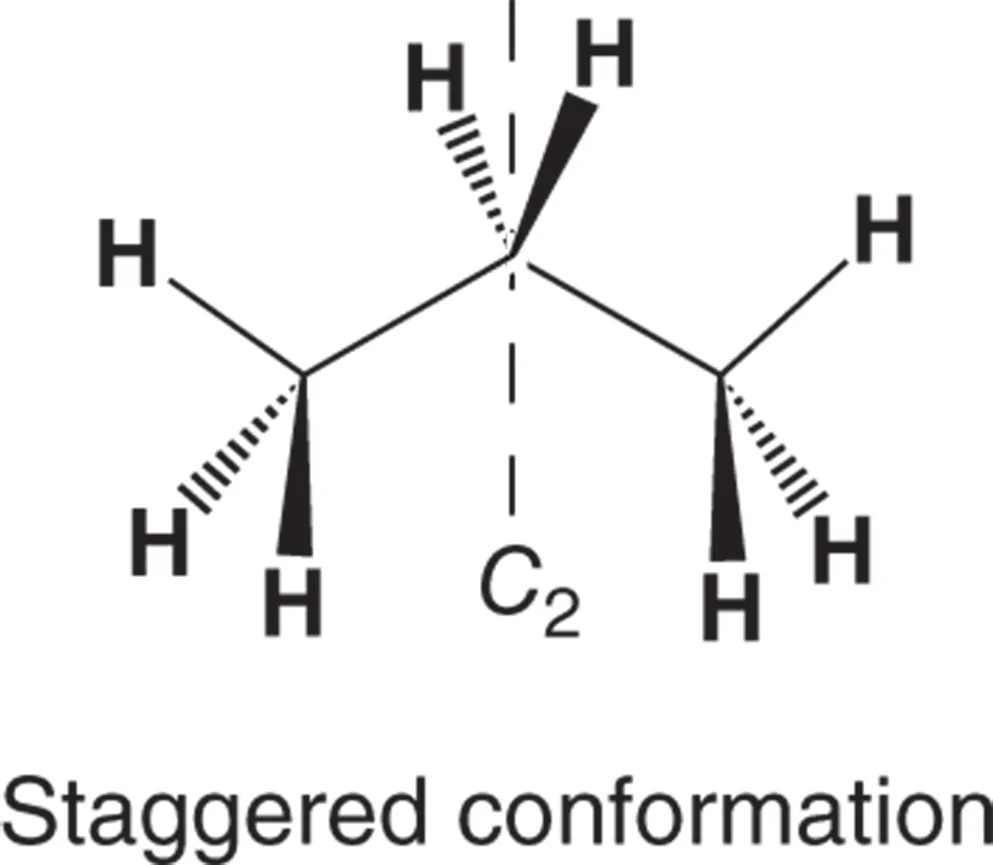
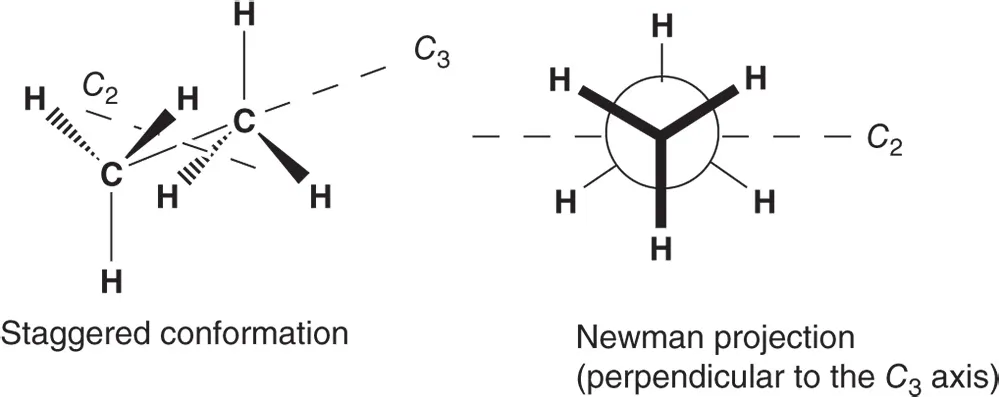
  2. Ethane is a flexible molecule that adopts a preferred staggered conformation (c. 3 kcal mol−1 more stable than the eclipsed conformation (Section 2.5.1), transition state of the rotation about its σ(CC) bond). Ethane has a C3‐ and three C2‐axes that are interconverted by rotation about the C3‐axis. Thus, the symmetry number σ = 3 × 2 = 6.
    c01u002
    Propane is a flexible molecule for which the doubly staggered conformation is the most stable one (C2v symmetry: one mirror plane of symmetry containing a C2‐axis of rotation) has one C2‐axis of rotation. Thus, the symmetry number σ = 2.
    c01u003
    Cyclopropane is a rigid molecule (D3h symmetry) with a C3‐ and three C2‐axes of rotation. Rotation about the C3 axis interconverts the C2‐axis. Thus, the symmetry numb...

Table of contents

  1. Cover
  2. Table of Contents
  3. 1 Equilibria and Thermochemistry
  4. 2 Additivity Rules for Thermodynamical Parameters and Deviations
  5. 3 The Rates of Chemical Reactions*
  6. 4 Molecular Orbital Theories
  7. 5 Pericyclic Reactions*
  8. 6 Organic Photochemistry
  9. 7 Catalytic Reactions
  10. 8 Transition‐Metal‐Catalyzed CC Bond Forming Reactions
  11. End User License Agreement