Provides an understanding of the relationship between social-ecological systems and multilevel governance so that readers can properly deal with hydrometeorological extreme events and hazards
Based on field investigations from EU research projects, this book is the first to devote itself to scientific and policy-related knowledge concerning climate change-induced extreme events. It depicts national and international strategies, as well as tools used to improve multilevel governance for the management of hydrometeorological risks. It also demonstrates how these strategies play out over different scales of the decision-making processes.
Facing Hydrometeorological Extreme Events: A Governance Issue offers comprehensive coverage of such events as floods, droughts, coastal storms, and wind storms. It showcases real-life success stories of multilevel governance and highlights the individuals involved and the resources mobilized in the decision-making processes. The book starts by presenting a synthesis of hydrometeorological extreme events and their impacts on society. It then demonstrates how societies are organizing themselves to face these extreme events, focusing on the strategies of integration of risk management in governance and public policy. In addition, it includes the results of several EU-funded projects such as CLIMB, STARFLOOD, and INTERREG IVB project DROP.
The first book dedicated to hydrometeorological extreme events governance based on field investigations from EU research projects
Offers a "multi-hazards" approach—mixing policy, governance, and field investigations' main outputs
Features the results of EU-funded projects addressing hydrometeorological extreme events
Part of the Hydrometeorological Extreme Events series
Facing Hydrometeorological Extreme Events is an ideal book for upper-graduate students, postgraduates, researchers, scientists, and policy-makers working in the field.
1 Laboratory CNRS 7324 Citeres, University of Tours, Tours, France
2 Lab’Urba, Ecole d'Urbanisme de Paris, Université Paris Est Créteil, Marne‐La‐Vallée, France
After the preamble on the complementarity of the six volumes of the series on hydrometeorological extreme events edited by Philippe Quevauviller, this chapter aims to provide the readers with two main reading grids. First, it proposes some definitions of the hydrometeorological extreme events considered in this book. Second, it refers to the concept of adaptive governance to introduce the framework proposed for the governance analysis of the three hydrometeorological extreme events considered in this book, namely floods, droughts, and coastal storms.
1.1 Introduction
Introducing this book on the governance of hydrometeorological extreme events necessitates, first of all, defining what is meant by hydrometeorological extreme events for societies and what they are forecast to be in the context of climate change. Then we will introduce the governance issue related to hydrometeorological events in order to frame the specific situations set out throughout this book, which sketch the specific geographical and political contexts within which these governance issues take place.
1.2 Facing hydrometeorological extreme events
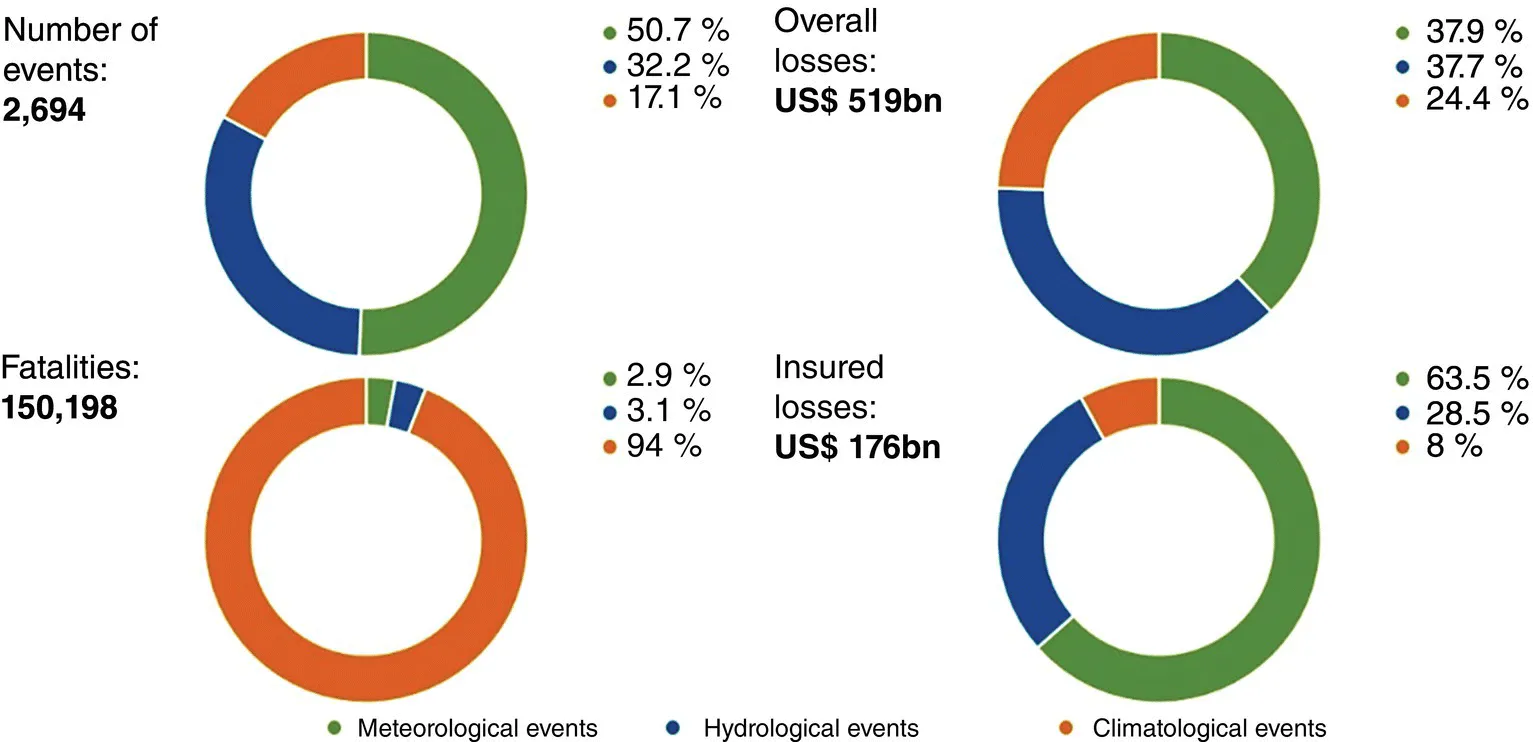
Hydrometeorological variability is inherent to terrestrial climate. Hydrometeorological extreme events are part of this variability. Societies are thus naturally exposed to hydrometeorological extreme events and have, through history, developed different strategies to manage their vulnerabilities. Each year, millions of people are affected by hydrometeorological extreme events all over the world, including Europe, with an observed and reported increase in severity and frequency (Harding et al. 2015). The total amount of floods and economic losses associated with these events have increased over the past decades (Bates et al. 2008; Kundzewicz et al. 2014), as confirmed by the NatCat SERVICE1 – a database on natural disasters managed by the Munich Re reinsurance agency (Figure 1.1). Overall losses have been assessed to represent more than USD 500 billion.
In 2012, the Intergovernmental Panel on Climate Change (IPCC) produced a Special Report on Managing the Risks of Extreme Events and Disasters to Advance Climate Change Adaptation. This report is commonly referred to as the SREX report. Its main objective is to prevent hydrometeorological extreme events by exploring the physical and social dimensions of weather‐ and climate‐related disasters. Thus, hydrometeorological extreme events must be considered in the context of global warming and its impacts.
According to the IPCC report on extreme events, climate extremes (extreme weather or climate event) means the occurrence of a value of a weather or climate variable above (or below) a threshold value near the upper (or lower) ends of the range of values observed for the variable (IPCC 2012). To simplify, both extreme weather events and extreme climate events are referred to collectively as ‘climate extremes’ (IPCC 2012). These include any rare, intense, and severe extreme events (Beniston et al. 2007).
All these extreme events – floods, droughts, and coastal storms – originate from climate‐system extremes such as persistent anticyclonic conditions or strong gradients in atmospheric pressure and temperature. Thus, if the climate changes, as a consequence, extreme events can also change. Scenarios proposed by the IPCC report on extreme events predict an increase in these events, both in frequency and intensity.
These extreme events are expected to have major impacts throughout Europe, including on water management. However, as regards the impacts on societies, it is always necessary to set these events in a historical context. As shown through the work of climate historians, history testifies to series of extreme events having taken place in Europe between the sixteenth and twentieth centuries (Garnier 2015). The impacts of past extreme events on societies (Le Roy Ladurie, Rousseau, and Vasak 2011) give important information on what current governance could consider in its risk‐assessment process. The Sendai framework for Disaster Risk Reduction, which was established by the UN General Assembly in March 2015 (as a follow up to the Hyogo framework), aimed at increasing the preparedness for climate change impacts through a framework supporting the ‘substantial reduction of disaster risk and losses in lives, livelihoods and health and in the economic, physical, social, cultural and environmental assets of persons, businesses, communities and countries’ (Sendai Framework 2015). In order to achieve this overall outcome by 2030, the Sendai working groups focused on the following goals: ‘Prevent new and reduce existing disaster risks through the implementation of integrated and inclusive economic, structural, legal, social, health, cultural, educational, environmental, technological, political and institutional measures that prevent and reduce hazard exposure and vulnerability to disaster, increase preparedness for response and recovery, and thus strengthen resilience’. These efforts are expected to: (i) generate the information base for the development of Sendai Framework implementation strategies, (ii) facilitate the development of risk‐informed policies and decision‐making processes, and (iii) guide the allocation of appropriate resources.2 This must be based on efficient governance for integrated risk management.
This being said, as an introduction to this book on the governance of hydrometeorological extreme events, it seems necessary to provide an overview of the main characteristics of the hydrometeorological extreme events presented and the main impacts and adaptation strategies proposed at European level. Since the main hydrometeorological extreme events occurring in Europe are floods, droughts, and coastal storms, this book focuses on these three types of extreme event.
1.3 Floods
In Europe, flooding is probably the leading natural hazard. Flood lists are mentioned in several webpages and commonly engraved on the piers of river bridges. The European Environment Agency provides a datasheet containing information on past floods in Europe since 1980,3 based on the reporting of European Union (EU) Member States for the EU Floods Directive (2007/60/EC), along with information provided by relevant national authorities and global databases on natural hazards. The summer of 2016 was the scene of major floods throughout Europe, where Germany and France, along with Austria, Belgium, Romania, Moldova, the Netherlands, and the United Kingdom were highly impacted.
1.3.1 Definition and characteristics
In English, the word flood describes both the natural variability of a river with a maximum flow during the wet period, and the inundation phenomenon due to the river coming out of its bed and filling the floodplains. Thus, a flooding event, as an extreme hydrometeorological event, is a situation in which water temporarily covers land not frequently flooded.
Flood can be described by hydrological characteristics such as:
Flood intensity, which is characterized by inundation depth and volume;
Flood frequency, which represents the number of times an area is inundated duri...
Table of contents
Cover
Table of Contents
List of Contributors
Editors
The Series Editor
Series Preface
Part I: Introduction
Part II: Floods
Part III: Droughts
Part IV: Coastal and Wind Storms
Part V: Conclusions, Perspectives
Index
End User License Agreement
Trusted by 375,005 students
Access to over 1.5 million titles for a fair monthly price.
Study more efficiently using our study tools.
Frequently asked questions
Yes, you can cancel anytime from the Subscription tab in your account settings on the Perlego website. Your subscription will stay active until the end of your current billing period. Learn how to cancel your subscription
No, books cannot be downloaded as external files, such as PDFs, for use outside of Perlego. However, you can download books within the Perlego app for offline reading on mobile or tablet. Learn how to download books offline
Perlego offers two plans: Essential and Complete
Essential is ideal for learners and professionals who enjoy exploring a wide range of subjects. Access the Essential Library with 800,000+ trusted titles and best-sellers across business, personal growth, and the humanities. Includes unlimited reading time and Standard Read Aloud voice.
Complete: Perfect for advanced learners and researchers needing full, unrestricted access. Unlock 1.5M+ books across hundreds of subjects, including academic and specialized titles. The Complete Plan also includes advanced features like Premium Read Aloud and Research Assistant.
Both plans are available with monthly, semester, or annual billing cycles.
We are an online textbook subscription service, where you can get access to an entire online library for less than the price of a single book per month. With over 1.5 million books across 990+ topics, we’ve got you covered! Learn about our mission
Look out for the read-aloud symbol on your next book to see if you can listen to it. The read-aloud tool reads text aloud for you, highlighting the text as it is being read. You can pause it, speed it up and slow it down. Learn more about Read Aloud
Yes! You can use the Perlego app on both iOS and Android devices to read anytime, anywhere — even offline. Perfect for commutes or when you’re on the go. Please note we cannot support devices running on iOS 13 and Android 7 or earlier. Learn more about using the app
Yes, you can access Facing Hydrometeorological Extreme Events by Isabelle La Jeunesse, Corinne Larrue, Isabelle La Jeunesse,Corinne Larrue in PDF and/or ePUB format, as well as other popular books in Sciences physiques & Météorologie et climatologie. We have over 1.5 million books available in our catalogue for you to explore.