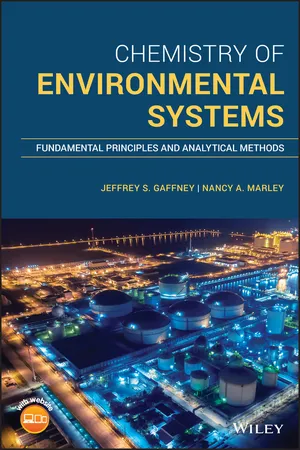
Chemistry of Environmental Systems: Fundamental Principles and Analytical Methods offers a comprehensive and authoritative review of modern environmental chemistry, discussing the chemistry and interconnections between the atmosphere, hydrosphere, geosphere and biosphere. Written by internationally recognized experts, the textbook explores the chemistries of the natural environmental systems and demonstrates how these chemical processes change when anthropogenic emissions are introduced into the whole earth system.
This important text:
Combines the key areas of environmental chemistry needed to understand the sources, fates, and impacts of contaminants in the environment
Describes a range of environmental analytical methodologies
Explores the basic environmental effects of energy sources, including nuclear energy
Encourages a proactive approach to environmental chemistry, with a focus on preventing future environmental problems
Includes study questions at the end of each chapter
Written for students of environmental chemistry, environmental science, environmental engineering, geoscience, earth and atmospheric sciences, Chemistry of Environmental Systems: Fundamental Principles and Analytical Methods covers the key aspects and mechanisms of currently identified environmental issues, which can be used to address both current and future environmental problems.
Environmental chemistry is traditionally defined as “the study of the sources, reactions, transport, effects and fates of chemical species, in water, soil, and air environments, and the effect of human activity on these” (Simple English Wikipedia, n.d.). This definition implies a major focus on the measurement of pollutants in the various environments. However, a more precise definition would be the study of chemistry in natural systems and how this chemistry changes when perturbed by anthropogenic activities and/or the release of chemicals into the environment which changes their natural background levels. Environmental chemistry is not simply the measurement of air, water, or soil pollutants. It is a multidisciplinary subject that requires the environmental chemist to have a solid background in all areas of chemistry, including analytical, physical, organic, inorganic, and simple biochemistry. It is also a discipline that requires studies across boundaries between the different fields of chemistry, physics, biology, ecology, meteorology, and others involved in the various environmental systems, which include the atmosphere, hydrosphere, geosphere, and biosphere. Understanding how these different systems interact allows the environmental chemist to give an accurate assessment of the impacts of chemical species on the environment as a whole.
Thus, the scope of environmental chemistry covers all of the Earth's systems and their interactions with each other. Future environmental chemists need to recognize these interactions and include them when predicting how energy and chemical usage will affect each of the various systems. Traditionally, environmental chemistry is taught in a compartmentalized manner, treating the chemistries of the air, water, soil, and biota separately. Although this is done in an effort to simplify the treatment of these complicated systems, it does not address the interactions between the different systems or the connections between the physics and chemistry of each system. Therefore, a major focus of this text will be on the connections between the various environmental compartments, with special attention given to the fundamental chemistry that is common to all of the various systems.
Environmental chemistry should not be confused with “green chemistry.” The goal of green chemistry is the development of chemical processes that use smaller amounts of safer chemicals with less energy use in order to lower their environmental impacts. The goal of environmental chemistry is the understanding of the chemical reactions and processes that control the environmental systems and how these are impacted by the addition of anthropogenic chemicals. This approach allows environmental chemistry to be proactive instead of reactive. In the past, environmental chemistry has had a more reactive approach, identifying problems after the occurrence of a tragedy or a clearly obvious impact on the environment with loss of life, damage to plants and animals, or radical changes in environmental conditions – such as the loss of visibility in air and water systems or the depletion of the stratospheric ozone layer. Some of these past incidents will be examined in this text as examples of events that have taught us the potential impacts of anthropogenic pollution on the environment and the importance of understanding how the different environmental systems are linked. The lessons learned from these events have helped us to understand how the whole Earth system works and how the separate environmental systems interact. So, this book will stress how the various chemistries of the natural systems in the atmosphere, geosphere, hydrosphere, and biosphere interact with each other, sometimes enhancing environmental impacts and sometimes mitigating those impacts.
1.2 Anthropogenic Pollution
Anthropogenic pollution is defined as the introduction of harmful substances or the creation of harmful impacts in the environment that are directly tied to man's activities, including: agriculture, industry, and energy production and use. It also includes the release and deposition into the environment of waste materials that end up in landfill or are incinerated. Anthropogenic pollution can be described as being intentional or nonintentional, with intentional pollution in many cases being tied to warfare. Our knowledge of the chemistry of the Earth's environmental systems is based on the studies of these anthropogenic impacts on our air and water resources due to the release of chemicals that are not natural to the environment or are emitted at much higher levels than natural.
The potential impacts on air and water quality from anthropogenic pollution have been recognized for a long time. The intentional pollution of water supplies with poisons or waste was used in ancient times, during long‐term sieges of major cities such as the siege of Tortona, Italy in 1155 led by Frederick Barbarossa (Bradbury, 1992). It has been documented as early as 1000 BCE with the ancient Chinese putting arsenic in the water supplies of their enemies (Kroll, 2006). Unintentional pollution was recognized to correlate with higher human population densities in cities. It was strongly linked to the observation of polluted air and water, which not only impact the environmental systems, but also human health and longevity. As early as the twelfth century, Moses Maimonides (Goodhill, 1971; Finlayson‐Pitts and Pitts, 2000), a well‐known philosopher and physician shown in Figure 1.1, noted in his writings about the city of Cairo that:
Figure 1.1 Moses Maimonides, a twelfth‐century philosopher and physician who reported on the degradation of water and air quality in Cairo.
Source: U.S. National Library of Medicine Digital Collection.
Comparing the air of cities to the air of deserts and arid lands is like comparing waters that are befouled and turbid to waters that are fine and pure. In the city, because of the height of its buildings, the narrowness of its streets, and all that pours forth from its inhabitants and their superfluities… the air becomes stagnant, turbid, thick, misty, and foggy… If there is no choice in this matter, for we have grown up in the cities and have become accustomed to them, you should… select from the cities one of open horizons… endeavor at least to dwell at the outskirts of the city… If the air is altered ever so slightly, the state of the Psychic Spirit will be altered perceptibly. Therefore you find many men in whom you can notice defects in the actions of the psyche with the spoilage of the air, namely, that they develop dullness of understanding, failure of intelligence and defect of memory…
This quote from Maimonides predates the Industrial Revolution, when the invention of the steam engine and enhanced farming techniques led to rapidly increasing populations. It clearly notes that, in past as well as present urban settings, anthropogenic pollution is strongly tied to population densities. The increase in population in centralized areas requires increases in energy and water usage, along with the increased transportation necessary to bring the required goods to and from the urban centers. Indeed, the remarks made by Maimonides hit on a number of the present impacts on the chemistry of natural systems, such as the degradation of air and water quality leading to an unpleasant and unhealthy environment.
Another example of the early recognition of health issues caused by exposure to environmental contaminants is the linking of cancer in young male chimney sweeps to environmental exposure by Sir Percival Pott, an English surgeon shown in Figure 1.2. In 1775 Pott attributed the high incidence of scrotal cancer in young chimney sweeps to the exposure and inhalation of chimney soot (Dobson, 1972). This was the first documented identification of the connection of an environmental occupational exposure to an unintentional health effect. It also led to one of the first child labor laws based on an environmental exposure impact on children's health called the Chimney Sweepers Act of 1788 (Hayes, 2008).
Figure 1.2 Sir Percival Pott, an English surgeon who found the association between soot exposure and cancer in young male chimney sweeps in 1775.
Source...
Table of contents
Cover
Table of Contents
About the Authors
Preface
Acknowledgments
Supplementary Material
1 Introduction to Environmental Chemistry
2 Atmospheric Composition and Basic Physics
3 The Fundamentals of Photochemistry
4 Chemistry of the Stratosphere
5 Chemistry of the Troposphere
6 Aerosols and Cloud Chemistry
7 Analytical Methods for Air Analysis
8 Chemistry of Surface and Ground Waters
9 Analytical Methods for Water Analysis
10 Fossil and Biomass Fuels
11 Climate Change
12 Nuclear Energy
13 Future Energy Sources and Sustainability
Appendix A: Answers to Study Problems
Appendix B: List of U.S. EPA Hazardous Air Pollutants – Air Toxics
Appendix C: Henry's Law Constants (Hx) for Selected Inorganic and Organic Compounds
Appendix D: Organic Water Pollutants, their Chemical Structures, Sources, and Concentration Limits in U.S. Drinking Water
Appendix E: Chemicals Used in the Hydraulic Fracturing of Oil Shales for Natural Gas Extraction
End User License Agreement
Trusted by 375,005 students
Access to over 1.5 million titles for a fair monthly price.
Study more efficiently using our study tools.
Frequently asked questions
Yes, you can cancel anytime from the Subscription tab in your account settings on the Perlego website. Your subscription will stay active until the end of your current billing period. Learn how to cancel your subscription
No, books cannot be downloaded as external files, such as PDFs, for use outside of Perlego. However, you can download books within the Perlego app for offline reading on mobile or tablet. Learn how to download books offline
Perlego offers two plans: Essential and Complete
Essential is ideal for learners and professionals who enjoy exploring a wide range of subjects. Access the Essential Library with 800,000+ trusted titles and best-sellers across business, personal growth, and the humanities. Includes unlimited reading time and Standard Read Aloud voice.
Complete: Perfect for advanced learners and researchers needing full, unrestricted access. Unlock 1.5M+ books across hundreds of subjects, including academic and specialized titles. The Complete Plan also includes advanced features like Premium Read Aloud and Research Assistant.
Both plans are available with monthly, semester, or annual billing cycles.
We are an online textbook subscription service, where you can get access to an entire online library for less than the price of a single book per month. With over 1.5 million books across 990+ topics, we’ve got you covered! Learn about our mission
Look out for the read-aloud symbol on your next book to see if you can listen to it. The read-aloud tool reads text aloud for you, highlighting the text as it is being read. You can pause it, speed it up and slow it down. Learn more about Read Aloud
Yes! You can use the Perlego app on both iOS and Android devices to read anytime, anywhere — even offline. Perfect for commutes or when you’re on the go. Please note we cannot support devices running on iOS 13 and Android 7 or earlier. Learn more about using the app
Yes, you can access Chemistry of Environmental Systems by Jeffrey S. Gaffney,Nancy A. Marley in PDF and/or ePUB format, as well as other popular books in Physical Sciences & Environmental Science. We have over 1.5 million books available in our catalogue for you to explore.