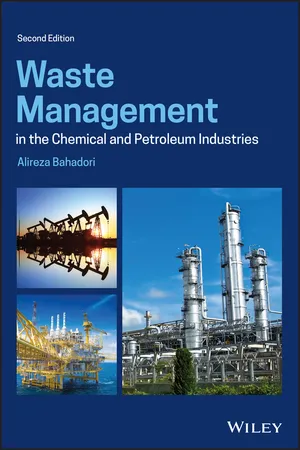
Waste Management in the Chemical and Petroleum Industries
eBook - ePub

Waste Management in the Chemical and Petroleum Industries

  1. English
  2. ePUB (mobile friendly)
  3. Available on iOS & Android
eBook - ePub

Waste Management in the Chemical and Petroleum Industries

About this book

Unravels fundamental engineering for the treatment, recovery, and disposal of solid waste, sludge and wastewater in the petroleum, chemical, and unconventional oil and gas processing industries

This new edition unravels essential requirements for the process design and engineering of the equipment and facilities pertaining to waste management for gas refineries, chemical plants, oil terminals, and petrochemical plants.

Updated throughout, Waste Management in the Chemical and Petroleum Industries, Second Edition offers chapters on wastewater treatment; physical unit operations; chemical treatment; biological treatment; and wastewater treatment in unconventional oil and gas industries. It also covers wastewater sewer systems; sewage treatment; and solid waste treatment and disposal.

New topics include:

  • water pollution terminals
  • the design procedure for effluent water pollution control
  • spill prevention and control
  • groundwater pollution control
  • wastewater pollution control in crude oil terminals
  • Information on the source of polymeric plants
  • examination of water and wastewater radioactivity
  • soil pollution
  • pipeline leak consequence evaluation

Waste Management in the Chemical and Petroleum Industries, Second Edition is an ideal text for researchers and advanced students in chemical, petroleum, and environmental fields, as well as for those in civil engineering.

Frequently asked questions

Yes, you can cancel anytime from the Subscription tab in your account settings on the Perlego website. Your subscription will stay active until the end of your current billing period. Learn how to cancel your subscription.
No, books cannot be downloaded as external files, such as PDFs, for use outside of Perlego. However, you can download books within the Perlego app for offline reading on mobile or tablet. Learn more here.
Perlego offers two plans: Essential and Complete
  • Essential is ideal for learners and professionals who enjoy exploring a wide range of subjects. Access the Essential Library with 800,000+ trusted titles and best-sellers across business, personal growth, and the humanities. Includes unlimited reading time and Standard Read Aloud voice.
  • Complete: Perfect for advanced learners and researchers needing full, unrestricted access. Unlock 1.4M+ books across hundreds of subjects, including academic and specialized titles. The Complete Plan also includes advanced features like Premium Read Aloud and Research Assistant.
Both plans are available with monthly, semester, or annual billing cycles.
We are an online textbook subscription service, where you can get access to an entire online library for less than the price of a single book per month. With over 1 million books across 1000+ topics, we’ve got you covered! Learn more here.
Look out for the read-aloud symbol on your next book to see if you can listen to it. The read-aloud tool reads text aloud for you, highlighting the text as it is being read. You can pause it, speed it up and slow it down. Learn more here.
Yes! You can use the Perlego app on both iOS or Android devices to read anytime, anywhere — even offline. Perfect for commutes or when you’re on the go.
Please note we cannot support devices running on iOS 13 and Android 7 or earlier. Learn more about using the app.
Yes, you can access Waste Management in the Chemical and Petroleum Industries by Alireza Bahadori in PDF and/or ePUB format, as well as other popular books in Physical Sciences & Industrial & Technical Chemistry. We have over one million books available in our catalogue for you to explore.

Information

1
Wastewater Treatment

Oil and gas are major sources of energy and revenue for many countries today, and their production has been described as one of the most important industrial activities in the 21st century therefore obviously waste treatment and disposal assume a greater degree of importance in the petroleum, chemical processing and unconventional oil and gas industries.
Wastewater treatment refers to the treatment of sewage and water used by residences, business, and industry to a sufficient level that it can be safely returned to the environment. It is important to treat wastewater to remove bacteria, pathogens, organic matter, and chemical pollutants that can harm human health, deplete natural oxygen levels in receiving water, and pose risks to animals and wildlife.
Natural water and wastewater are characterized in terms of their physical, chemical, and biological composition. The principal physical properties and the chemical and biological constituents of wastewater and their sources make a lengthy list. Each designated water body should be controlled according to regulations which may be composed of both basic and more detailed numerical criteria, as briefly discussed below.
Basic freedom from pollution. As far as is practically possible, all bodies of water should attain the basic criteria of the Five Freedoms from Pollution:
  1. 1. Free from suspended solids or other substances that enter the water as a result of human activity and that will settle to form putrid or otherwise objectionable sludge deposits, or that will adversely affect aquatic life.
  2. 2. Free from floating debris, oil, scum, and other floating materials entering the water as a result of human activity in amounts sufficient to be unsightly or cause degradation.
  3. 3. Free from materials entering the water as a result of human activity producing color, odor, or other conditions in such a degree as to create a nuisance.
  4. 4. Free from substances entering the water as a result of human activity in concentrations that are toxic or harmful to human, animal or aquatic life and/or are rapidly lethal in the mixing zone.
  5. 5. Free from nutrients entering the water as a result of human activity in concentrations that create nuisance growths of aquatic weeds and algae.
The water contaminant parameters determined in refinery wastewater include biochemical oxygen demand (BOD), chemical oxygen demand (COD), oil, total suspended solids (TSS), ammonia (NH3), phenolics, hydrogen sulfide (H2S), trace organics, and some heavy metals.
Table 1.1 shows the major sources of each of these contaminants. P...

Table of contents

  1. Cover
  2. Table of Contents
  3. Preface
  4. About the Author
  5. 1 Wastewater Treatment
  6. 2 Physical Unit Operations
  7. 3 Chemical Treatments
  8. 4 Biological Treatments
  9. 5 Wastewater Treatment in the Unconventional Oil and Gas Industries
  10. 6 Wastewater Sewer Systems
  11. 7 Sewage Treatment
  12. 8 Solid Waste Treatment and Disposal
  13. Definitions and Terminology
  14. Bibliography
  15. Index
  16. End User License Agreement