In response to the rise of various forms of the extreme in economies, organizations and societies (such as disruptive innovation, climate emergency, financial crisis, high-risk sport, etc.), an ambitious 21st century program sets the agenda of management sciences around the unknown, disruption, uncertainty and risk.
Management of Extreme Situations presents the research results from the conference organized at the Cerisy-la-Salle International Cultural Center, France, in 2016. It testifies to the existence of an international community that brings together, around management sciences, various disciplines studying the management concept of extreme situations.
Through the analysis of varied contexts (polar and mountain expeditions, fire rescue services, exploration projects in the military field, creative industries, etc.), this book offers an initial grammar of the extreme. It presents a heuristic for the management of these situations – particularly in terms of sensemaking, ambidexterity and knowledge expansion.
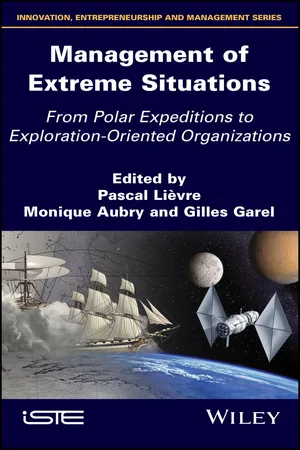
eBook - ePub
Management of Extreme Situations
From Polar Expeditions to Exploration-oriented Organizations
- English
- ePUB (mobile friendly)
- Available on iOS & Android
eBook - ePub
Management of Extreme Situations
From Polar Expeditions to Exploration-oriented Organizations
About this book
Information
PART 1
Exploration and the Extreme
SECTION 1
The Logic of Exploration
1
An Exemplary Exploration Story: Nansen’s Expedition to the North Pole
1.1. Introduction
The purpose of this contribution is to discuss an emblematic project in the field of polar expeditions. The project falls within the category of “extreme exploration situations” in order to document the profound nature of the organizational performance of this type of collective action. On a theoretical level, we are in the wake of radical innovation project management that conditions the development of this type of project to a process of knowledge expansion (Nonaka 1994; Midler 1996; Hatchuel et al. 2005; Lenfle 2008; Cohendet and Simon 2007). We approach this question of knowledge expansion from the perspective of a cognitive dynamic of learning (Wenger 1998; Nooteboom 2008), which is a necessary condition for any development of this type of project. From an empirical investigation of about 10 polar expeditions, we were able to identify three registers that must be the subject of vigilance for a project manager in responsibility: the construction of meaning, the capacity for organizational ambidexterity and the expansion of experiential and scientific knowledge (Lièvre 2016). Different combinations are possible between these three registers that build different organizational agencies, in the sense of Girin’s work (1995), that affect the performance of collective action.
We chose one of the greatest achievements in polar history, the Norwegian Fridtjof Nansen’s expedition to the North Pole in 1893. This expedition has all the attributes of exploration projects in terms of the unknown, scalability, uncertainty and risk and at a level of intensity that makes this project quite interesting from a scientific point of view due to its radical nature.
There are some elements that can measure the project. At the time, the North Pole was a real unknown place. Scientific controversies were intense and numerous on the subject. For example, the German geographer Auguste Peterman (1850) defended the theory of the Open Polar Sea, under the influence of the warm currents of the Gulf Stream, documented by the observations of Kane’s expedition (1853) that contrasted with the theory of the Norwegian meteorologist Henrik Mohn (1884) who defended the existence of an ice cap covered by glacial currents. Vital risk was omnipresent in this type of adventure where boats were crushed by ice and there were few survivors. As geographer Marie-Françoise Andrée (2001) has explained, this period of falling temperatures known as the “Little Ice Age” had paradoxically been the golden age of polar exploration fuelled by the quest for the Arctic. In fact, it was a formidable time for polar shippers with dramatic consequences: for example, the Franklin expedition disaster in search of the Northwest Passage (1855) (two ships and 120 crewmen missing), no less than five shipwrecks from the seven ships sent in search of Franklin, and finally the sinking of HSS Jeannette (1881), an American expedition going to the North Pole. In this context, Nansen’s expedition already appeared to be an achievement. Indeed, all sailors returned safe and sound. The boat returned safely to port, after voluntarily letting itself be caught in the ice. Indeed, the project was extremely daring since it involved going up the coast of Siberia by taking advantage of the warm Gulf Stream current, getting caught in the ice and taking advantage of the glacial currents to let itself be carried to the North Pole, then to the open waters of Spitzberg and back to Norway. The North Pole was not reached but the expedition reached the northernmost point of the time (86°14’ LN).
A few months after the expedition, Nansen published his logbook. This book was translated very quickly into many languages and is the bedside reading of many generations of polar shippers to this day. It was from this knowledge base that the North Pole was reached by two Americans, Cook in 1908 and Peary in 1909. We see above all the creation of a Norwegian school for polar expeditions (Sverdrup, Amundsen), in contrast to an English school (Franklin, Scott, Shackleton) which was based on the principles of maritime exploration developed by James Cook. This Norwegian school had two major world successes with Amundsen: the first crossing of the NW Passage (1906) and the conquest of the South Pole (1911), while the English school experienced disasters and failures. The South Pole became the subject of a radical confrontation, at the same time, between these two modes of exploration, with the Norwegian explorer Amundsen, on the one hand, and the English explorer Scott, on the other hand. We know the unfortunate outcome of this English expedition that ended near a depot of life that could not be reached, while the Norwegian flag was flying at the South Pole. Explorers like Paul Emile Victor in the 1950s, and even Jean Louis Etienne in France and Borge Ousland in Norway, consider Nansen’s expedition as an irreplaceable reference.
We simply propose to illustrate from this expedition how the three registers we have identified are positively affected and contribute to the organizational performance of this type of project.
The first register to follow in order to understand the relevance of the organizational arrangement of this expedition is that of the construction of meaning for all the actors throughout the progress of this project. We will focus only on Nansen, the conductor of this expedition.
1.2. A project that makes “sense” because it is consistent with an identity-based learning trajectory
We consider the construction of meaning for actors in situations as a prerequisite for any capacity for learning, adaptation and creativity in line with Weick’s (2001) work. But ontologically, it is not a strictly discursive and/or semantic register, but rather a relational ontology (enactive) as discussed by Varela (1996), a singular form of interaction between each actor and their environment, an adaptive embodied sensitivity where emotion–cognition–motor function are linked, which refers to what Récopé (2018, see Chapter 9 of this book) calls a phenomenology of activity, finely articulating authors like Varela, Canguilhem, and Merleau-Ponty. This question of meaning as it is expressed in actions and situations, in vivo, refers to the actor’s own norms in reference to a world of value that is expressed in polar oppositions between a positive and a negative (Canguilhem 1966), structured and structuring unconscious dispositions to act that orient toward a style of practice (Bourdieu 1994). But this sensitivity can also be expressed at a given moment in the context of a discursive activity and it is also related to semantic fields. This sensitivity is created during the life history of individuals in an identity-based learning trajectory (Wenger-Trayner et al. 2014).
In the field of polar ski expeditions, it is the investigation of practices that have appeared both highly differentiated and highly structured that has led us to focus on the explorers’ own standards (Lièvre et al. 2003). We have been led to distinguish, on the one hand, “explorer beings” for whom the expedition is first in relation to their life, which will result in their being strongly affected by the situations, and “beings” who simply carry out explorations in a secondary way. The latter are in fact less affected by the situations. Beyond this question of commitment, on the other hand, different styles of practice appear in terms of sensitivity and value that express an orientation when organizing the exploration that takes the form of a quality convention and guides each operation of the exploration. We were able to identify four major sensitivities that express an orientation in the exploration: toward progression techniques such as the pleasure of skiing, toward the achievement of a sporting feat, toward the exploration and discovery of an unknown environment and toward science or ecological activism (Lièvre et al. 2003, 2018). We were able to create a polar map of these sensitivities that express distances and proximities between them, but also multiple possibilities of combination.
Nansen’s expedition is part of an identity-based learning trajectory of a polar expeditionary being developing a sensitivity to the interface between exploration and science. Nansen’s sensitivity is built into his life story.
We propose to highlight some key events in Nansen’s life story, which show the great coherence between the project of this expedition to the North Pole and Nansen’s identity aspirations.
Fridtjof Nansen was born on October 21, 1861, in the near suburbs of Christiana (Oslo in 1905) in Norway. He came from a wealthy family; his father was a lawyer. From an early age, he developed a passion for outdoor activities in the mountains and on the sea. The main activities in the summer were swimming and fishing, while in the fall, the main hobby was hunting in the forest. Winters in Norway are mainly devoted to skiing, which Nansen practiced from the age of two. He would later become a ski champion in his own country. Also, it is on skis in winter that...
Table of contents
- Cover
- Table of Contents
- Preface
- Cerisy Symposiums Selection of Publications
- Introduction
- Part 1: Exploration and the Extreme
- Part 2: Creativity and Organizational Reliability
- Part 3: Register of the Intelligibility of Extreme Management Situations
- Part 4: The Variety of Extreme Situations and Disciplinary Perspectives
- Conclusion
- List of Authors
- Index
- End User License Agreement
Trusted by 375,005 students
Access to over 1.5 million titles for a fair monthly price.
Study more efficiently using our study tools.
Frequently asked questions
Yes, you can cancel anytime from the Subscription tab in your account settings on the Perlego website. Your subscription will stay active until the end of your current billing period. Learn how to cancel your subscription
No, books cannot be downloaded as external files, such as PDFs, for use outside of Perlego. However, you can download books within the Perlego app for offline reading on mobile or tablet. Learn how to download books offline
Perlego offers two plans: Essential and Complete
- Essential is ideal for learners and professionals who enjoy exploring a wide range of subjects. Access the Essential Library with 800,000+ trusted titles and best-sellers across business, personal growth, and the humanities. Includes unlimited reading time and Standard Read Aloud voice.
- Complete: Perfect for advanced learners and researchers needing full, unrestricted access. Unlock 1.5M+ books across hundreds of subjects, including academic and specialized titles. The Complete Plan also includes advanced features like Premium Read Aloud and Research Assistant.
We are an online textbook subscription service, where you can get access to an entire online library for less than the price of a single book per month. With over 1.5 million books across 990+ topics, we’ve got you covered! Learn about our mission
Look out for the read-aloud symbol on your next book to see if you can listen to it. The read-aloud tool reads text aloud for you, highlighting the text as it is being read. You can pause it, speed it up and slow it down. Learn more about Read Aloud
Yes! You can use the Perlego app on both iOS and Android devices to read anytime, anywhere — even offline. Perfect for commutes or when you’re on the go.
Please note we cannot support devices running on iOS 13 and Android 7 or earlier. Learn more about using the app
Please note we cannot support devices running on iOS 13 and Android 7 or earlier. Learn more about using the app
Yes, you can access Management of Extreme Situations by Pascal Lièvre, Monique Aubry, Gilles Garal, Pascal Lièvre,Monique Aubry,Gilles Garal in PDF and/or ePUB format, as well as other popular books in Business & Management. We have over 1.5 million books available in our catalogue for you to explore.