As the world's energy sources continue to develop, with less reliance on traditional fossil fuels and more reliance on cleaner, more efficient, alternative energy sources, nuclear power continues to be a dividing point for many people. Some believe it is the answer to our energy problems for the future, while others warn of the risks. Written by a retired scientist who spent most of his career at the Idaho National Laboratory (INL), this book aims to delve into the issues surrounding nuclear power and dispel its myths, while building an argument for why the United States should develop a nuclear power plan for the future.
As a "whistleblower," the author spent much of the last ten years of his career at the INL raising concerns about how its mission of serving as the Department of Energy's lead laboratory in radioactive waste management was not being properly managed. While the United States continues to tread water on the issue of nuclear energy, the author believes that a nuclear "renaissance" is not only possible but is necessary for meeting the world's growing demand for energy, especially clean energy.
With fossil fuels slowly dying out and renewable energy sources not able to handle the demand for a continuously growing energy-consuming public, nuclear is an obvious solution. This book is a must-have for any engineer working in nuclear power, students hoping to go into that industry, and other engineers and scientists interested in the subject. This book is both "technical" and "political" because they're equally important in determining what actually happens in institutions dealing with technical problems.
Unlike most first world nations, the majority of Africa’s 54 countries continue to exhibit alarmingly high rates of both population growth and poverty [1]. Approximately 380 million of its ~1.2 billion people are extremely poor – often hungry – and ten of the world’s most underdeveloped [2] countries – Mozambique, Guinea, Burundi, Burkina Faso, Eritrea, Sierra Leone, Chad, Central African Republic, Democratic Republic of Congo, and Niger – are located therein. Furthermore, although considered exceptionally underdeveloped, none of them are among the twenty countries recognized to possess the world’s lowest living costs (Cheap 2018) meaning that Africa’s poor people are considerably poorer in fact than are those in more technologically advanced but poor by OECD standards nations like Romania. Most of Africa’s people are plagued by a lack of basic infrastructure due to dysfunctional and, often, self-serving governance further complicated by long festering civil/tribal/religious conflicts and therefore face bleak futures6. Much of Africa is also apt to be particularly hard-hit by climate change - the Sahara desert is getting bigger7. The fact that most of its countries are ill equipped to deal with any sort of natural disaster, possess economies comprised primarily of subsistence farming on progressively poorer-quality land, and have grossly underfunded public health, physical infrastructure, and education services constitute only some of the factors considered in compiling quality-of-life rankings. Most of the United Nation’s measures of Human Development [3] also consider the fairness of income/wealth distribution for which Africa’s countries are also especially low-ranking [4]. Cambridge’s Sir Partha Dasgupta, recipient of almost every award that economists can bestow, has pointed out that most of the recent GNP increases of 2nd/3rd world countries have come at the expense of their average citizens’ personal assets [5].
Africa’s (and the World’s) still burgeoning population growth exacerbates all of its problems. As of 2015, the UN’s mid-range population growth projection is that Africa will have ~4.5 billion inhabitants by 2100 AD – about three times that similarly anticipated for the world’s currently most populous nation, China. The populations of 28 African countries are predicted to more than double between 2015 and 2050 and, by 2100, those of Angola, Burundi, Democratic Republic of Congo, Malawi, Mali, Niger, Somalia, Uganda, United Republic of Tanzania and Zambia are to increase at least five-fold.
Frankly, I consider such projections unrealistic for the following reasons. First, the world’s current political trends - increasing “populism” (extreme polarization often bordering upon fascism) driven primarily by rapidly increasing class, power, and wealth disparities. Second, the armed-to-the teeth “leader of the western world’s” nervousness about the fact that its dominance of the world’s economic system is rapidly diminishing. Third, additional population stressors driven by climate change and resource limitations. Fourth, and finally, most of human history (nature?) suggests that those factors could ignite another “world war” apt to kill far more people than did the 20th century’s and thereby curb (or reverse) population growth.
Unless a new, worldwide, “Fair Deal” somehow comes to pass8, the relative demographic weight of the world’s developed countries will drop shifting economic power to developing nations. The already-developed countries’ labor forces will age and decline constraining their economic growth and raise the demand for “cheap” non-documented immigrant workers which will likely further increase the frequency of killings, burnings, and bombings driven by jingoistic populism. Most of the world’s population growth will be concentrated in the poorest, youngest, and most heavily faith-based (mostly Muslim) countries many of which will continue to be unable to provide adequate education, capital, and employment opportunities for their young people.
Finally, most of the world’s population will live in cities, with the largest such heavily urbanized areas in the poorest countries, where adequate policing, sanitation, health care, and even clean water are likely to be available only to their richest inhabitants. Such urbanization is apt to be profoundly destabilizing. People moving to cities within developing countries during the rest of this century are apt to have far lower per capita incomes than did those of most of today’s industrial countries when they did so. The United States, did not reach 65 percent urbanization until 1950, when its per capita income was nearly $118,000 in 2019 dollars. By contrast, countries like Nigeria, Pakistan, and the Philippines now approaching similar levels of urbanization, have per capita incomes of $2,300–$5,200. Countries with younger populations are especially prone to civil unrest and less able to create or sustain democratic institutions. The more heavily urbanized they become, the more they are apt to experience grinding poverty and anarchic violence. In good times, a thriving economy might keep urban residents employed and governments flush with sufficient resources to meet their needs. More often however, people living in sprawling, impoverished cities are victimized by crime lords, gangs, and petty rebellions. Thus, the rapid urbanization of the developing world is apt to bring in more exaggerated form, the same problems that urbanization brought to nineteenth-century Europe: cyclical employment, inadequate policing, and limited sanitation and education which spawned wide-spread labor strife, periodic violence, and sometimes, even revolutions. International terrorism originates in fast-urbanizing developing countries. Within poor sprawling megacities like Mogadishu and Damascus, neighborhood gangs armed with Internet enabled social networking offer excellent opportunities for the recruitment, maintenance, and hiding of terrorist networks [6].
When life is cheap, worthwhile jobs unavailable, and the future looks even worse, young people often to go to war.
US Pentagon studies [7] concluded that the root cause of majority of such deaths will be disease and starvation engendered by the disintegration of technology-dependent societies dependent upon increasingly limited/degraded resources (land, food, fuel, high grade ores, etc). In his book, “Small is Beautiful: A Study of Economics as if People Mattered”, Ernst Schumacher [8] observed that today’s technological civilization is unsustainable because the finite resources enabling it are treated as inventory (income) rather than capital. The sustainability of today’s economic systems therefore requires continued growth of both population9 and total wealth (GDP), both of which are impossible in a finite world.
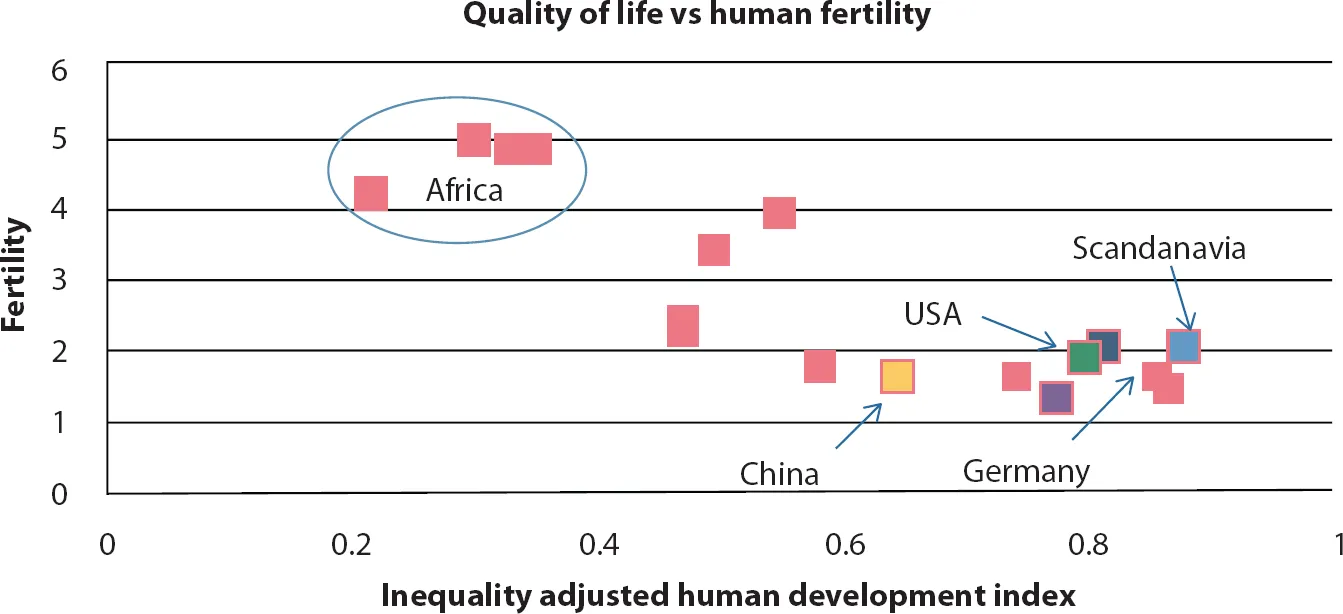
Second, if our world’s future leaders were to decide to implement the changes needed to address the technical issues otherwise likely to lead to war, doing so would result in much lessened fertility [9]. Figure 1 depicts the effect that increasing people’s prosperity10 has upon their reproductive choices (replacement fertility ~2.1) - if the future were to become both much richer and fairer than it is now, today’s unsustainable population growth would quickly end.
Figure 1 Prosperity vs human reproductive choices (WIKIPEDIA data).
Consequently our leadership’s objective should become encouraging the development of a genuinely sustainable and much more egalitarian world in which every individual regardless of where they live or who they are does indeed matter11. Until they acknowledge the above-related facts, embrace appropriate goals, and begin to act accordingly, we’ll just continue to spin our wheels while blaming “the other guys”.
What are those goals?
Since food represents any living creature’s most fundamental need and its source for humanity is farm land, I’ll begin by describing what’s been happening along those lines in the world’s currently most undeveloped continent, Africa. A recent Brookings Institute report [10], points out that, “no matter how effectively other conditions are remedied, per capita food production in Africa will continue to decrease unless soil fertility depletion is effectively addressed.” It goes on to say that a second major problem with the oft-assumed African “land abundance” hypothesis is its inconsistency with convincing evidence that its soils are being simultaneously depleted and eroded by current agricultural practices including a decline in fallowing. While some African leaders along with the management of “land grabbing” (?) international agribusiness concerns seem to feel that Africa still has plenty of yet-undeveloped arable land, many of Africa’s poorest people (mostly subsistence farmers) can’t afford to let any of theirs lie fallow and thereby recover: some families live on 0.36 ha (0.9 US acre) farms yielding under 1 t of grain/ha (t = tonne = 10+3 kg = 10+6 grams: ha = hectare = 10+4 m2 = 2.59 US acre) while the first-world’s farmers routinely produce 3 to 12 t/ha of whatever cash crop they chose to plant on several order of magnitude larger farms.
The key differences between the agricultural practices of developed nations and most of Africa’s include:
Developed nations heavily fertilize their croplands – most of Africa’s farmers can’t afford artificial fertilizers and often have to burn any manures or crop residues they can gather to cook their food.
Developed nations’ farmers can afford to irrigate their croplands – most of Africa’s can’t. That issue is compounded by the fact that much of Africa’s nominally arable land doesn’t get enough rain to reliably support anything other than skeletal cow or goat grazing.
Most developed-nation farms are both large and productive enough to enable their owners to buy/utilize specialized machinery which renders their labor far less exhausting and much more rewarding12. The world’s poorest farmers still work themselves to death with primitive tools.
6 “Life has become more brutal and brutish”, Wole Soyinka (84 year-old Nigerian playwright & philosopher). CGTN interview, 16Feb2019. 7 Much of, Spain, Portugal and the southwestern US is becoming more desert-like and each year’s heat waves are killing more people everywhere. 8 The Fair Deal was an ambitious set of proposals continuing Roosevelt’s New Deal liberalism presented by U.S. President Harry S. Truman in his 1949 State of the Union address. It’s most important proposals were aid to education, universal health insurance, the Fair Employment Practices Commission, and repeal of the Taft–Hartley Act. However, because a Conservative Coalition controlled Congress, they were all debated at length and then voted down. 9 The Earth now supports about three times as many people as it did when I was born and five times more than when my grandfather was. Most of that growth is due to the fact that our energy-enabled civilization’s technological advances have decreased child mortality (not raised birth rates) and rendered it possible to feed far more people. I suspect that if ...
Table of contents
Cover
Title Page
Copyright
Introduction
Chapter 1: Africa’s Especially Special Issues
Chapter 2: Why Everything Boils Down to Energy Inputs
Chapter 3: A Sustainable Nuclear Renaissance’s Other “Killer Apps”
Chapter 5: Today’s More Promising Breeder Reactor Concepts
Chapter 6: Economics: The Main Reason that the USA’s Nuclear Power Industry is Now on the Ropes
Chapter 7: The Nuclear Establishment’s Self-Inflicted Wounds
Chapter 8: “The Damned Human Race”
Chapter 9: Why the Western World’s Erstwhile Leader in Nuclear Energy Must “Embrace Change”
Chapter 10: Suggestions for Improvement
Chapter 11: Conclusions
References
Appendix I. Reprocessing
Appendix II. MSFR Isobreeder Fuel Salt Reprocessing
Appendix III. More Opinions about TERRAPOWER’s Reactor Concepts
Appendix IV. Example Additive Molar Volume Calculation
Appendix V. QBasic Startup Fissile Program
Appendix VI. A More Realistic Tube-In-Shell Thorium Breeder Reactor Startup Scenario
Appendix VII. Letter Sent to INEEL’s Director circa 2001 (After “Separations” & Before “Steam Reforming” was the Site’s “Preferred Alternative”)
Appendix VIII. Letter Sent to Two of DOE’s Inspector General’s Lawyers Just after My Job Had Been Downsized for the Last Time
Appendix IX. Suggestions for Improving INL Reprocessing Waste Management
Appendix X. Greater Confinement Disposal
Appendix XI. How « hot » Are DOE’s High Level Wastes?
Appendix XII. How the Nuclear Industry’s «experts» Sometimes Mislead Us
Appendix XIII. Example of a Promising Concept that Needs Experimental Verification as Soon as Possible
Appendix XIV. INL’s Steam Reforming Process
Index
End User License Agreement
Trusted by 375,005 students
Access to over 1.5 million titles for a fair monthly price.
Study more efficiently using our study tools.
Frequently asked questions
Yes, you can cancel anytime from the Subscription tab in your account settings on the Perlego website. Your subscription will stay active until the end of your current billing period. Learn how to cancel your subscription
No, books cannot be downloaded as external files, such as PDFs, for use outside of Perlego. However, you can download books within the Perlego app for offline reading on mobile or tablet. Learn how to download books offline
Perlego offers two plans: Essential and Complete
Essential is ideal for learners and professionals who enjoy exploring a wide range of subjects. Access the Essential Library with 800,000+ trusted titles and best-sellers across business, personal growth, and the humanities. Includes unlimited reading time and Standard Read Aloud voice.
Complete: Perfect for advanced learners and researchers needing full, unrestricted access. Unlock 1.5M+ books across hundreds of subjects, including academic and specialized titles. The Complete Plan also includes advanced features like Premium Read Aloud and Research Assistant.
Both plans are available with monthly, semester, or annual billing cycles.
We are an online textbook subscription service, where you can get access to an entire online library for less than the price of a single book per month. With over 1.5 million books across 990+ topics, we’ve got you covered! Learn about our mission
Look out for the read-aloud symbol on your next book to see if you can listen to it. The read-aloud tool reads text aloud for you, highlighting the text as it is being read. You can pause it, speed it up and slow it down. Learn more about Read Aloud
Yes! You can use the Perlego app on both iOS and Android devices to read anytime, anywhere — even offline. Perfect for commutes or when you’re on the go. Please note we cannot support devices running on iOS 13 and Android 7 or earlier. Learn more about using the app
Yes, you can access Nuclear Power by Darryl Siemer in PDF and/or ePUB format, as well as other popular books in Technology & Engineering & Mechanical Engineering. We have over 1.5 million books available in our catalogue for you to explore.