Information, Knowledge and Agile Creativity will enlighten entrepreneurs, and is ideal for facilitating an organization's ability to react and adapt to its environment.
Creativity is a system that engenders innovation. While integral at the conception stage, it is also important before and after this phase. This book offers a collection of tools, as well as a methodology, to estimate the agility of an organization to generate and transform ideas into solutions that are not only new but also adapted to their users.
To this end, this book presents strategic foresight and problem comprehension methods; tools of sharing and visual information formatting; animation tips for creativity workshops; techniques for generating ideas; and tools for visualizing and mapping ideas, information, and knowledge.
eBook - ePub
Information, Knowledge and Agile Creativity
- English
- ePUB (mobile friendly)
- Available on iOS & Android
eBook - ePub
Information, Knowledge and Agile Creativity
About this book
Information
1
Creativity for Innovation
In a general context, the terms creativity and innovation are often used as synonyms to refer to a process whose objective or result is the production of a novelty. However, these two terms do not address the same aspects of the development of a novelty, even though intuitively, when we consider them as steps in a process leading to the realization of a novelty, we place creativity before innovation. If we choose to consider them as two currents that can be developed in parallel with this same process, we very quickly believe that there must be many exchanges between them and therefore that they must be considered as complementary.
In this book, we will discuss creativity as a system and not only as a process, linking it directly to an expected objective of innovation. We therefore make the a priori choice of a creativity that precedes innovation. We will see that this consideration based on the idea of a system makes it possible to consider more complex and especially cyclical relationships between the stages of creativity and innovation. However, before coming to these considerations, it seems necessary for us, in order to properly address these distinctions and complementarities between the concepts expressed by these two terms, to review their definitions, since certain nuances are made depending on the fields and authors. We will also rely on the different forms or variations in the way innovation is approached and to better make the link with certain techniques and methods to support creativity.
1.1. Definitions of creativity
A large number of researchers from very different fields of research (arts, history, philosophy, psychology, management sciences, sociology, etc.) have taken an interest in creativity and have tried to define it. Although a comprehensive overview of the proposed definitions seems impossible for us to achieve, it is easier to regroup them by “family”. In this way, it is possible to approach and present definitions of creativity from a global virtual set that brings them all together, and then to consider its different partitions (subsets) and intersections. It is a question of qualifying them according to the definitional elements that distinguish them and connect them.
Thus, an initial partition of the set of definitions of creativity that can be read can be divided according to whether the authors consider creativity from an individual or collective point of view [SIM 08], i.e. from the perspective of the team/group [OLD 96] or the organization [CAR 11]. Depending on the approaches, these two points of view may or may not be compatible. Beyond this first distinction, three different perspectives on creativity emerge. It can be considered as a capacity, process (i.e. a particular form of capacity), set of methods or result of the implementation of at least one of the above qualifiers. If we are interested in mental processes, the framework will be described as individual [GUI 67, HER 13, MAC 78, MED 62], and if we are in a collective framework, we will often talk about organizational processes [AMA 88, CAR 11, LER 15, WOO 93]. In any case, fundamentally, if we look at creativity in practice, there will be no significant consequences between the act of considering it above all as an attitude or posture [BEH 12, MAG 06, SMI 90, WIN 75], a capacity [AMA 88, DEG 99, JON 72, MED 62] or a process [CAR 11, HER 13, MAG 06, OSB 88], as a set of predispositions perceived as such [ANZ 81, KU 14, MCI 12, ROB 06], which must be cultivated and developed, or as a set of methods and techniques to be mastered to promote its implementation [BON 87, HER 13, KLI 13, SWI 04], or as the result of such implementation [AMA 88, KOE 89, MAG 06, WOO 93]. Then, we can see some distinctions depending on how we approach creativity. It is possible to associate it directly or not with: a process or phase known as “ideation”, i.e. the generation of ideas [AMA 88, JON 72, LER 15, MAC 65], a new production [MAC 65, MED 62, OSB 88, WOO 93], a more or less significant sum of combinations and associations of existing abstract or concrete elements [KOE 89, MAG 06, MED 62, OSB 88], an original work or production [AMA 88, DEG 99, JON 72, OSB 88], very often qualified as such or with regard to a utility in relation to a problem or situation, i.e. in relation to the real world [AMA 88, LUB 94, MAC 65, WOO 93], and if it is a question of organizational creativity, if possible leading to innovation [BUR 13, LEL 10, LOU 13, OSB 88].
The proposed scheme of the chignole (drill bit) (Figure 1.1) brings together this sum of definitions that can be considered separately, all at the same time or in any other grouping corresponding to your preferences or application frameworks. We wanted to end it with a link to innovation, because this is part of our primary consideration in our view of creativity in this book.
Similarly, we place ourselves within an organizational framework for the practice of creativity, without neglecting individual creativity or the means to implement it. This is not very original. At the enterprise level, creativity, if encouraged, must lead to the cooperation of people from complex and sometimes quite distinct environments [SUI 08] in order to contribute to the production of an innovation [BAR 88, IAN 04, MOO 96]. This requires a collective organization that requires a lot of effort and above all a strategy for developing exchanges between individuals. Creativity can then result from a set of interrelationships developed between different people, within teams [AMA 88, OLD 96, ROB 00], as well as in terms of networks of more extensive actors [MAG 06, SIM 08, WOO 93]. If well managed, these interrelationships can produce innovations, make it possible to disseminate, transform and create many kinds of knowledge [BOD 96, LEL 10, NON 97], but if poorly managed, they can just as easily stifle individual creativity and consequently that of organization [UZZ 05]. Creativity within an organization therefore aims to generate original and useful ideas, but must also be able to play a role in mediating the organization’s new knowledge so that the ideas and knowledge developed can be disseminated, understood and lead to innovations [BRI 17a]. Organizational creativity then consists of an internal process aimed at getting new products accepted within the company [DUR 06]. In this sense, there is a better understanding of the role that creative sessions play in gaining acceptance for certain changes in organizations. S. Brion and C. Mothe [BRI 17a] clarify this point by pointing out that risk-taking is better accepted and gives better results if it concerns creativity, i.e. “the development of ambitious and bold ideas”. The process of transforming ideas into innovation must therefore contribute to significantly reducing this risk taking as the new process, product, service, etc. is developed [BRI 17a]. To do this, the development of creativity within an organization must take into account all of its characteristics, including the variety of its components. It seems to us that J. -Y. Barbier and C. Viala’s model of multi-level organizational creativity [BAR 13] illustrates all these elements to be taken into account when implementing a successful creativity process within an organization (Figure 1.2).
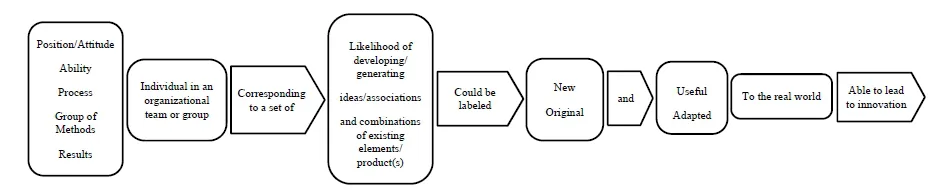
Figure 1.1. Definition of creativity in the form of a chignole (drill bit)
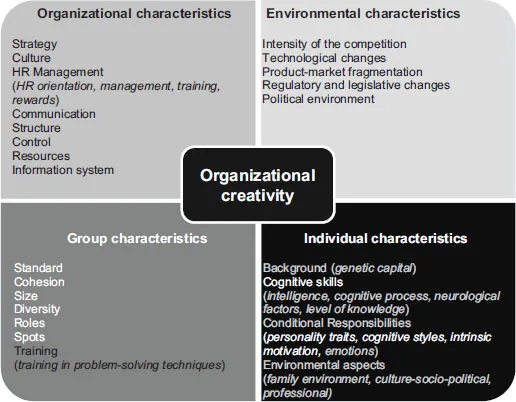
Figure 1.2. Multi-level model of organizational creativity [BAR 13]
Finally, the characteristics of novelty, originality, usefulness and adaptation to an innovation framework will be the subject of further processing throughout this book. As the title indicates, we will also address creativity when we can call it agile. We remember that we use the term agility here to describe an ability to change maneuvers in a very short time, i.e. agility in the sense of C.W. Richards [RIC 96]. The elements structuring the schema of the creativity hierarchy and the multi-level model of organizational creativity are therefore considered in a perspective of continuous movements, undergoing acceleration and other changes that a company must control as well as possible in order to remain able to adapt to new rules of the game. The idea of maneuver is then to be associated with a movement corresponding to a form of innovation.
1.2. The different forms of innovation
As in the case of creativity, there are many definitions that have been proposed for innovation. We will not dwell here on their variety, but we will simply retain a definition of innovation at the crossroads of the Schumpeterian interpretation and the Oslo Manual proposed by the OECD. This is primarily the adoption of the widely accepted definition of innovation in the Oslo Manual [OEC 05]:
The implementation of a new or significantly improved product (good or service), or process, a new marketing method, or a new organizational method in business practices, workplace organization or external relations. [OEC 05]
Then, it is necessary to add the fact that it is the entrepreneur who chooses what will be the subject of the innovation [SAL 86] which, from then on, until it becomes a success, can only be considered as an objective (of innovation) and not as an outcome (innovation). In the business world, this success has been characterized by J. Schumpeter as “economically viable” [SCH 34]. That being said, even though the economic dimension is not always predominant, we keep in mind that for innovation to occur, it is necessary for a minimum community of individuals to adopt it. To do this, there must be appropriation and translation of the novelty within a network of more or less important actors, of which the adopting individuals will be part, but will not be the only participants [LAT 05].
With regard to forms of innovation, we have already stated, on the basis of the Oslo Manual’s definition of innovation, that these could be product, service, process, method or organization innovation. However, innovation can also be viewed from a different perspective than one that focuses on the element that is the subject of the innovation and the environment that is supposed to adopt it. To this end, we will focus on product, service and method innovations when the method focuses on how to use or gain acceptance for the product or service. In this more limited context, we can consider several categories or forms of innovation.
1.2.1. Incremental innovation and radical innovation
Traditionally, when addressing the issue of product/service innovation, we begin by expressing the difference between continuous or incremental innovation and radical or disruptive innovation. Incremental innovation is simply a continuous series of improvements made as laboratory or field experiments, technological advances, societal changes, etc. continue. For example, changes in the design of a product or in the way it is offered to its audience are made in successive layers that can be anticipated in the short term. Within the framework of a product, after a certain number of improvements, all the products meeting the same need tend to be reduced and above all to be designed according to a small number, or even a single dominant design. This notion of dominant design was proposed by Abernathy and Utterback in the 1970s [UTT 75]. In this sense, a dominant design may include a series of characteristics dictated by the market-leading product, which thus create similar habits and expectations on the part of users and imitative effects on the part of competitors, but it may also result from practices specific to users for which the products tend to be better adapted or from standards imposed by a state or sector of activity [FER 17]. The term design includes the aesthetic as well as the technological or methodological characteristics of the product that may be affected by the dominant design. The products all end up looking the same (almost all cars consist of four wheels, a body, an engine, two front seats, one of which is for the driver, etc.); they can be grouped into broad product classes with identical characteristics (two-wheel, three-wheel, four-wheel scooters; open and closed scooters, etc.); the technologies and materials used to design them being the same, or can be classified among a small number of families; the methods used to produce them, present them (quartz watches, manual winding, automatic winding, hybrid winding, etc.) and sell them (online sales, shop sales, hybrid sales: click & collect, drive, etc.) are relatively identical.
Faced with these design routines, a dis...
Table of contents
- Cover
- Table of Contents
- Introduction
- 1 Creativity for Innovation
- 2 Recognizing and Questioning the Problem
- 3 Monitoring and the Intelligence Cycle
- 4 Visual Communication and Idea Management
- 5 Animating Teams to Stimulate Collective Creativity
- 6 Some Techniques to Stimulate and Aid Creativity
- 7 System Mapping and Analysis
- Conclusion
- Bibliography
- Index
- End User License Agreement
Trusted by 375,005 students
Access to over 1.5 million titles for a fair monthly price.
Study more efficiently using our study tools.
Frequently asked questions
Yes, you can cancel anytime from the Subscription tab in your account settings on the Perlego website. Your subscription will stay active until the end of your current billing period. Learn how to cancel your subscription
No, books cannot be downloaded as external files, such as PDFs, for use outside of Perlego. However, you can download books within the Perlego app for offline reading on mobile or tablet. Learn how to download books offline
Perlego offers two plans: Essential and Complete
- Essential is ideal for learners and professionals who enjoy exploring a wide range of subjects. Access the Essential Library with 800,000+ trusted titles and best-sellers across business, personal growth, and the humanities. Includes unlimited reading time and Standard Read Aloud voice.
- Complete: Perfect for advanced learners and researchers needing full, unrestricted access. Unlock 1.5M+ books across hundreds of subjects, including academic and specialized titles. The Complete Plan also includes advanced features like Premium Read Aloud and Research Assistant.
We are an online textbook subscription service, where you can get access to an entire online library for less than the price of a single book per month. With over 1.5 million books across 990+ topics, we’ve got you covered! Learn about our mission
Look out for the read-aloud symbol on your next book to see if you can listen to it. The read-aloud tool reads text aloud for you, highlighting the text as it is being read. You can pause it, speed it up and slow it down. Learn more about Read Aloud
Yes! You can use the Perlego app on both iOS and Android devices to read anytime, anywhere — even offline. Perfect for commutes or when you’re on the go.
Please note we cannot support devices running on iOS 13 and Android 7 or earlier. Learn more about using the app
Please note we cannot support devices running on iOS 13 and Android 7 or earlier. Learn more about using the app
Yes, you can access Information, Knowledge and Agile Creativity by Stéphane Goria,Pierre Humbert,Benoit Roussel in PDF and/or ePUB format, as well as other popular books in Business & Management. We have over 1.5 million books available in our catalogue for you to explore.