Modelling of flow in naturally fractured reservoirs is quickly becoming mandatory in all phases of oil and gas exploration and production. Creation of a Static Conceptual Fracture Model (SCFM) is needed as input to create flow simulations for today and for prediction of flow into the future. Unfortunately, the computer modelers tasked with constructing the gridded fracture model are often not well versed in natural fracture characterization and are often forced to make quick decisions as to the input required by the software used to create these models.
Static Conceptual Fracture Modelling: Preparing for Simulation and Development describes all the fracture and reservoir parameters needed to create the fracture database for effective modelling and how to generate the data and parameter distributions. The material covered in this volume highlights not only natural fracture system quantification and formatting, but also describes best practices for managing technical teams charged with creating the SCFM. This book will become a must on the shelf for all reservoir modelers.
The purpose of this manuscript is to provide a guide for the construction of a quantitative Static Conceptual Fracture Model (SCFM) from predominantly physical descriptive rock data, which along with a Dynamic Conceptual Model (DCFM) constructed from predominantly fluid and reservoir engineering data, can be used for reservoir flow simulation (concept from Trice 2000). These simulations constrain the current reservoir behavior, as well as predict how it will perform in the future.
This manuscript will discuss the various parameters that are needed to constrain the SCFM, and later, populate computer models used to generate gridded fracture models as input to simulation. The various parameters will be detailed along with techniques I have used to gather the needed data and populate the computer models. The parameters discussed are the same regardless of the simulation modeling style used or the computer programs used to house the data and make the needed reservoir calculations. In addition, I will comment on what to do and not do in technical planning when acquiring some of the needed data sets.
An important aspect of the modeling process is, in my mind, innovation. The rock and fracture data needed for the models can come from different sources and different scales of measurement. For example, constraining fracture corridor width in the subsurface can come from core, image logs and geophysical data. All three are measured at different scales and levels of precision, therefore, giving different values and accuracy. The important thing in the modeling is to make the measurement however you can with the data you have. The variation within the distribution of the measures is perhaps more important than the actual values, as values can be shifted in bulk during history matching to obtain credible results with respect to reservoir response. The guiding principle in my mind is innovation. Get the parameter distributions however you can with the data available.
Several of the topic areas described herein have previously been documented in the two editions of a previous textbook (Nelson 1985, 2001). However, this author is not a computer modeler. Rather, I have more than 40 years' experience studying fractured reservoirs and providing real‐time assistance to the experienced computer modelers during the process.
The computer modelers know very well the ins‐and‐outs of inputting the data and successfully getting appropriate results in the proper format. However, a team of multidisciplinary workers (geologists, geophysicists, engineers, petrophysicists, etc.) are needed to generate the basic fracture and reservoir data. This team is intimately familiar with the input data and knows its strengths and weaknesses which is especially important during history matching of simulation results. They, or their representative (a Fracture Champion), are the appropriate people to assist the computer modeling expert(s) in evaluating and selecting appropriate input of the natural fracture‐related data. An excellent example of the process is given in Richard et al. (2017).
What is presented here is a procedure for completion of a well‐constrained SCFM. Of course, individual reservoir studies may lack many of the data types needed for the complete model, especially early in the history of a project. In most studies, the SCFM generation occurs in steps over time. We move from early model descriptions with little hard data to later models with richer data bases to draw from, therefore, leading to a better constrained model with lower associated risk.
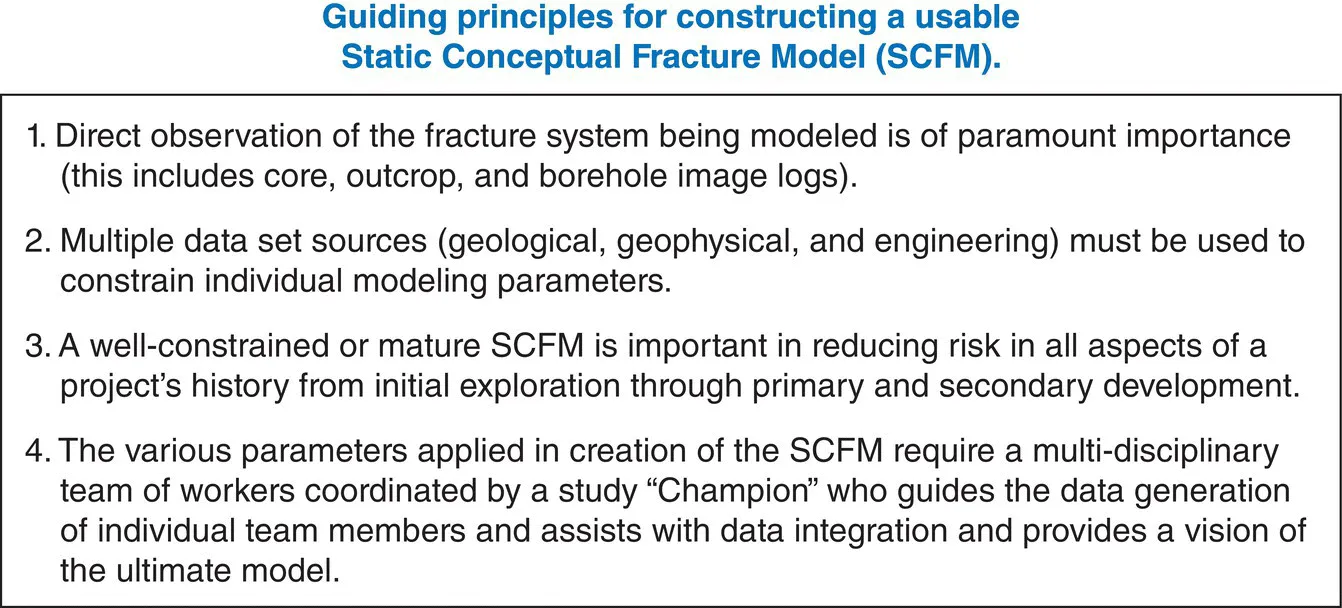
The procedure detailed in this book has been created using several guiding principles. These include the following in Figure 1.1.
Figure 1.1 A compiled list of guiding principles for constructing a usable Static Conceptual Fracture Model (SCFM).
2 What Is a Static Conceptual Fracture Model and Why Do We Build It?
Current practices in the numerical simulation of fractured reservoirs rely on the creation of both static and dynamic conceptual models to construct an integrated reservoir model to be simulated. The Static Conceptual Fracture Model (SCFM) focuses on the physical description of the fracture system present and how it varies throughout the reservoir; while the Dynamic Conceptual Fracture Model (DCFM) focuses on the reservoir fluid properties and the fluid‐flow characteristics of the fractures and matrix and their variation in 3D. The first usage of the terms or model sub‐types that I know of is from Robert Trice in 2000 at an SPE Research Forum on Naturally Fractured Reservoirs in Nice, France, Figure 2.1. These conceptual models are an elemental volume representation of the reservoir representing the entire reservoir with all its variability; Davy et al. (2018), Richard et al. (2017).
Figure 2.1 Depicted is a schematic of how static and dynamic fracture data are generated and combined to form the final simulation model; after Trice (2000), SPE Research Forum, Nice, France. This was a very early introduction to the idea of parallel Static Conceptual Fracture Model (SCFM) and Dynamic Conceptual Fracture Model (DCFM) creation that are merged into the final product for simulation.
There is great variation in how SCFMs are created due to data limitations and scales of observation. Ideally, the model includes a quantitative description of all elements of the fracture system and their variation in 3D.
In my studies, I developed an organized series of steps I use to create an SCFM.
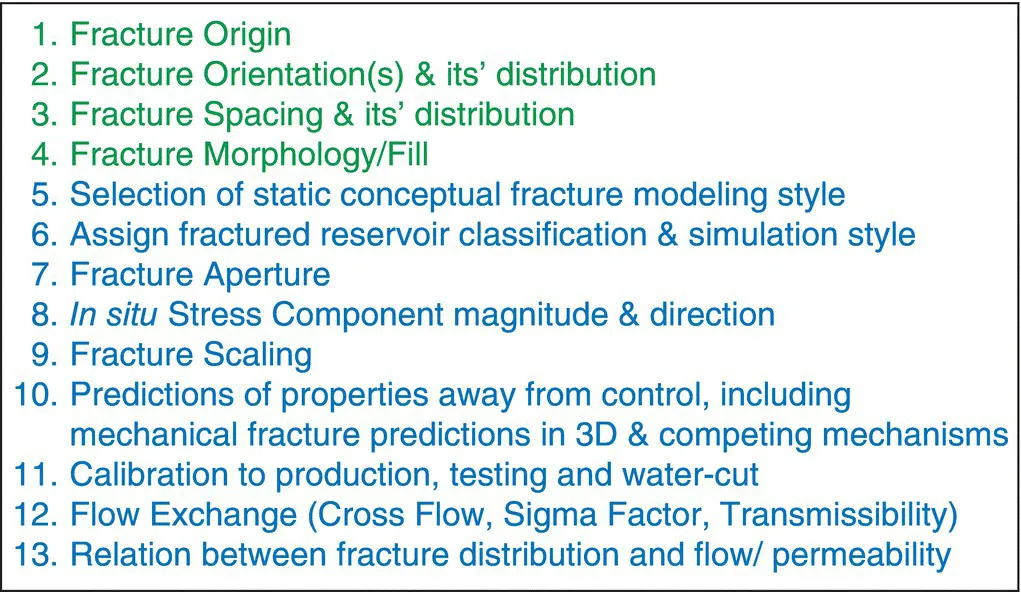
To complete the process for the creation of the SCFM, there are 13 major topic areas that must be constrained in the reservoir, Figure 2.2. This list highlights major study areas, each of which may contain multiple data sets, analysis techniques and computer applications. A similar list can be constructed for creation of a DCFM, but that is not included in this volume.
Figure 2.2 The 13 key topic areas needed to fully constrain an effective SCFM. The topic areas highlighted in green are typical for most standard fractured reservoir studies. The topic areas highlighted in blue are the additional topic areas needed for an effective quantitative fracture model.
Source: from Nelson (2011b).
Highlighted in green in Figure 2.2 (first four parameters) are the standard approaches performed in a typical qualitative fractured reservoir study with focus on...
Table of contents
Cover
Table of Contents
Foreword
Acknowledgments
1 Purpose and Scope
2 What Is a Static Conceptual Fracture Model and Why Do We Build It?
3 Fracture Model Creation Workflow
4 Gathering Natural Fracture Orientation and Intensity Data Directly
5 Gathering Natural Fracture Orientation and Intensity Data Indirectly
6 Analyzing the Natural Fracture Data Once Gathered
7 Gathering and Analyzing Structural Data
8 Gathering Constraints on Fracture Aperture
9 Creation of Natural Fracture Scaling Laws
10 Gathering and Analyzing Mechanical Property Distribution Data
11 Locating Fracture Corridors
12 Rock Anisotropy and its Importance in Determining Dominant‐Fracture Orientation and Relative Intensity
13 Determine the In‐situ Stress Directions and Magnitudes and their Variation
14 Production Calibration
15 Determining the Fractured Reservoir Classification and, Therefore, Which Simulation Style Is Most Appropriate
16 Use of Reservoir Analogs
17 The Importance of 3D Visualization in Data Integration and Static Fracture Model Creation
18 Thoughts on History Matching of Simulation Results
19 Preparing the Fracture Data for Input to the Gridded Model
20 Discussion of Error and Uncertainty in the Modeling Process
Appendix B: How we Use Various Seismic Attributes to Predict Natural Fracture Intensity in the Subsurface, After Nelson (2006)
Appendix C: How I Learned to Interpret Natural Fractures in Core
Symbols and Abbreviations
References
Index
End User License Agreement
Trusted by 375,005 students
Access to over 1.5 million titles for a fair monthly price.
Study more efficiently using our study tools.
Frequently asked questions
Yes, you can cancel anytime from the Subscription tab in your account settings on the Perlego website. Your subscription will stay active until the end of your current billing period. Learn how to cancel your subscription
No, books cannot be downloaded as external files, such as PDFs, for use outside of Perlego. However, you can download books within the Perlego app for offline reading on mobile or tablet. Learn how to download books offline
Perlego offers two plans: Essential and Complete
Essential is ideal for learners and professionals who enjoy exploring a wide range of subjects. Access the Essential Library with 800,000+ trusted titles and best-sellers across business, personal growth, and the humanities. Includes unlimited reading time and Standard Read Aloud voice.
Complete: Perfect for advanced learners and researchers needing full, unrestricted access. Unlock 1.5M+ books across hundreds of subjects, including academic and specialized titles. The Complete Plan also includes advanced features like Premium Read Aloud and Research Assistant.
Both plans are available with monthly, semester, or annual billing cycles.
We are an online textbook subscription service, where you can get access to an entire online library for less than the price of a single book per month. With over 1.5 million books across 990+ topics, we’ve got you covered! Learn about our mission
Look out for the read-aloud symbol on your next book to see if you can listen to it. The read-aloud tool reads text aloud for you, highlighting the text as it is being read. You can pause it, speed it up and slow it down. Learn more about Read Aloud
Yes! You can use the Perlego app on both iOS and Android devices to read anytime, anywhere — even offline. Perfect for commutes or when you’re on the go. Please note we cannot support devices running on iOS 13 and Android 7 or earlier. Learn more about using the app
Yes, you can access Static Conceptual Fracture Modeling by Ronald A. Nelson in PDF and/or ePUB format, as well as other popular books in Physical Sciences & Geology & Earth Sciences. We have over 1.5 million books available in our catalogue for you to explore.