Hydraulic fracturing (or "fracking") has been a source of both achievement and controversy for years, and it continues to be a hot-button issue all over the world. It has made the United States an energy exporting country once again and kept the price of gasoline low, for consumers and companies. On the other hand, it has been potentially a dangerous and destructive practice that has led to environmental problems and health issues. It is a deeply important subject for the petroleum engineer to explore as much as possible.
This collection of papers is the first in the series, Sustainable Energy Engineering, tackling this very complex process of hydraulic fracturing and its environmental and economic ramifications. Born out of the journal by the same name, formerly published by Scrivener Publishing, most of the articles in this volume have been updated, and there are some new additions, as well, to keep the engineer abreast of any updates and new methods in the industry.
Truly a snapshot of the state-of-the-art, this groundbreaking volume is a must-have for any petroleum engineer working in the field, environmental engineers, petroleum engineering students, and any other engineer or scientist working with hydraulic fracturing.
*Adopted from Aminzadeh, F., 2018, Hydraulic Fracturing, An Overview, Journal of Sustainable Energy Engineering, Vol. 6, Issue 4, pp. 204–228.
Abstract
This article provides an overview of the state of the art in hydraulic fracturing, a controversial topic of the last decade. To Frack or not to Frack, That is the Question; was posed at a meeting of the Western Regional Society of Petroleum Engineers. The fact is, we have witnessed an intense debate over hydraulic fracturing’s economic benefits and the role it has played in securing energy independence, and its ill effects (perceived or real) during the past decade. Many, in particular those in the fossil energy industry, consider shale oil/gas, with the associated horizontal drilling and hydraulic fracturing, as one of the major developments in the oil and gas industry of the past two decades. Others, especially many environmentalists, consider fracking proponents as public enemy number one.
Different sections of this entry attempt to highlight different scientific facts about hydraulic fracturing, the common-sense environmental concerns, and the respective economic ramifications. After a brief overview of the principles of hydraulic fracturing in section “What Is Hydraulic Fracturing?”, we discuss the importance of hydraulic fracturing in section “Why Hydraulic Fracturing Is Important.” This is followed by fracture characterization (section “Fracture Characterization”) and geomechanics (section “Geomechanics of Hydraulic Fracturing”). They examine the natural fractures in the subsurface and how one can characterize them, how hydraulic fracturing helps to expand the natural fractures and/or create new (stimulated) fractures as well as the underlining rock mechanics properties and the related stress regime.
Section “Environmental Aspects of Hydraulic Fracturing” addresses different environmental concerns about hydraulic fracturing. This includes the potential ground water contamination, amount of water used for hydraulic fracturing the water disposal process, and methane emission concerns. Another environmental concern is the risk of induced seismicity or man-made earthquakes. Given the publicized controversy on whether and to what extent hydraulic fracturing creates induced seismicity section “Induced Seismicity” is dedicated to deal with this issue. The key message of this article is the best way to answer the question with which we began, namely to frack or not to frack, lies with science; the hope is, with sound scientific and engineering investigation, truth will prevail - “veritas omnia vincit.”
Keywords: Hydraulic fracturing (HF), shale resources, energy resources, micro-seismic data, economic factors, environmental impact of HF, fracture characterization, geomechanics, induced seismicity, ground water contamination, stress field
1.1 What is Hydraulic Fracturing?
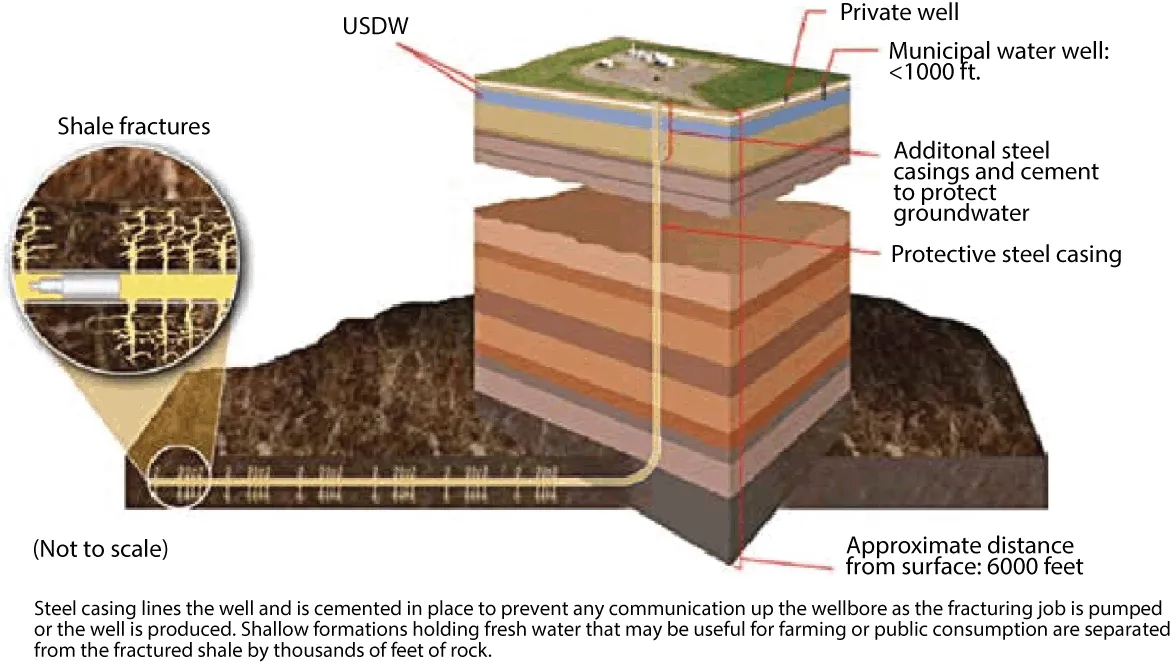
Hydraulic fracturing (HF) is an oil and gas operation used to recover hydrocarbon resources that are trapped in low-permeability shale and other lithologies. Over geologic time periods, these resources were formed by the maturation of kerogen, the organic precursor of petroleum. However, unlike conventional oil and gas where hydrocarbons migrate into the reservoir from a separate source, the hydrocarbon source and reservoir rock share low permeability, forming an unconventional system. While there are significant volumes of hydrocarbon trapped in unconventional reservoirs, the extremely low natural permeability of the formations impedes commercial production using conventional techniques. HF is a process that involves injection of large volumes of water (several million gallons), sand, and small volumes of chemical additives to increase oil or natural gas flow from low permeability formations. The large pressure associated with injection of “fracturing fluid” creates new fractures and extends existing fractures that enhance hydrocarbon flow, while sand mixed with injected fluid holds the new and existing fractures open. Some of the injected fluid flows back to the wellbore and is pumped to the surface, or is injected back to the reservoir. Figure 1.1 is an example of a typical HF configuration.
Figure 1.1 An example of a typical HF configuration [1].
HF is usually performed on horizontal or directional wells, oftentimes with the well azimuth being perpendicular to the direction of maximum horizontal in situ stress. Figure 1.1 shows a schematic display of the horizontal well and the enlarged shale fractures are shown in the bottom left part of Figure 1.1 display of the horizontal well and the enlarged shale fractures are shown in the top right with the multistage (3 stages) fracturing.
Although HF has been used since the 1950s, over the last decade it has been the subject of intense public debate. Some of the concern has been over its potential impacts on drinking water, the potential for emission of gas, and the associated induced seismicity or manmade earthquakes. For more on various aspects of HF debate and its benefits and drawbacks, see HF 101 [2], California Council on Science and Technology (CCST) report on well stimulation [3], and HF in Colorado [4].
1.2 Why Hydraulic Fracturing is Important
HF and horizontal drilling have played a key role in making shale a significant part of the fossil energy resources globally, especially in the United States (US). According to the US Energy Information Administration [5], 95% of new US wells drilled in 2016 were hydraulically fractured. This accounts for two-thirds of total US natural gas production half of US crude oil production. While shale oil and gas has contributed substantially to US reserves and greatly impacted US oil production (increasing by about 3.2 million barrels/day), it is sobering to note that its contribution to global reserves is rather modest. US reserves of shale oil amount to 40 billion barrels, an amount comparable to the annual global consumption of oil [6]. Thus, the availability of this resource does end the dominance of conventional oil as the primary source of global energy, and it limits the political and economic leverage major oil producing countries have enjoyed in the past.
It should be noted that since 2015, due to lower oil and gas prices, we have seen a noticeable decline in shale related activities, from exploration to drilling and production. According to the Baker Hughes rig count data, at peak in March 2015 there were 1900 active oil rigs operating in the various US basins [7]. Following the price collapse, the rig count dropped to about 400 in June 2016 and then began climbing again in response to higher oil prices. As of early 2018 the number of oil rigs stood at about 1000. The relative speed with which these operations can be turned on and off has a profound influence on the ability of oil producers to raise oil prices by limiting their own production.
The increased production of shale oil in the USA has made it easier for the world oil market to withstand several incidents when production and export from certain countries was halted from war or other political upheavals [8].
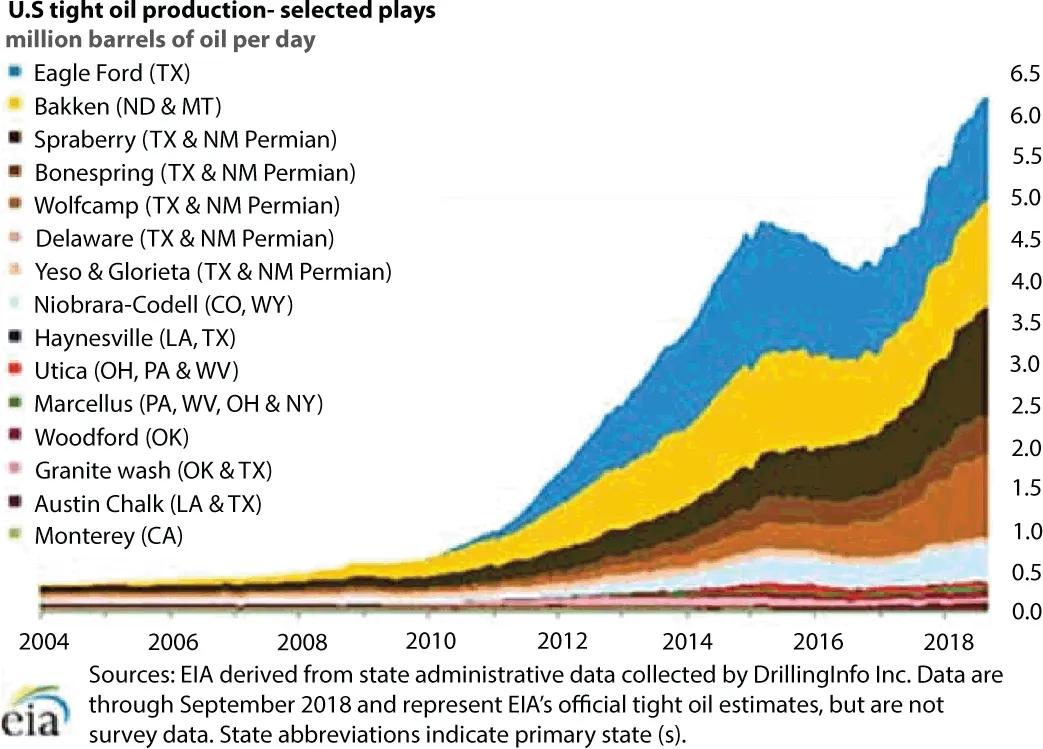
Producing shale oil can cost upwards of $60/ barrel. Prior to 2006 oil pricing hovered around $40/barrel, making HF cost prohibitive. Subsequently, largely in response to increasing global demand, the oil price rose to above $100/barrel (with some spikes as high as $140/barrel). At these higher prices, shale oil production by HF was profitable and it spurred drilling activities in many US basins. The profitability can vary significantly from one play to the next. Figure 1.2 shows an earlier peak for shale production for different US plays that arrived in 2015, after which it dipped through 2017, with the rate of decline being an indication of the price sensitivities in different plays. Since 2017, production increased in all plays.
Figure 1.2 The explosion of shale production since 2010 [5].
Modern HF combined with horizontal drilling allows multiple wells to be drilled from one surface location, reducing the size of the drilling area above ground by as much as 90%. Fracking is the key to unlocking vast US shale resources, freeing up oil and natural gas that previously was inaccessible while protecting groundwater supplies and the environment. America’s shale energy revolution began with extensive US government agencies and contractors (e.g., Department of Energy, DOE; Gas Technology Institute, GTI). This was further accelerated by privately financed efforts (e.g., oil and gas operators and service companies). In both cases, the primary driver was new technology.
The notion of fracturing rocks to improve permeability is an old one. Based on an idea proposed by Floyd Farris of Stanolind Oil and Gas Corporation (later, Amoco and then BP), attempts at producing oil in tight formations were made by using mixtures of naphthenic acid and palm oil (napalm). The process, “Hydrafrac,” was patented in 1949 and licensed to Haliburton.
The Devonian shale basins of the Western Appalachian, Michigan, and Illinois Basins were known to contain vast quantities of gas, but the low permeability of the rock limited production from this resource. The declining US reserves of natural gas prompted the DOE and the GTI to sponsor research and development efforts for technologies for assessing and producing gas from this resource. These efforts led to techniques such as the slick-water fracture, horizontal drilling, and microseismic technology for characterizing and exploiting these resources. This included several DOE supported demonstration projects in Ohio, Texas, and New Mexico to validate these technologies (API 2018) [9].
The development of commercial fracking is largely due to the efforts of Mitchell Energy, who drew on the government-funded work, and despite numerous setbacks persisted for decades in improving the technologies and driving down their costs. Of course, the rise in the cost of crude oil in 2008 helped in the process. Once hydraulic fracking became economically feasible, it was widely deployed by many companies, and experiential learning drove down the costs. Unleashing natural gas from shale resulted in a sharp decline of its cost from about $15/Mbtu in 2008 to around $3/Mbtu in 2014. About one third of the natural gas is used for producing hydrogen, which in turn is used industrially to refine fuels or produce fertilizers. The large availability of natural gas at relatively low cost has allowed US refineries to increase their output and increase exports of finished products.
While those against HF may argue otherwise, the industry proponents maintain shale gas has also had a positive environmental impact. Since natural gas ...
Table of contents
Cover
Title Page
Copyright
Foreword
Part 1: Introduction
Part 2: General Concepts
Part 3: Optimum Design Parameters
Part 4: Fracture Reservoir Characterization
Part 5: Environmental Issues of Hydraulic Fracturing
Index
End User License Agreement
Trusted by 375,005 students
Access to over 1.5 million titles for a fair monthly price.
Study more efficiently using our study tools.
Frequently asked questions
Yes, you can cancel anytime from the Subscription tab in your account settings on the Perlego website. Your subscription will stay active until the end of your current billing period. Learn how to cancel your subscription
No, books cannot be downloaded as external files, such as PDFs, for use outside of Perlego. However, you can download books within the Perlego app for offline reading on mobile or tablet. Learn how to download books offline
Perlego offers two plans: Essential and Complete
Essential is ideal for learners and professionals who enjoy exploring a wide range of subjects. Access the Essential Library with 800,000+ trusted titles and best-sellers across business, personal growth, and the humanities. Includes unlimited reading time and Standard Read Aloud voice.
Complete: Perfect for advanced learners and researchers needing full, unrestricted access. Unlock 1.5M+ books across hundreds of subjects, including academic and specialized titles. The Complete Plan also includes advanced features like Premium Read Aloud and Research Assistant.
Both plans are available with monthly, semester, or annual billing cycles.
We are an online textbook subscription service, where you can get access to an entire online library for less than the price of a single book per month. With over 1.5 million books across 990+ topics, we’ve got you covered! Learn about our mission
Look out for the read-aloud symbol on your next book to see if you can listen to it. The read-aloud tool reads text aloud for you, highlighting the text as it is being read. You can pause it, speed it up and slow it down. Learn more about Read Aloud
Yes! You can use the Perlego app on both iOS and Android devices to read anytime, anywhere — even offline. Perfect for commutes or when you’re on the go. Please note we cannot support devices running on iOS 13 and Android 7 or earlier. Learn more about using the app
Yes, you can access Hydraulic Fracturing and Well Stimulation, Volume 1 by Fred Aminzadeh in PDF and/or ePUB format, as well as other popular books in Physical Sciences & Energy. We have over 1.5 million books available in our catalogue for you to explore.