More Incidents that Define Process Safety book describes over 50 incidents which have had a significant impact on the chemical industry as well as the basic elements of process safety. Each incident is presented in sufficient detail to gain an understanding of root causes for the event with a focus on lessons learned and the impact the incident had on process safety. Incidents are grouped by incident type including Reactive chemical; Fires; Explosions; Environmental/toxic releases; and Transportation incidents. The book also covers incidents from other industries that illustrate the safety management elements.
The book builds on the first volume and adds incidents from China, India, Italy and Japan. Further at the time the first volume was being written, CCPS was developing a new generation of process safety management elements that were presented as risk based process safety; these elements are addressed in the incidents covered.
Incidents that Define Process Safety (IDPS) (CCPS 2008) is one of the most popular books in the CCPS collection. Clearly, there is a desire to learn from incidents in the process safety community. So, what makes a second volume necessary?
First, the international growth of the chemical and petrochemical industries, especially in Asia. Incidents from around the world are included in both of these books. This second volume includes incidents from China, India, Japan, United Kingdom, and the United States.
Second, the passage of more than ten years has created a new audience less versed in the historical record. If you go into a chemical engineering classroom today and ask, “How many people here have heard of Bhopal?” almost no one will raise their hand. Yet Bhopal was the worst industrial accident in history.
Third, and most troubling; incidents keep happening. Some of the same types of incidents are being repeated. It is hoped that by continuing to make people aware of these incidents and creating an opportunity to learn from them, that people will take actions to prevent their recurrence.
At the time Incidents that Define Process Safety was being written, CCPS was developing a new generation of process safety management elements that were presented in the book Guidelines for Risk Based Process Safety (RBPS) (CCPS 2007). The incident descriptions in this book will identify management system failures aligned with the RBPS elements.
1.2 CCPS RISK BASED PROCESS SAFETY ELEMENTS
Elements of process safety management (PSM) were encoded in documents such as Guidelines for Implementing Process Safety Management Systems (CCPS 1994) and in regulations including the United States OSHA’s Process Safety Management of Highly Hazardous Chemicals regulation (OSHA 1992). Both of these documents are credited with improving process safety.
In the mid-2000s, CCPS developed and published Guidelines for Risk Based Process Safety (RBPS) (CCPS 2007) to move to the next generation of process safety management. RBPS recognizes that not all hazards are equal and emphasizes that the resources devoted to PSM should be appropriate to the hazards and risks of a given operation, in addition to meeting regulations and codes. RBPS also added several elements to the management of process safety.
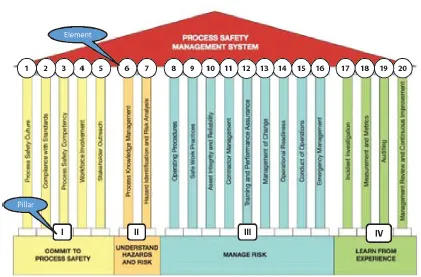
There are twenty elements of RBPS, divided into four “pillars”:
Pillar I. Commit to Process Safety
Pillar II. Understand Hazards and Risk
Pillar III. Manage Risk
Pillar IV. Learn from Experience.
The pillars and elements of the CCPS RBPS framework are shown in Figure 1.2-1. These pillar and element numbers will be referred to, as needed, during the incident discussions.
Figure 1.2-1Risk Based Process Safety (RBPS) approach
1.2.1 Pillar I - Commit to Process Safety
This is the cornerstone of process safety excellence. Organizations generally do not improve without strong leadership and solid commitment. The entire organization must make the same commitment. The five elements in this pillar are:
1. Process Safety Culture.
Process safety culture is a commonly held set of values, norms, and beliefs. It can be stated as “How we do things around here,” “What do we expect here,” and “How we behave when no one is watching.”
2. Compliance with Standards.
Compliance with standards requires identifying, developing, and implementing standards. Standards should be developed for both new construction and existing equipment. These can be internal and external standards, national and international codes and standards, and local jurisdiction regulations and laws.
3. Process Safety Competency.
Process safety competency requires creating, developing, and maintaining process safety knowledge; continuously improving that knowledge and competency; ensuring that appropriate process safety information is available to people who need it; and consistently applying that knowledge.
4. Workforce Involvement.
Workforce involvement is active participation of company and contractor workers in the design, development, implementation, and continuous improvement of process safety in the workplace.
5. Stakeholder Outreach.
Stakeholder outreach strives to make relevant process safety information available to a variety of organizations, including the neighboring community, local emergency responders, and other companies in the industry.
1.2.2 Pillar II - Understand Hazards and Risk
Organizations that understand their hazards and risks are better able to allocate resources in the most effective manner to manage those risks. The two elements in this pillar are:
6. Process Knowledge Management.
Process knowledge management involves activities associated with compiling, cataloging, and making process safety information (PSI) available. It also includes understanding the information, not simply compiling data.
7. Hazard Identification and Risk Analysis (HIRA).
HIRA encompasses all activities involved in identifying hazards and evaluating risks at facilities, throughout their life cycle, to make certain that risks to employees, the public, and the environment are managed within the organization’s risk tolerance.
1.2.3 Pillar III - Manage Risk
The “Manage Risk” pillar focuses on three issues: safely operating and maintaining processes that pose the risk, managing changes to those processes to ensure that the risk remains tolerable, and preparing for, responding to, and managing incidents that do occur. The nine elements in this pillar are;
8. Operating Procedures.
Operating Procedures requires written instructions for all phases of operation, including routine, non-routine, and emergency. Good procedures also describe the process, hazards, tools, protective equipment, and controls in sufficient detail so that operators understand the hazards, can verify that controls are in place, and can confirm that the process responds in an expected manner.
9. Safe Work Practices (SWP).
SWP covers non-routine work and is often supplemented with permits. These fill the gap between operating and maintenance procedures and the hazards and risks specific to the work being conducted at the time.
10. Asset Integrity and Reliability.
Asset integrity and reliability is the systematic implementation of inspections, tests, and maintenance to ensure that equipment and safety-critical devices will be functional for their intended application throughout their life.
11. Contractor Management.
Contractor management is a system of controls to ensure that contracted services support both safe facility operations and the company’s process safety and personal safety performance goals. This element includes the selection, acquisition, use, and monitoring of such contracted services.
12. Training and Performance Assurance.
Training and performance assurance involves practical instruction ...
Table of contents
Cover
Title Page
Copyright
More Incidents that Define Process Safety
ACRONYMS AND ABBREVIATIONS
GLOSSARY
ACKNOWLEDGMENTS
PREFACE
Foreword
1 Introduction
2 Reactive Chemical Incidents
3 Fire Incidents
4 Explosion Incidents
5 Environmental and Toxic Release Incidents
6 Transportation Incidents
7 Non-Oil/Chemical Incidents
Appendix 1 Matrix relating incidents, industries, and RBPS elements
References
INDEX
End User License Agreement
Trusted by 375,005 students
Access to over 1.5 million titles for a fair monthly price.
Study more efficiently using our study tools.
Frequently asked questions
Yes, you can cancel anytime from the Subscription tab in your account settings on the Perlego website. Your subscription will stay active until the end of your current billing period. Learn how to cancel your subscription
No, books cannot be downloaded as external files, such as PDFs, for use outside of Perlego. However, you can download books within the Perlego app for offline reading on mobile or tablet. Learn how to download books offline
Perlego offers two plans: Essential and Complete
Essential is ideal for learners and professionals who enjoy exploring a wide range of subjects. Access the Essential Library with 800,000+ trusted titles and best-sellers across business, personal growth, and the humanities. Includes unlimited reading time and Standard Read Aloud voice.
Complete: Perfect for advanced learners and researchers needing full, unrestricted access. Unlock 1.5M+ books across hundreds of subjects, including academic and specialized titles. The Complete Plan also includes advanced features like Premium Read Aloud and Research Assistant.
Both plans are available with monthly, semester, or annual billing cycles.
We are an online textbook subscription service, where you can get access to an entire online library for less than the price of a single book per month. With over 1.5 million books across 990+ topics, we’ve got you covered! Learn about our mission
Look out for the read-aloud symbol on your next book to see if you can listen to it. The read-aloud tool reads text aloud for you, highlighting the text as it is being read. You can pause it, speed it up and slow it down. Learn more about Read Aloud
Yes! You can use the Perlego app on both iOS and Android devices to read anytime, anywhere — even offline. Perfect for commutes or when you’re on the go. Please note we cannot support devices running on iOS 13 and Android 7 or earlier. Learn more about using the app
Yes, you can access More Incidents That Define Process Safety by in PDF and/or ePUB format, as well as other popular books in Technology & Engineering & Industrial Health & Safety. We have over 1.5 million books available in our catalogue for you to explore.