A guide to the technical and calculation problems of chemical reactor analysis, scale-up, catalytic and biochemical reactor design
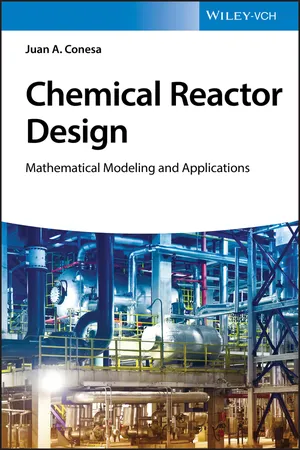
Chemical Reactor Design offers a guide to the myriad aspects of reactor design including the use of numerical methods for solving engineering problems. The author - a noted expert on the topic - explores the use of transfer functions to study residence time distributions, convolution and deconvolution curves for reactor characterization, forced-unsteady-state-operation, scale-up of chemical reactors, industrial catalysis, design of multiphasic reactors, biochemical reactors design, as well as the design of multiphase gas-liquid-solid reactors.
Chemical Reactor Design contains several examples of calculations and it gives special emphasis on the numerical solutions of differential equations by using the finite differences approximation, which offers the background information for understanding other more complex methods. The book is designed for the chemical engineering academic community and includes case studies on mathematical modeling by using of MatLab software. This important book:
- Offers an up-to-date insight into the most important developments in the field of chemical, catalytic, and biochemical reactor engineering
- Contains new aspects such as the use of numerical methods for solving engineering problems, transfer functions to study residence time distributions, and more
- Includes illustrative case studies on MatLab approach, with emphasis on numerical solution of differential equations using the finite differences approximation
Written for chemical engineers, mechanical engineers, chemists in industry, complex chemists, bioengineers, and process engineers, Chemical Reactor Design addresses the technical and calculation problems of chemical reactor analysis, scale-up, as well as catalytic and biochemical reactor design.
- English
- ePUB (mobile friendly)
- Available on iOS & Android
eBook - ePub
About this book
Information
Part I
Reactor Analysis, Design, and Scale‐up
1
Nonideal Flow
1.1 Introduction
Basic chemical reactors (plug flow reactor or PFR, andcontinuously stirred tank reactor or CSTR) are studied considering their behavior is that of an ideal reactor. Unfortunately, in practice, we often find behaviors that are far from that considered ideal. Consequently, working with them, the chemical engineer must be able to handle and diagnose the behavior of these reactors. At the time of describing the nonideal behavior of a reactor, three concepts are introduced: the residence time distributions (RTDs), the quality of the mixture (not discussed in this book), and the models that can be used to describe the reactor. These three concepts are used to describe the deviations of the mixing assumed in the ideal models and are considered as attributes of the mixture in nonideal reactors.
One way of approaching the study of nonideal reactors is to consider them, in a first approximation, as if the flow model were the one corresponding to a CSTR or a PFR. However, in real reactors, the nonideal flow model implies a minor conversion, so a method that allows for this conversion loss to be considered must be available. Therefore, a higher level of approximation implies the use of information about the RTD.
1.2 Residence Time Distribution (RTD) Function
The idea of introducing the RTD in the analysis of the behavior of reactors occurred thanks to MacMullin and Weber (in 1935), although it was Danckwerts (later, in 1953) who structured this analysis and defined most of the distributions of interest.
In an ideal PFR, all the particles (or units) of material that leave the reactor have remained in it the same time. Analogously, in an ideal (well‐mixed) batch reactor, all part...
Table of contents
- Cover
- Table of Contents
- Preface
- Nomenclature
- Part I: Reactor Analysis, Design, and Scale‐up
- Part II: Catalytic, Multiphase and Biochemical Reactor Design
- Index
- End User License Agreement
Trusted by 375,005 students
Access to over 1.5 million titles for a fair monthly price.
Study more efficiently using our study tools.
Frequently asked questions
Yes, you can cancel anytime from the Subscription tab in your account settings on the Perlego website. Your subscription will stay active until the end of your current billing period. Learn how to cancel your subscription
No, books cannot be downloaded as external files, such as PDFs, for use outside of Perlego. However, you can download books within the Perlego app for offline reading on mobile or tablet. Learn how to download books offline
Perlego offers two plans: Essential and Complete
- Essential is ideal for learners and professionals who enjoy exploring a wide range of subjects. Access the Essential Library with 800,000+ trusted titles and best-sellers across business, personal growth, and the humanities. Includes unlimited reading time and Standard Read Aloud voice.
- Complete: Perfect for advanced learners and researchers needing full, unrestricted access. Unlock 1.5M+ books across hundreds of subjects, including academic and specialized titles. The Complete Plan also includes advanced features like Premium Read Aloud and Research Assistant.
We are an online textbook subscription service, where you can get access to an entire online library for less than the price of a single book per month. With over 1.5 million books across 990+ topics, we’ve got you covered! Learn about our mission
Look out for the read-aloud symbol on your next book to see if you can listen to it. The read-aloud tool reads text aloud for you, highlighting the text as it is being read. You can pause it, speed it up and slow it down. Learn more about Read Aloud
Yes! You can use the Perlego app on both iOS and Android devices to read anytime, anywhere — even offline. Perfect for commutes or when you’re on the go.
Please note we cannot support devices running on iOS 13 and Android 7 or earlier. Learn more about using the app
Please note we cannot support devices running on iOS 13 and Android 7 or earlier. Learn more about using the app
Yes, you can access Chemical Reactor Design by Juan A. Conesa in PDF and/or ePUB format, as well as other popular books in Physical Sciences & Industrial & Technical Chemistry. We have over 1.5 million books available in our catalogue for you to explore.