Economic growth and rising levels of consumption in developing and developed countries has been observed as being deeply coupled with natural resource usage and material consumption. The increasing need for natural resources has raised concerns regarding issues such as resource scarcity, undesirable environmental impacts due to material extraction, primary production, and suboptimal product disposal, and social or political tensions. Product End-of-Life (EoL) options, such as reusing or recycling, attempt to limit or reduce the amount of waste sent to a landfill, providing strategic means to decouple the link between economic growth and resource usage. These EoL options have the potential to close material loops, further utilizing wastes as resources, reducing environmental impacts, conserving natural resources, reducing material prices, and providing job opportunities in developing countries.
Remanufacturing, on the other hand, is a unique EoL option due to increasing the number of life cycles of a product before final disposal. First, recurring environmental benefits, such as emission and raw material extraction avoidance are obtained with each additional product life cycle. Second, individual resource efficiency yields increase through product remanufacture. Resource efficiency or, using more with less will continue to compound with each additional life cycle. Third, recirculating products decreases the demand and dependency for primary resource production, further closing the material loop and creating a more circular economy. In addition, remanufacturing can initiate more preferable EoL options such as recovery, recycling, and waste reduction.
While remanufacturing offers numerous benefits, there is significant lack of literature and books covering the fundamentals of operations, technologies and business models. The proposed book will provide in-depth coverage of remanufacturing fundamentals and its strong link to circular economy and resource efficiency.
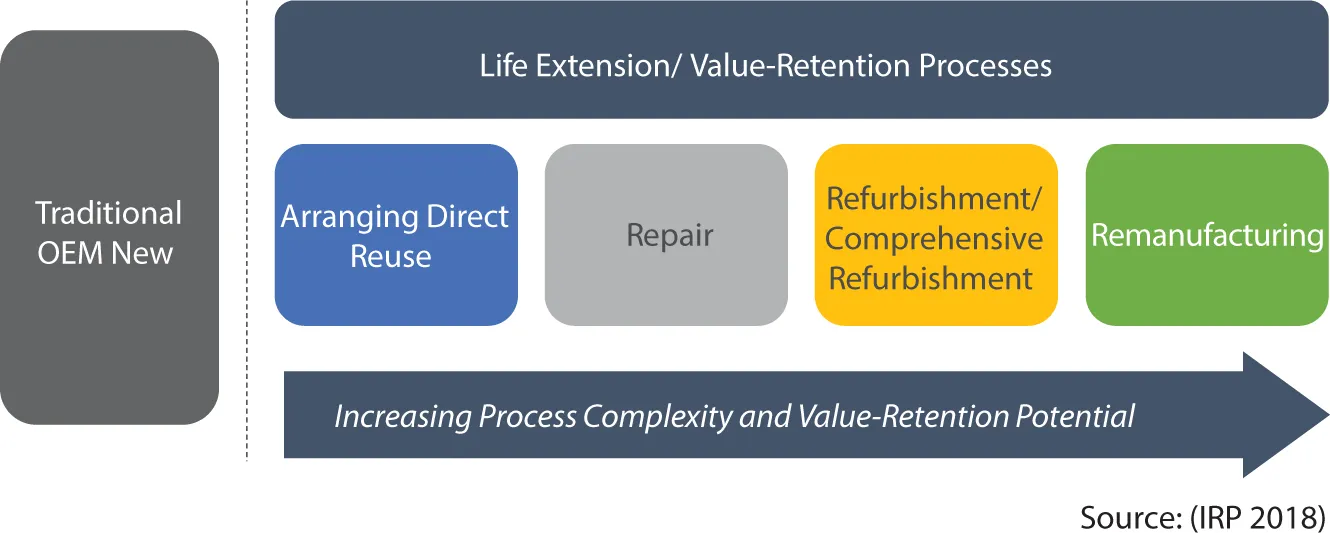
The circular economy offers a framework for transforming wasteful and inefficient linear systems into cascading systems that retain the inherent value of products, reduce negative externalities, and improve resource-efficiency. The cycling of technical nutrients within a circular economy can be achieved through product value-retention processes (VRPs) that include direct reuse, repair, refurbishment, and remanufacturing. Product case studies reveal that VRPs offer differing degrees of process and resource-use intensity, and as such, each contributes different economic and environmental benefits and circularity. Value-retention and impact metrics, measured relative to new product options, include new material use (kg/unit), energy use (MJ), emissions (kg CO2-eq.), production waste (kg/unit), cost advantage (% $USD/unit), and employment opportunity (Full-time Laborer/unit or FTE/unit). When compared to a traditional new product, all VRPs create significant resource efficiency and circularity opportunities. When compared to other VRPs, Partial Service-Life VRPs (direct reuse and repair) require significantly fewer resources, and thus result in relatively lower environmental and economic costs than Full Service Life VRPs (refurbishment and remanufacturing); However, more intensive Full Service Life VRPs ensure relatively greater utility, service-life, and value for the customer. Because of these differences, VRPs may be adopted strategically to pursue a range of business and policy objectives.
The full potential value of the circular economy goes beyond the recycling of materials in their raw form; in the circular economy, value is ultimately embedded in our ability to retain the embodied and inherent value of product material, structural form, and ultimate function. Capturing, preserving, and re-employing this value not only offsets virgin material requirements, but also reduces required production activities and instills new value altogether by ensuring the completion of, and/or potentially extending a product’s expected life. In this respect, value-retaining production processes that include arranging direct reuse, repair, refurbishment, comprehensive refurbishment, and remanufacturing (hereafter referred to as value-retention processes or VRPs) are essential for improving industrial system circularity.
Through the deployment and scaling of VRPs worldwide, important environmental and economic objectives of increased system circularity, and the decoupling of economic growth from environmental degradation, can be successfully pursued. There is no single solution that is at once universally applicable, socially equitable, economically efficient, and environmentally healthy. As such, it is critical, to understand the different ways in which these processes may interact within and affect categorically diverse economies.
The International Resource Panel (IRP), a branch of the United Nations Environment Programme (UNEP) investigated each of these VRPs, including their role in the current industrial paradigm, and their potential to impact the future of the circular economy [1]. This assessment helped to shed light on the contribution that VRPs can make to the pursuit of enhanced resource efficiency and the reduction of environmental impacts associated with primary material production and traditional linear manufacturing. Some of the major insights and outcomes of this IRP Report are covered within this chapter.
1.2 Overview and Evaluation of Value-Retention Processes
VRPs are distinctively different from, and far less understood than recycling. VRPs help to ensure the offset of virgin material requirements, the collection and reuse of valuable materials, and the retention of embodied and inherent value, by ensuring the completion of, and/or potentially the extension of a product’s expected service life. Expanding the use of VRP practices can offer substantial and verifiable benefits in terms of resource efficiency, circular economy, and protection of the global environment. However, their intensities and adoption globally have been limited due to significant technical, market infrastructure, and policy barriers.
1.2.1 Defining Value-Retention Processes
One of the main challenges facing VRPs around the world, as corroborated via international market access negotiations [2] and the US International Trade Commission (USITC) [3], is the wide range of definitions and interpretations of different VRPs. There are often multiple issues at stake, including common terminology differentiations made within and across sectors, as well as regulations focused on protecting consumer interests in certain countries. For example, while the VRP activity called ‘reconditioning’ in the electronics industry (as preferred by the Professional Electrical Apparatus Recyclers League), ‘rebuilding’ by the Federal Trade Commission, and ‘remanufacturing’ under a definition accepted by the WTO, the intent for each of these terms is the same: “… the process of returning the electrical product to safe, reliable condition …” [4]. Alternately, the medical sector typically uses the term ‘refurbishment’ for the same VRP that the aerospace sector would use the term ‘overhaul’ to describe; In fact, both definitions are clearly describing what would be considered ‘remanufacturing’ in other sectors.
Given the potential for confusion, the 2018 IRP Report [1] distinguished between each of the VRPs, and adopted VRP definitions and terminologies that are consistent with internationally recognized sources (where they exist) that include, but are not limited to, the Basel Convention Glossary of Terms (Document UNEP/CHW.13/4/Add.2) [7] and Directive 2008/98/EC [8] (Figure 1.1).
Figure 1.1 Definitions and structure of value-retention processes within this report.
1.2.1.1 Arranging Direct Reuse
Arranging direct reuse refers to: “The collection, inspection and testing, cleaning, and redistribution of a product back intothe market under controlled conditions (e.g. a form...
Table of contents
Cover
Title Page
Copyright
Preface
Chapter 1: Value-Retention Processes within the Circular Economy
Chapter 2: The Role of Remanufacturing in a Circular Economy
Chapter 3: Remanufacturing Business Models
Chapter 4: Remanufacturing, Closed-Loop Systems and Reverse Logistics
Chapter 5: Product Service and Remanufacturing
Chapter 6: Design for Remanufacturing
Chapter 7: Global Challenges and Market Transformation in Support of Remanufacturing
End User License Agreement
Trusted by 375,005 students
Access to over 1.5 million titles for a fair monthly price.
Study more efficiently using our study tools.
Frequently asked questions
Yes, you can cancel anytime from the Subscription tab in your account settings on the Perlego website. Your subscription will stay active until the end of your current billing period. Learn how to cancel your subscription
No, books cannot be downloaded as external files, such as PDFs, for use outside of Perlego. However, you can download books within the Perlego app for offline reading on mobile or tablet. Learn how to download books offline
Perlego offers two plans: Essential and Complete
Essential is ideal for learners and professionals who enjoy exploring a wide range of subjects. Access the Essential Library with 800,000+ trusted titles and best-sellers across business, personal growth, and the humanities. Includes unlimited reading time and Standard Read Aloud voice.
Complete: Perfect for advanced learners and researchers needing full, unrestricted access. Unlock 1.5M+ books across hundreds of subjects, including academic and specialized titles. The Complete Plan also includes advanced features like Premium Read Aloud and Research Assistant.
Both plans are available with monthly, semester, or annual billing cycles.
We are an online textbook subscription service, where you can get access to an entire online library for less than the price of a single book per month. With over 1.5 million books across 990+ topics, we’ve got you covered! Learn about our mission
Look out for the read-aloud symbol on your next book to see if you can listen to it. The read-aloud tool reads text aloud for you, highlighting the text as it is being read. You can pause it, speed it up and slow it down. Learn more about Read Aloud
Yes! You can use the Perlego app on both iOS and Android devices to read anytime, anywhere — even offline. Perfect for commutes or when you’re on the go. Please note we cannot support devices running on iOS 13 and Android 7 or earlier. Learn more about using the app
Yes, you can access Remanufacturing in the Circular Economy by Nabil Nasr in PDF and/or ePUB format, as well as other popular books in Technology & Engineering & Industrial Engineering. We have over 1.5 million books available in our catalogue for you to explore.