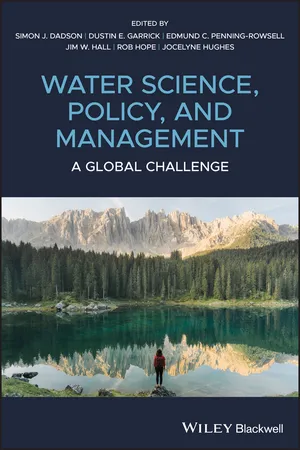
Water Science, Policy and Management
  1. English
  2. ePUB (mobile friendly)
  3. Available on iOS & Android
eBook - ePub

About this book

Provides an in-depth look at science, policy and management in the water sector across the globe

Sustainable water management is an increasingly complex challenge and policy priority facing global society. This book examines how governments, municipalities, corporations, and individuals find sustainable water management pathways across competing priorities of water for ecosystems, food, energy, economic growth and human consumption. It looks at the current politics and economics behind the management of our freshwater ecosystems and infrastructure and offers insightful essays that help stimulate more intense and informed debate about the subject and its need for local and international cooperation.

This book celebrates the 15-year anniversary of Oxford University's MSc course in Water Science, Policy and Management. Edited and written by some of the leading minds in the field, writing alongside alumni from the course, Water Science, Policy and Management: A Global Challenge offers in-depth chapters in three parts: Science; Policy; and Management. Topics cover: hydroclimatic extremes and climate change; the past, present, and future of groundwater resources; water quality modelling, monitoring, and management; and challenges for freshwater ecosystems. The book presents critical views on the monitoring and modelling of hydrological processes; the rural water policy in Africa and Asia; the political economy of wastewater in Europe; drought policy management and water allocation. It also examines the financing of water infrastructure; the value of wastewater; water resource planning; sustainable urban water supply and the human right to water.

  • Features perspectives from some of the world's leading experts on water policy and management
  • Identifies and addresses current and future water sector challenges
  • Charts water policy trends across a rapidly evolving set of challenges in a variety of global areas
  • Covers the reallocation of water; policy process of risk management; the future of the world's water under global environmental change; and more

Water Science, Policy and Management: A Global Challenge is an essential book for policy makers and government agencies involved in water management, and for undergraduate and postgraduate students studying water science, governance, and policy.

Frequently asked questions

Yes, you can cancel anytime from the Subscription tab in your account settings on the Perlego website. Your subscription will stay active until the end of your current billing period. Learn how to cancel your subscription.
No, books cannot be downloaded as external files, such as PDFs, for use outside of Perlego. However, you can download books within the Perlego app for offline reading on mobile or tablet. Learn more here.
Perlego offers two plans: Essential and Complete
  • Essential is ideal for learners and professionals who enjoy exploring a wide range of subjects. Access the Essential Library with 800,000+ trusted titles and best-sellers across business, personal growth, and the humanities. Includes unlimited reading time and Standard Read Aloud voice.
  • Complete: Perfect for advanced learners and researchers needing full, unrestricted access. Unlock 1.4M+ books across hundreds of subjects, including academic and specialized titles. The Complete Plan also includes advanced features like Premium Read Aloud and Research Assistant.
Both plans are available with monthly, semester, or annual billing cycles.
We are an online textbook subscription service, where you can get access to an entire online library for less than the price of a single book per month. With over 1 million books across 1000+ topics, we’ve got you covered! Learn more here.
Look out for the read-aloud symbol on your next book to see if you can listen to it. The read-aloud tool reads text aloud for you, highlighting the text as it is being read. You can pause it, speed it up and slow it down. Learn more here.
Yes! You can use the Perlego app on both iOS or Android devices to read anytime, anywhere — even offline. Perfect for commutes or when you’re on the go.
Please note we cannot support devices running on iOS 13 and Android 7 or earlier. Learn more about using the app.
Yes, you can access Water Science, Policy and Management by Simon James Dadson, Dustin E. Garrick, Edmund C. Penning-Rowsell, Jim W. Hall, Rob Hope, Jocelyne Hughes, Simon James Dadson,Dustin E. Garrick,Edmund C. Penning-Rowsell,Jim W. Hall,Rob Hope,Jocelyne Hughes in PDF and/or ePUB format, as well as other popular books in Technology & Engineering & Environmental Management. We have over one million books available in our catalogue for you to explore.

1
Water Science, Policy, and Management: Introduction

Simon J. Dadson1, Edmund C. Penning‐Rowsell1,2, Dustin E. Garrick3, Rob Hope1,3, Jim W. Hall4, and Jocelyne Hughes1
1 School of Geography and the Environment, University of Oxford, UK
2 Flood Hazard Research Centre, Middlesex University, London, UK
3 Smith School of Enterprise and the Environment, University of Oxford, UK
4 Environmental Change Institute, University of Oxford, UK

1.1 Introduction

Understanding the risks and opportunities presented by the changing water cycle, and the intensifying demands and competition for freshwater, is one of the most pressing challenges facing scientists, water managers and policy‐makers. In the context of rapid climate, land cover and other environmental changes, the requirement to protect communities against water‐related natural hazards, the stewardship of water resources to provide reliable water quantity and quality, and the provision of clean, safely‐managed drinking water and improved sanitation to a population predicted to exceed 9 billion, constitute a defining challenge for the twenty‐first century. This challenge has inspired the University of Oxford to offer a graduate programme in Water Science Policy and Management since 2004, which to date has seen over 350 students from 57 countries graduate, of which more than half are women. This book is formed from contributions by more than a dozen academics and practitioners who have taught the course, in each case writing in co‐authorship with more than two dozen alumni.
This introductory chapter outlines key drivers of change in the water environment and explains how these drivers may evolve into the future, creating new issues and risks requiring interventions. We then outline what we consider to be key challenges facing those responsible for water and its governance and management, globally, in the context of scientific understandings, policy priorities, and management opportunities. We make reference here to the chapters that follow on particular aspects of water science, policy and management, thereby contextualizing those chapters and enabling the reader to see them in a broader context. The final chapter of this book (Chapter 20) gives our vision for the future role of interdisciplinary water education and research in creating greater understanding of the complexities involved and the opportunities for progress.

1.2 Drivers of Change: Environment, Politics, Economics

The water sector is strongly impacted by the recent, rapid, and widespread effect of economic growth, often exacerbated by weak governance and inequality. Alongside these human drivers, environmental change, including climate change and variability and changes in land cover and land management, exerts impacts which are often felt most acutely in societies least able to adapt. The opportunities and challenges presented by growing and moving populations, in the context of changing water availability, threaten the sustainable, equitable and efficient use of water resources for economic development.
As demonstrated in Chapter 2, the evidence is overwhelmingly in support of anthropogenic global warming, and it is notable that climate science has unequivocally demonstrated that observed historical climate change is due to anthropogenic emission of fossil carbon (Box 1.1). In the presence of overwhelming evidence, the debate has now shifted towards understanding the regional and local consequences of warming, and their impacts on hydroclimatic variability and extremes. Revealing the regional picture adds additional uncertainty and raises the crucial question of how much additional evidence must we wait for before we act, either in mitigation of future change, or in order to adapt to what may constitute a ‘new normal’ range of climatic variability? There are many tools at our disposal to answer such questions. Indeed, the challenge to policy‐makers and their advisors, and to practitioners in the field of water management, is to extract the salient information on which to base decisions from the plethora of data currently available on the subject (see Chapters 2 and 14).

Box 1.1 The Paris Agreement

The Accord de Paris is an agreement within the United Nations Framework Convention on Climate Change (UNFCCC 2015), dealing with greenhouse‐gas emissions mitigation, adaptation, and finance, starting in the year 2020. The agreement was negotiated by representatives of 196 countries at the 21st Conference of the Parties of the UNFCCC in Le Bourget, France, and adopted by consensus on 12 December 2015. The Agreement’s long‐term goal is to keep the increase in global average temperature to well below 2°C above pre‐industrial levels, and to limit the increase to 1.5°C, to substantially reduce the risks and effects of climate change. Under the Agreement, each country must determine, plan, and regularly report on the contribution that it undertakes to mitigate global warming. No mechanism forces a country to set a specific target by a specific date, but each target should go beyond previously set targets. In addition to reporting information on mitigation, adaptation and support, the Agreement requires that the information submitted by each country undergoes international technical expert review.
The consequences of failing to meet the Paris commitments for flooding and water resources are potentially serious, although there is considerable uncertainty in current projections (see Chapter 2). Even with 1.5°C warming, significant increases in rainfall and therefore flood risk are likely, particularly in flood‐prone south‐east Asia. The outlook for water resources is also strongly dependent on the Paris Accord, with projections of exacerbated water scarcity in already drought‐prone areas, should the 1.5°C commitment not be met. Nonetheless, much uncertainty remains, not least because the pathways to 1.5°C involve changes not only to greenhouse gas concentrations but also to atmospheric aerosols and land use.
UNFCCC. (2015). Paris Agreement . Available at: https://unfccc.int/files/meetings/paris_nov_2015/application/pdf/paris_agreement_english_.pdf.
Whilst global attention has quite properly focused on climate change, widespread policy‐driven changes in land cover and management also rank amongst the most striking perturbations to the natural environment that impinge on the water sector. Land cover changes may occur by direct policy intervention; they may also occur as land managers respond individually to market forces and the regulatory environment. Together these changes can also impact land use (tree planting, agricultural practices) by affecting what it is economic to do in the rural environment. The impact, for example, of nitrate on long‐lived groundwater quality is of particular note (Chapters 3 and 4), as is the impact of regulatory practices on water quality as evidenced by the EU Water Framework Directive, which is credited with driving a significant, but small, improvement in aquatic biodiversity (Chapter 5). Policies and economic incentives exert a powerful control over land management and agriculture, with impacts that are often felt more immediately and with greater certainty than climatic variability or change but which also act as threat multipliers or stressors of freshwater ecosystems when combined with climate change (e.g. algal blooms, Chapter 4; invasive species proliferation, Chapter 5).
Demographic drivers of change include the growth of global population centres in Asia and Africa, including ‘mega‐cities’ with populations greater than 10 million. Nonetheless, the reality of population growth, urbanization, and the growth of agriculture to support a growing affluent population in the developing world will have profound consequences for water consumption (Chapter 8) and for water quality. As such it is vital to consider not only the physical and natural consequences but also the potential political responses in the light of projected growth of urban populations (Chapters 12 and 18).
Water plays a crucial role in many sectors of the economy and is frequently analysed as a factor of production or as a public economic good. Connections with the energy and agricultural sectors are often highlighted, not least because agriculture consumes by far the most water of any economic sector, and reliable water supplies are needed for energy production. These linkages serve both to amplify the sensitivities of the water sector to global change, and to mandate broad consideration of water‐related impacts on other economic sectors in policy development and the consequent enactment of management decisions, particularly in relation to water allocation and reallocation in a rapidly changing world (Chapter 8).
The global importance of water in industrialized and developing economies is also recognized via the Sustainable Development Goals (SDGs), which explicitly mandate universal and equitable drinking water supplies and improved sanitation services, sustainable water withdrawals and protection of ecosystems (Box 1.2). Compared with the earlier Millennium De...

Table of contents

  1. Cover
  2. Table of Contents
  3. List of Contributors
  4. Foreword
  5. Acknowledgements
  6. 1 Water Science, Policy, and Management
  7. Part I: Water Science
  8. Part II: Policy
  9. Part III: Water Management
  10. Index
  11. End User License Agreement