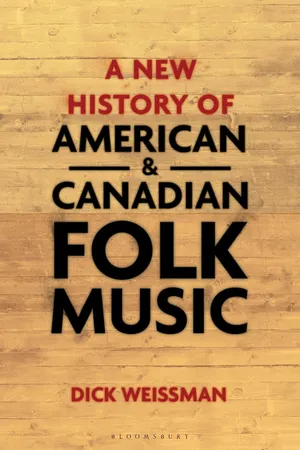
Building on his 2006 book, Which Side Are You On?, Dick Weissman's A New History of American and Canadian Folk Music presents a provocative discussion of the history, evolution, and current status of folk music in the United States and Canada. North American folk music achieved a high level of popular acceptance in the late 1950s. When it was replaced by various forms of rock music, it became a more specialized musical niche, fragmenting into a proliferation of musical styles. In the pop-folk revival of the 1960s, artists were celebrated or rejected for popularizing the music to a mass audience. In particular the music seemed to embrace a quest for authenticity, which has led to endless explorations of what is or is not faithful to the original concept of traditional music.
This book examines the history of folk music into the 21st century and how it evolved from an agrarian style as it became increasingly urbanized. Scholar-performer Dick Weissman, himself a veteran of the popularization wars, is uniquely qualified to examine the many controversies and musical evolutions of the music, including a detailed discussion of the quest for authenticity, and how various musicians, critics, and fans have defined that pursuit.
- 344 pages
- English
- ePUB (mobile friendly)
- Available on iOS & Android
eBook - ePub
A New History of American and Canadian Folk Music
About this book
Information
1
From the Beginning: Folksong Collectors and Collections and Regional Music Styles in the United States and Canada
Musicologists divide music into three archetypes: folk, popular, and classical. Classical music is relatively easy to categorize: the music exists through the composition and notation of new music that is performed by musicians who are trained to read and write music in the form of traditional music notation.
Popular music carries the connotation of mass marketed music insofar as that is possible during the particular period that the critic may be writing about. Its goal is tied to commercial factors in the sense that there is a long-standing and intense business of creating this sort of music and marketing it in the widest sphere possible. Moreover, it is tied into for-profit business relationships on the part of composers, artists, record companies, music publishers, and the small army of intermediaries who present this music. That includes concert and night club promoters, performing venues, managers, agents, sound technicians, tour managers, and the various professionals and business people who make a living creating and promoting this music.
Folk music has generally been regarded as music that is created in communities and family environments that does not necessarily require performances outside a home or community. This relative freedom from the intrusion of commerciality has long attracted folklorists and utopian philosophers or historians who admire the notion of creating music in communities or families. They see folk music as pure and untainted, compared to the self-conscious way that popular music is created and marketed.
This romanticized view of the music capitalizes on a kind of arrogant view of the folk as “noble savages,” people who are entirely unintellectual, live in isolation, and resist the advances of any sort of modernistic or technological innovations. This viewpoint appeared somewhat viable in the late nineteenth and early twentieth centuries when mass communications as we experience them in the twenty-first century were non-existent or present only on the fringes of American culture.
The Industrial Revolution and the romantic philosophers
Much of the original fascination of intellectuals with folk music derived from the social changes caused by the Industrial Revolution in the last half of the eighteenth century and the first half of the nineteenth century. The days of the idyllic rural life that such intellectuals idolized were transformed by lengthy industrial work days and the transformation of primarily rural lifestyles to the urban slums that became the new homes for the working class.
The German philosopher Johann Gottfried von Herder (1744–1803) also began to worry about the artificiality of “modern” life and its emphasis on the rational. Free flowing folk culture presented a looser and more pleasant way of looking at life. Herder himself collected the lyrics of folksongs and even coined the word folksong. Even before Herder’s time, collections of traditional ballads were published in England, and in 1763 an English clergyman named Thomas Percy published his ballad collection Reliques of English Poetry, drawing on an earlier collection of ballads.
Communal ballad making vs. the notion of individual composition and broadside ballads
Herder and the Brothers Grimm, who collected and published fairy tales, believed that ballads were communally composed. This notion of mystical group composition suited their conception of the folk as a sort of anonymous but wonderfully primitive mass. It also suited their skepticism about the new industrialism where products were mass manufactured without originality or “soul.”
Cecil Sharp (1859–1924) was an English composer and folksong collector who argued that folksongs had an original and specific author and that the collective effort was the transmission of the songs from that author to other individuals who in turn spread and sometimes revised or re-arranged the original song as they traveled from one place to another.
A further complication ensued when contemporary ballad makers published and sold songs in broadsides or song sheets. During this period, broadsides were regarded as cheap, inferior, and popularized versions of folksongs or simply as trash made for popular consumption.
Later on, folksong collector Edward (Sandy) Ives (1859–1924) studied three folksong makers: Larry Gorman, Joe Scott, and Lawrence Doyle. These three composers were all originally Canadian but worked in the woods of Maine and New Brunswick. All of them wrote original songs. For many folklorists the true test of a folksong was whether it was passed on and continued to be sung by others, and all three of these composers wrote songs that passed that test.
Child, Kittredge, and John Lomax
Interest in collecting and publishing collections of folksongs in the United States developed somewhat later, but in 1882 Harvard scholar Francis James Child published a collection of English folksongs sung in the United States that derived from Scottish or English sources, focusing on songs that preceded the invention of the printing press. This allowed him to entirely evade the subject of broadside ballads. Child’s research continued for forty years, and he published 305 different titles as well as variants. He did not include music in his researches. Child’s student George Lyman Kittredge was one of the fathers of American folksong research.
John Lomax
It wasn’t until the early years of the twentieth century that folklorists, musicologists, and ethnomusicologists started collecting American folksongs. The person who became the most famous collector, although not the first one, was John A. Lomax. Lomax was a student of ballad scholar George Lyman Kittredge and Kittredge encouraged Lomax, who began his folksong endeavors by collecting cowboy songs. Later he recruited his son Alan to assist him in collecting folksongs all over the United States, especially in southern prisons.
The two Lomaxes had very different orientations. John was a conservative southerner and Alan’s political beliefs placed him on the far left. They both shared a Herder-like attitude toward the black prisoners whose songs they recorded. They saw these prisoners as noble savages, people whose music was virtually uninfluenced by popular music commerciality.
Both Lomaxes were involved in various controversies in their lengthy career, and I will discuss Alan’s career much later in this book. John almost immediately found himself in rough waters when he ran up against fellow cowboy song collector “Cowboy Jack” Tharp. Tharp published a songbook in 1908 that included five songs he had written. When Lomax re-printed one of Tharp’s original songs without credit, the feud was on! In the 1916 revised edition of the Lomax book he added the other four Tharp originals. Later Lomax claimed that Tharp had “stolen” songs from him, a claim refuted by folklorist D. K. Wilgus.
It was not unusual for the nineteenth-century British ballad collectors to edit the songs they had collected, because either they included bawdy material or the editor felt the songs could be improved upon. Lomax took this process to the next level, by combining various versions of the same song, and then editing them as a single piece of work, and copywriting them in his own name, as though he were the author of the song. When the folksong revival took off in the 1950s and pop-folk groups recorded these songs, these copyrights began to be lucrative. One of the people that Lomax recorded was songster Blind Willie McTell. While recording him for the Library of Congress, Lomax let the tape recorder run during their conversations. In a bizarre and condescending manner Lomax asks McTell if he knows any protest songs. McTell seems puzzled by the request and tells Lomax that he doesn’t know any songs like that because things are going well for him. Lomax is quite insistent on this subject and continues to press McTell for such songs. He seems entirely unaware that if McTell knew such songs he might well resist singing them for a white man with a Texas accent.
There is also quite a bit to say about John Lomax’s relationship with Huddie (Ledbetter) Lead Belly, which began when Lead Belly was a prisoner in Texas. Because this story includes the extensive involvement of John’s son Alan, I will take up this thread of the story in a later chapter.
Howard W. Odum
Sociologist Howard Odum collected African-American blues, work songs, and religious songs and began publishing the religious songs in 1906. He followed this up in 1911 by publishing 115 secular songs. Together with fellow sociologist Guy Johnson, Odum compiled two books, one of secular songs and one of religious songs that were published by the University of North Carolina Press in 1925 and 1926, respectively. He also wrote three novels about a rambling blues singer named Left Wing Gordon that were published in 1931. Considering that Odum’s primary field was sociology, and that he had acquired a reputation as an important scholar who specialized in southern regional studies, this was a remarkable attempt to relate to the world of a bluesman.
Odum’s articles were not the first published studies of African-American music. Charles Pickard Ware, Lucy McKim Garrison, and William Francis Allen’s Slave Songs of the United States appeared in 1867. This was a collection mostly, but not entirely, of religious songs collected after the Civil War in the South Carolina Sea Islands. The book has been re-printed several times. In a sense, it was before its time because it preceded the interest in American folksongs that was created by the Lomax and Odum and Johnson books. It even preceded the formation of the American Folklore Society in 1888.
The settlement schools and Cecil Sharp
A number of schools were opened in Appalachia in the early years of the twentieth century. They were called “settlement schools.” This movement was influenced by schools founded in London in the late nineteenth century, and by social worker Jane Addams’ Hull House in Chicago. The teachers and administrators of these schools came from both Kentucky and New England. Because they were located in relatively isolated geographic areas, the schools also came to function as community centers that included dormitories for the students. The schools grew much of their own food, ran health clinics, included cooperative stores, sold local arts and crafts, and collected local music and stories. The earliest settlement schools included the Hindman Settlement School, founded in 1902, and the Pine Mountain Settlement School and the Stuart Robinson School, both founded in 1913.
One of the women who migrated to Appalachia was Olive Dame Campbell who migrated south when her husband was appointed president of Piedmont College in Demorest, Georgia, in the northern part of the state. In 1908–12 Ms. Campbell began to collect folksongs while she was accompanying her husband during trips through the southern mountains. He was conducting a study of social and economic conditions while she pursued her music collecting. By 1913 the couple had moved to Asheville, North Carolina, where she pursued these interests while he became CEO of the Russell Sage Foundation. Campbell also founded the John C. Campbell Folk School in North Carolina in 1925, years after the Sharp expedition.
In 1916 Campbell heard that Cecil Sharp, an English composer and folksong collector, was visiting the United States and she visited him in Lincoln, Massachusetts, to show him her folksong collection. Sharp believed that he could stimulate a revival of interest in folksongs in England by collecting American versions of the Child ballads. She accompanied Sharp and his assistant Maud Karpeles (1885–1976) on a nine-week collecting trip that proved to be very fruitful. They published this collection of 122 songs and ballads in 1917.
During the next two years, Sharp made two other trips to the United States, this time accompanied only by Maud Karpeles. All told, Sharp spent forty-six weeks in Appalachia, and collected 1,612 songs. He died while compiling all of this music, but Karpeles was able to continue the work and she compiled the book English Folk Songs from the Southern Appalachians in 1932.
Because he was a trained musician, he included tunes with the songs. Sharp was a worshiper of the “primitive,” and he had no interest in collecting anything resembling the popular music of the day. Sharp also had no interest in the culture of African Americans, and in fact saw their music as part of the vulgarization of American life. This contributed to the romantic view of Appalachia espoused by scholars of the day, in disregard of Benjamin Filene’s findings that African Americans in fact constituted 13.4 percent of the population of the region at the time of Sharp’s collecting work. It also led to scholars ignoring the fact that there was a strong tradition of black-white musical interaction, and quite a few black banjo players and fiddlers who worked from the same general repertoire that white musicians were playing. Subsequent recordings by such white musicians as Uncle Dave Macon and Dock Boggs, which included such songs and instrumentals along with the researches of such folklorists and collectors as Stuart Jamieson, Kip Lornell, and Mike Seeger amplified the importance of this error.
Although Sharp had little interest in any original American music, he included a few songs that were native to America like John Hardy and The Lonesome Prairie. Despite these limitations, the work that Sharp, Campbell, and Karpeles did was enormously important and stimulated folklorists and music historians to collect music in many remote corners of the United States. According to folksong scholar D. K. Wilgus, Sharp established rapport with regional folksong collectors by meeting them. Thereby, he eliminated the potential for the sort of territorial feuds that had erupted between John Lomax and Jack Tharp.
Regional collectors
There were scholars and inspired amateurs collecting songs all over the United States. Some restricted themselves to particular states, like the Frank C. Brown North Carolina Collection and Henry M. Belden’s work in Missouri. Other collectors focused on regions, particular groups of working people, or specific ethnic groups. Vance Randolph spent his lifetime collecting songs and folklore in the Ozark Mountains, Dorothy Scarborough compiled collections of both southern mountain and African-American songs, Phillips Barry collected songs in Maine, and Charles Lummis compiled four hundred Spanish-American folksongs in California. Occupational songs were represented by Joanna C. Colcord’s collections of sailors’ songs in 1924 and 1938, Charles J. Finger’s Frontier Ballads, George Pullen Jackson’s collections of white spirituals, George Korson’s collections of mining songs beginning in 1927, George Milburn’s The Hobo’s Hornbook from 1930, and Franz Rickaby’s 1926 Ballads and Songs of the Shanty Boy. In later years, scholars compiled collections that basically were compilations of work done by previous folksong collectors but were unpublished or incomplete at the time of publication.
Some scholars focused on specific ethnic groups, including the already-cited works of Howard Odum and Guy Johnson, two books of black spirituals by James Weldon Johnson and J. Rosamund Johnson (1925 and 1926), R. Nathaniel Dett’s collection of spirituals published in 1927 and 1936, and Newman I. White’s American Negro Folk-Songs (1928).
Laura Boulton and Natalie Curtis collected the music of American Indians, while a remarkable woman named Frances Densmore compiled over a dozen books of Native American songs, traveling all over the United States and into Canada through virtually the entire first half of the twentieth century.
The strange career of Lawrence Gellert
Recently blues scholar Bruce Conforth has written an illuminating book about one of the more mysterious figures in American folksong. Lawrence Gellert was born in 1898, the son of a Hungarian refugee. For many years, he lived in the shadow of his brother Hugo, who was an art editor for the New Masses, a magazine that was a cultural organ associated with the Communist Party.
In 2013, the Scarecrow Press published Bruce Conforth’s book African American Folksong and American Cultural Politics: The Lawrence Gellert Story. Because Gellert was such a mysterious figure whose very place of death is unknown except possibly to a few close-mouthed members of his family. Conforth researched Gellert’s life for years before completing this book. Because he was also the custodian at the Gellert Archives at the University of Indiana, Conforth also is the person most familiar with that collection, which includes some 600 songs and numerous folk tales.
As Conforth tells the story, Lawrence Gellert was an unsuccessful, troubled person whose siblings variously owned a furniture business and in Hugo’s case, was a successful and prominent art editor for the magazine the New Masses. Around 1922, Lawrence found himself adrift and because of either a nervous breakdown or some attempt to establish his own identity, he left New York City for Tryon, North Carolina. Conforth believes that Gellert started collecting music around 1924 with a very poor-quality wire recorder. Gellert had something of a southern white patron who protected him against suspicious townsfolk or unpleasant situations, and Gellert proceeded to travel and record many African-American singers...
Table of contents
- Cover
- Halftitle Page
- Title Page
- Contents
- Preface: A personal note
- Acknowledgments
- Introduction: A New Look at American and Canadian Folk Music
- 1. From the Beginning: Folksong Collectors and Collections and Regional Music Styles in the United States and Canada
- 2. Mass Distribution: Radio, Records, and Pre-World War Two Artists
- 3. Early Protest Music: The Industrial Workers of the World, the Coal Miners, the Cotton Mills, and the Communist and Socialist Agitators
- 4. The Almanac Singers, People’s Song, People’s Artists, and the Blacklist
- 5. The Weavers and the Beginning of the Folk Revival
- 6. Meanwhile, Back in Canada
- 7. Selling the Music: The New York Scene
- 8. Beyond the Big Apple: The Coffeehouses, Folk Music Organizations, and Folk Music Instrument Shops in Boston, Chicago, Denver, Los Angeles, Philadelphia, the Pacific Northwest, San Francisco, and Toronto
- 9. The Riddle of Authenticity
- 10. The Civil Rights Movement
- 11. Folk-Rock, the British Invasion, and the Rise of the Singer-Songwriters
- 12. The Increasing Influence of Singer-Songwriters and the Women’s Music Movement
- 13. North American Folk Festivals and Summer Teaching Camps
- 14. Instrumental Music: The Development and Expansion of Musical Possibilities
- 15. The Folk Music Business
- 16. What’s Going On: Expansion, Contraction, and Evolution
- 17. Looking Back: An Evaluation of Four Major Figures in the Folk Revival
- 18. Today and Tomorrow
- Appendix
- Index
- Imprint
Trusted by 375,005 students
Access to over 1.5 million titles for a fair monthly price.
Study more efficiently using our study tools.
Frequently asked questions
Yes, you can cancel anytime from the Subscription tab in your account settings on the Perlego website. Your subscription will stay active until the end of your current billing period. Learn how to cancel your subscription
No, books cannot be downloaded as external files, such as PDFs, for use outside of Perlego. However, you can download books within the Perlego app for offline reading on mobile or tablet. Learn how to download books offline
Perlego offers two plans: Essential and Complete
- Essential is ideal for learners and professionals who enjoy exploring a wide range of subjects. Access the Essential Library with 800,000+ trusted titles and best-sellers across business, personal growth, and the humanities. Includes unlimited reading time and Standard Read Aloud voice.
- Complete: Perfect for advanced learners and researchers needing full, unrestricted access. Unlock 1.5M+ books across hundreds of subjects, including academic and specialized titles. The Complete Plan also includes advanced features like Premium Read Aloud and Research Assistant.
We are an online textbook subscription service, where you can get access to an entire online library for less than the price of a single book per month. With over 1.5 million books across 990+ topics, we’ve got you covered! Learn about our mission
Look out for the read-aloud symbol on your next book to see if you can listen to it. The read-aloud tool reads text aloud for you, highlighting the text as it is being read. You can pause it, speed it up and slow it down. Learn more about Read Aloud
Yes! You can use the Perlego app on both iOS and Android devices to read anytime, anywhere — even offline. Perfect for commutes or when you’re on the go.
Please note we cannot support devices running on iOS 13 and Android 7 or earlier. Learn more about using the app
Please note we cannot support devices running on iOS 13 and Android 7 or earlier. Learn more about using the app
Yes, you can access A New History of American and Canadian Folk Music by Dick Weissman in PDF and/or ePUB format, as well as other popular books in Media & Performing Arts & Folk Music. We have over 1.5 million books available in our catalogue for you to explore.