Choice Outstanding Academic Title for 2020
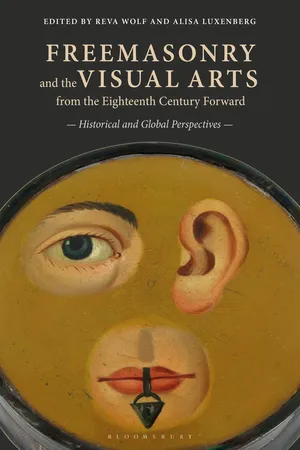
With the dramatic rise of Freemasonry in the eighteenth century, art played a fundamental role in its practice, rhetoric, and global dissemination, while Freemasonry, in turn, directly influenced developments in art. This mutually enhancing relationship has only recently begun to receive its due. The vilification of Masons, and their own secretive practices, have hampered critical study and interpretation. As perceptions change, and as masonic archives and institutions begin opening to the public, the time is ripe for a fresh consideration of the interconnections between Freemasonry and the visual arts. This volume offers diverse approaches, and explores the challenges inherent to the subject, through a series of eye-opening case studies that reveal new dimensions of well-known artists such as Francisco de Goya and John Singleton Copley, and important collectors and entrepreneurs, including Arturo Alfonso Schomburg and Baron Taylor. Individual essays take readers to various countries within Europe and to America, Iran, India, and Haiti. The kinds of art analyzed are remarkably wide-ranging-porcelain, architecture, posters, prints, photography, painting, sculpture, metalwork, and more-and offer a clear picture of the international scope of the relationships between Freemasonry and art and their significance for the history of modern social life, politics, and spiritual practices. In examining this topic broadly yet deeply, Freemasonry and the Visual Arts sets a standard for serious study of the subject and suggests new avenues of investigation in this fascinating emerging field.
eBook - ePub
Freemasonry and the Visual Arts from the Eighteenth Century Forward
Historical and Global Perspectives
- 304 pages
- English
- ePUB (mobile friendly)
- Available on iOS & Android
eBook - ePub
Freemasonry and the Visual Arts from the Eighteenth Century Forward
Historical and Global Perspectives
About this book
Information
1
Freemasonry in Eighteenth-Century Portugal and the Architectural Projects of the Marquis of Pombal
David Martín López
This essay considers the significance of the philo-masonic attitude of the influential Portuguese Enlightenment politician, the Marquis of Pombal (1699–1782), through the analysis of his urban policies and of works of art and architecture created under his rule, most of them overseen by his friend, the architect and Freemason Carlos Mardel (1696–1763).1 Despite the recent growth in research on the history of Freemasonry, there remains a bias in the academic world against the study of connections between art and Freemasonry in Europe. This bias is most evident in Italy, Spain, and Portugal. In these three countries, Freemasonry was established in the early eighteenth century, soon after the founding of the Grand Lodge of England. The roots of the resistance to studying Freemasonry and the visual arts in southern Europe can be traced back to this period, when a papal bull of 1738 condemned the fraternal order.
Sebastião José de Carvalho e Melo, Marquis of Pombal and Count of Oeiras, has been both criticized for his affiliation with Masonry and admired for expelling the Jesuits from Portugal and Brazil.2 Without evidence, some historians have imbued Pombal with political motivations that pose difficulties for the study of this important figure in Portugal’s history. I propose to ask, what changes in our understanding of Pombal if we speculate that he was a Freemason? How can art be useful for this proposition? By analyzing his biography and examining the symbolism in several artistic and architectural projects associated with him, I will explore these questions.
Pombal was one of the principal political leaders of Portugal during the Enlightenment. After the 1755 earthquake, he was responsible for the urban transformation of Lisbon and social reforms throughout the kingdom. Earlier, Pombal had been protected by King D. João V (r. 1706–50) who epitomized the absolutism of the period. Portugal was enjoying a Golden Age because of the gold it acquired from its colony of Brazil, but this profit was used to finance a war against Spain rather than to improve the infrastructure of Portugal.3 Moreover, the king’s major concerns before the great earthquake were to demonstrate extreme luxury and opulence, to maintain the Catholic religion, and to advance modern technology. With his new source of funds, D. João was able to move forward with these initiatives.4
João V resisted the practice of Freemasonry at the same time that he protected individual Masons. Masonic symbols and references abound in architecture erected during his reign. An extraordinary image, possibly a portrait of João V, apparently painted shortly after his reign, presents itself on the door of the meeting room in the chapter house of Elvas Cathedral, in a work that portrays the king with masonic tools, including a golden trowel (Color pl. 1). Golden trowels were frequently used in masonic rituals, such as the consecration of foundation stones. The trowel implies the cement that is a symbol of union and fraternity in Freemasonry.5 Is the painting an encrypted allegory that indicated the king’s protection of Freemasonry in Portugal or his membership in the order? We cannot decode with certainty this royal portrait or allegory, but I will provide examples of how D. João V protected, either directly or indirectly, through Pombal and other politicians, many of the first Freemasons of his kingdom.
Pombal remains one of the most enigmatic personalities of the eighteenth century, and his possible adherence to Freemasonry, perhaps through initiation in London or Vienna where he served as Portuguese ambassador from 1738 to 1744 and from 1745 to 1749, respectively, has not been documented. It is not unusual that one cannot confirm Pombal’s masonic affiliation, because in the Catholic countries of the Iberian Peninsula during that period, such documentation was not kept or was destroyed by Freemasons to protect both their institutions and their reputations. Yet, as the historian José Antonio Ferrer Benimeli warns, most of the politicians who were responsible for the expulsion of the Jesuits from Portugal, Spain, France, and Italy have been called Freemasons without any evidence to support such an identity.6 Most historians who believe in the masonic association of Pombal speculate that he was initiated in London or Vienna.7
The Freemason and historian António de Oliveira Marques proposes that the evidence of Pombal’s Freemasonry can be found in many artistic manifestations of masonic symbolism in works created under his administration.8 In the 1990s, Oliveira Marques’s theory seemed risky, but now through art historical methods and new considerations of the period, one can reinforce and embrace it. This essay will demonstrate the existence of several masonic references in Pombal’s residences and in architectural projects realized under his direction.
The main façade of the residence of the Marquis of Pombal in Évora displays a coat of arms and a masonic reference that do not appear in any of his other residences. The coat of arms crowns the small palace’s façade and is inscribed 1753 (Fig. 1.1). By then, Pombal had returned from Vienna and was already in the service of King D. José I (r. 1750–77). Carved in white marble, the cartouche represents Pombal’s arms, topped by a nobleman’s armor and helmet on which stands a bird with a horseshoe in its beak. One element, although linked to a certain tradition in Portuguese heraldry, is here quite similar to an article of masonic ritual dress.9 The coat of arms is sculpted as though it were a leather apron, with its ribbon-like ties and buckle. This object could serve as an aesthetic metalanguage to communicate to the initiated the symbolic rhetoric of the masonic order, and the marquis’s identity as a Mason.

Figure 1.1 Pombal Palace, main entrance with the coat of arms of Pombal, 1753, Évora, Portugal. Photograph by the author.
The Symbolism of the Baixa
After the earthquake that devastated Lisbon in 1755, the Marquis of Pombal directed the urban recovery and went on to help enact social reforms in the kingdom. The disaster that took place on November 1, 1755 had continental aftershocks. The earthquake shattered Europeans not only from a sentimental and humanitarian point of view but also from symbolic and cultural ones, calling into question the Christian morality of the time.10 Nevertheless, the city needed to be rebuilt and to function. As Leonor Ferrão contends, the project for rebuilding the area of Lisbon known as the Baixa was an instrument of power to demonstrate the state’s ability to create a more hygienic modern city and to favor, as...
Table of contents
- Cover
- Half-Title Page
- Title Page
- Contents
- List of Illustrations
- Acknowledgments
- Introduction: The Mystery of Masonry Brought to Light
- 1 Freemasonry in Eighteenth-Century Portugal and the Architectural Projects of the Marquis of Pombal
- 2 The Order of the Pug and Meissen Porcelain: Myth and History
- 3 Goya and Freemasonry: Travels, Letters, Friends
- 4 Freemasonry’s “Living Stones” and the Boston Portraiture of John Singleton Copley
- 5 The Visual Arts of Freemasonry as Practiced “Within the Compass of Good Citizens” by Paul Revere
- 6 Building Codes for Masonic Viewers in Baron Taylor’s Voyages pittoresques et romantiques dans l’ancienne France
- 7 Freemasonry and the Architecture of the Persian Revival, 1843–1933
- 8 Solomon’s Temple in America: Masonic Architecture, Biblical Imagery, and Popular Culture, 1865–1930
- 9 Freemasonry and the Art Workers’ Guild: The Arts Lodge No. 2751, 1899–1935
- 10 Picturing Black Freemasons from Emancipation to the 1990s
- 11 Saint Jean Baptiste, Haitian Vodou, and the Masonic Imaginary
- Selected Bibliography
- Index
- Plate Section
- Copyright
Trusted by 375,005 students
Access to over 1.5 million titles for a fair monthly price.
Study more efficiently using our study tools.
Frequently asked questions
Yes, you can cancel anytime from the Subscription tab in your account settings on the Perlego website. Your subscription will stay active until the end of your current billing period. Learn how to cancel your subscription
No, books cannot be downloaded as external files, such as PDFs, for use outside of Perlego. However, you can download books within the Perlego app for offline reading on mobile or tablet. Learn how to download books offline
Perlego offers two plans: Essential and Complete
- Essential is ideal for learners and professionals who enjoy exploring a wide range of subjects. Access the Essential Library with 800,000+ trusted titles and best-sellers across business, personal growth, and the humanities. Includes unlimited reading time and Standard Read Aloud voice.
- Complete: Perfect for advanced learners and researchers needing full, unrestricted access. Unlock 1.5M+ books across hundreds of subjects, including academic and specialized titles. The Complete Plan also includes advanced features like Premium Read Aloud and Research Assistant.
We are an online textbook subscription service, where you can get access to an entire online library for less than the price of a single book per month. With over 1.5 million books across 990+ topics, we’ve got you covered! Learn about our mission
Look out for the read-aloud symbol on your next book to see if you can listen to it. The read-aloud tool reads text aloud for you, highlighting the text as it is being read. You can pause it, speed it up and slow it down. Learn more about Read Aloud
Yes! You can use the Perlego app on both iOS and Android devices to read anytime, anywhere — even offline. Perfect for commutes or when you’re on the go.
Please note we cannot support devices running on iOS 13 and Android 7 or earlier. Learn more about using the app
Please note we cannot support devices running on iOS 13 and Android 7 or earlier. Learn more about using the app
Yes, you can access Freemasonry and the Visual Arts from the Eighteenth Century Forward by Reva Wolf, Alisa Luxenberg, Reva Wolf,Alisa Luxenberg in PDF and/or ePUB format, as well as other popular books in Art & Art & Politics. We have over 1.5 million books available in our catalogue for you to explore.