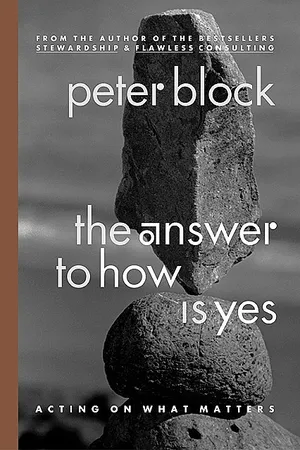
Modern culture's worship of "how-to" pragmatism has turned us into instruments of efficiency and commerce—but we're doing more and more about things that mean less and less. We constantly ask "how? and still struggle to find purpose and act on what matters. Instead of acting on what we know to be of importance, we wait for bosses to change, we seek the latest fad, we invest in one more degree. Asking how keeps us safe—instead of being led by our hearts into uncharted territory, we keep our heads down and stick to the rules. But we are gaining the world and losing our souls.
Peter Block puts the "how-to" craze in perspective and presents a guide to the difficult and life-granting journey of bringing what we know is of personal value into an indifferent or even hostile corporate and cultural landscape. He raises our awareness of the trade-offs we've made in the name of practicality and expediency, and offers hope for a way of life in which we're motivated not by what "works," but by the things that truly matter in life—idealism, intimacy, depth and engagement.
We begin with the costs of asking How? too quickly or too eagerly. When we ask how to do something, it expresses our bias for what is practical, concrete, and immediately useful, often at the expense of our values and idealism. It assumes we don’t know, and this in itself becomes a defense against action. This section underlines the importance of getting the question right and paying careful attention to the nature of the debate.
Getting the question right may be the most important thing we can do. We define our dialogue and, in a sense, our future through the questions we choose to address. Asking the wrong question puts us in the philosopher’s dilemma: We become the blind man looking in a dark room for a black cat that is not there.
74
15
how is the wrong question. How? is not just one question, but a series of questions, a family of questions. It is the predominance of this family of questions that creates the context for much of what we do.
How? is most urgent whenever we look for a change, whenever we pursue a dream, a vision, or determine that the future needs to be different from the past. By invoking a How? question, we define the debate about the changes we have in mind and thereby create a set of boundaries on how we approach the task. This, in turn, influences how we approach the future and determines the kind of institutions we create and inhabit. I want to first identify six questions that are always reasonable, but when asked too soon and taken too literally may actually postpone the future and keep us encased in our present way of thinking.
Question One: How do you do it?
This is the How? question in basic black, serviceable in most situations. It seems innocent enough, and in fact it is innocent, for when I ask this question, I take the position that others know, I don’t. I am the student, they are the teacher. The question carries the belief that what I want is right around the corner; all that prevents me from turning that corner is that I lack information or some methodology. What this question ignores is that most of the important questions we face are paradoxical in nature. A paradox is a question that has many right answers, and many of the answers seem to conflict with each other. For example, “How do we hold people accountable?” Well, real accountability must be chosen. But if we wait for people to choose accountability, and they refuse, don’t we then need to hold them accountable? If we set up oversight systems to ensure this, then what are we getting: accountability or compliance?
16
The paradoxical questions that lead us to what matters most are those familiar, persistent, complicated questions about our lives, individually and organizationally, that defy clear solutions. We all want to know what we were placed on this earth for, what path is best for us, how to sustain long-term intimate relationships, how to raise a child, how to create a community. At work we try to change the culture, increase performance, find and keep great people, deal with failure, develop leaders, predict where our business is going, be socially responsible. These are large questions, but the small ones also are difficult: Where do I spend this day? Where has the time gone? What is this meeting really about? Why is this project on life support? Where can I get eat a healthy meal? Why don’t I get home by 6:00 PM?
We can pursue methods and techniques for answering these questions, or we can appreciate their profound complexity. We can acknowledge the possibility that if there were a methodological answer, we would have found it by now. We can accept the possibility that dialogue and struggle with the question carries the promise of a deeper resolution. Maybe if we really understood what the question entailed, if we approached it as a philosopher instead of an engineer, this would take us to the change or learning that we seek.
The real risk in the “how to do it” question is coming to it too quickly. It finesses deeper questions of purpose, it implies that every question has an answer, and rushes past whether or not we have the right initial question. The rush to a How? answer runs the risk of skipping the profound question: Is this worth doing? And it skirts the equally tough corollary questions: Is this something I want to do? Is this a question that is mine, that matters to me? Or is it a question, or debate, that has been defined by others? And if it has been defined by others, do I have a right to say no to the demand? Here is one more question that precedes methodology: Why are we still asking this question?
17
You might say that this more profound line of inquiry takes too long, that it can paralyze us from taking decisive action. Well, hold this concern for the moment, because it is just this concern that keeps us operating within boundaries that do not serve us well.
Question Two: How long will it take?
We live in a culture of speed, short cycle time, instant gratification, fast food, and quick action. So the question of How long? becomes important. Why wouldn’t we want everything right now? How long?—like the others—makes its own statement: If it takes too long, the answer is probably no. It implies that change or improvement needs to happen quickly, the faster the better. In this way,
the question How long? drives us to actions that oversimplify the world.
If we believe that faster is better, we choose those strategies that can be acted upon quickly. As individuals, we would rather lose weight with a quick fix of diet pills than the slower, more demanding process of changing a lifetime of eating and exercise habits.
Similarly, in the workplace we choose change strategies that we can act on now. We want changes to occur in days, weeks, and months, not years. This is one appeal of attempting to change the culture by changing the structure, revamping rewards, and instituting short, universal behavior-specific training programs. These are concrete and decision-able actions, amenable to instant execution. Change through dialogue and widespread participation is rejected.
18
The most important effect of the How long? question is that it drives us to answers that meet the criteria of speed. It runs the risk of precluding slower, more powerful strategies that are more in line with what we know about learning and development. We treat urgency like a performance-enhancing drug, as if calling for speed will hasten change, despite the evidence that authentic transformation requires more time than we ever imagined.
Question Three: How much does it cost?
The question of cost is first cousin to the question of time. Instead of instant gratification, we seek cheap grace. The question makes the statement that if the price is high, this will be a problem. It embodies the belief that we can meet our objectives, have the life and institutions that we want, and get them all at a discount. It carries the message that we always want to do it for less, no matter how rich we are. For many issues, this is fine. When we are dealing with tangible goods and services, then cost should drive the discussion.
The cost question, however, also controls the discussion of questions that are less amenable to economic determination. At work, there are concerns about safety, about the environment, about the treatment of people; these are larger and vastly more complex issues than getting a product out the door. When we put cost at the forefront, we are monetizing a set of values, and we do this at great risk. At a regional meeting of the National Forest Service I attended, one subgroup felt that services and activities offered by the NFS, such as outdoor education and recreation, as well as commercial use, should be individually costed so as to create a valid marketplace for decisions on how much financial support was needed for each. At stake, though, were the more difficult questions: Whose forests are they? If people do not have the money to pay, should they not have access to public lands? Plus, what impact would essentially commercializing the forest lands have on the goal of preserving them?
19
Regardless of our personal stance on an issue, when we zero in on cost too soon we constrain our capacity to act on certain values. We value people, land, safety, and it is never efficient or inexpensive to act on our values. There is no such thing as cheap grace. When we consider cost too early or make it the overriding concern, we dictate how our values will be acted upon because the high-cost choices are eliminated before we start.
As individuals, we affect our families and the community we live in by how we address the cost question. We vote on the culture we want by the way we opt to control costs. When we save money at the superstores, we make it difficult for local businesses to survive. When we vote for reduced taxes, we put an unbearable strain on local education and government services.
The question “how much will it cost?” puts the economist at the head of the table. We want the economists to sit with us, but how much do we want them to dominate the discussion? When the cost question comes too early, we risk sacrificing what matters most to us for the sake of economy.
The most common rationalization for doing things we do not believe in is that what we really desire either takes too long or costs too much.
Question Four: How do you get those people to change?
This is the power question. There are many ways to position it: “Those people” need to change for the good of the organization, they need to change for their own good, for the good of the family, for the sake of the next generation, for the sake of society. Here are some examples of the ways we hinge our desired future onto someone else’s transformation:
20
At Home: How do you get children to clean up, study more, show respect . . . you name it. How do you get your him or her to pay attention, get a job, show love, stay home . . .
At Work: How do you get top management to walk its talk, work together, be role models, send one message, know we are here . . . you name it.
Abroad: How do you get another culture to work as hard as Americans do, to consume more, save more, live the values of the U.S. corporation . . . in essence, to be more like us.
We may say we want others to change for good reasons. But no matter how we pose the question, it is always a wish to control others. In asking the question we position ourselves as knowing what is best for others.
In all the years I have been doing consulting work and running educational workshops, this is the most common opening question. The majority of all consulting engagements are commissioned with the goal of changing other people’s behavior. You constantly hear clients ask, “How do we get those people on board?”—as if we are in the boat and they are not. We want to enroll people, align people, bring them up to speed, motivate them, turn them around, and in the end, get rid of the dead wood.
The desire to get others to change is alive and well in our personal lives also. If only the other person would learn, grow, be more flexible, express more feeling or less feeling, carry more of the load, or be more vulnerable, then our relationship would improve. Most of us enter therapy complaining about the behavior of parents, partners, co-workers, children. While we may package our complaint as a desire to help them, we are really expressing our desire to control them.
21
The behavior we describe in others may be an accurate description, but that is not the point. The point is, our focus on “those people” is a defense against our own responsibility. The question “How do you get those people to change?” distracts us from choosing who we want to become and exercising accountability for creating our environment. We cannot change others, we can just learn about ourselves. Even when we are responsible for employees or children, we surrender our freedom and our capacity to construct the world we inhabit when we focus on their change.
No one is going to change as a result of our desires. In fact, they will resist our efforts to change them simply due to the coercive aspect of the interaction. People resist coercion much more strenuously than they resist change. Each of us has a free will at our core, so like it or not, others will choose to change more readily from the example set by our own transformation than by any demand we make of them. To move away from the spirit of coercion, we replace the question “How do you get them to change?” with “What is the transformation in me that is required?” Or, “What courage is required of me right now?” When we shift the focus to our own actions, we also have to be careful not to ask it as a How? question. This is not a question about methodology, it is a question of will and intention. And when we honestly ask ourselves about our role in the creation of a situation that frustrates us, and set aside asking about their role, then the world changes around us.
Question Five: How do we measure it?
This question makes the statement “If you cannot measure it, it does not exist.” Or to p...
Table of contents
Cover Page
Title Page
Copyright Page
Dedication
Introduction: Acting on What Matters
Part 1: The Question
Part 2: Three Qualities
Part 3: The Requirements
Part 4: Social Architecture
Bibliography
Acknowledgments
Index
About the Author
About Designed Learning
Trusted by 375,005 students
Access to over 1.5 million titles for a fair monthly price.
Study more efficiently using our study tools.
Frequently asked questions
Yes, you can cancel anytime from the Subscription tab in your account settings on the Perlego website. Your subscription will stay active until the end of your current billing period. Learn how to cancel your subscription
No, books cannot be downloaded as external files, such as PDFs, for use outside of Perlego. However, you can download books within the Perlego app for offline reading on mobile or tablet. Learn how to download books offline
Perlego offers two plans: Essential and Complete
Essential is ideal for learners and professionals who enjoy exploring a wide range of subjects. Access the Essential Library with 800,000+ trusted titles and best-sellers across business, personal growth, and the humanities. Includes unlimited reading time and Standard Read Aloud voice.
Complete: Perfect for advanced learners and researchers needing full, unrestricted access. Unlock 1.5M+ books across hundreds of subjects, including academic and specialized titles. The Complete Plan also includes advanced features like Premium Read Aloud and Research Assistant.
Both plans are available with monthly, semester, or annual billing cycles.
We are an online textbook subscription service, where you can get access to an entire online library for less than the price of a single book per month. With over 1.5 million books across 990+ topics, we’ve got you covered! Learn about our mission
Look out for the read-aloud symbol on your next book to see if you can listen to it. The read-aloud tool reads text aloud for you, highlighting the text as it is being read. You can pause it, speed it up and slow it down. Learn more about Read Aloud
Yes! You can use the Perlego app on both iOS and Android devices to read anytime, anywhere — even offline. Perfect for commutes or when you’re on the go. Please note we cannot support devices running on iOS 13 and Android 7 or earlier. Learn more about using the app
Yes, you can access The Answer to How Is Yes by Peter Block in PDF and/or ePUB format, as well as other popular books in Business & Business General. We have over 1.5 million books available in our catalogue for you to explore.