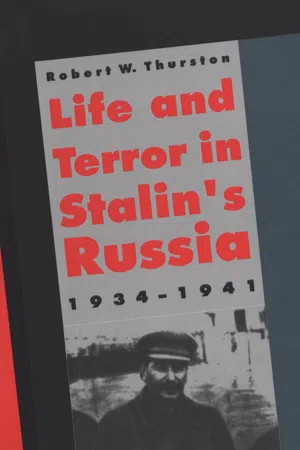
Life and Terror in Stalin's Russia, 1934-1941
eBook - PDF

Life and Terror in Stalin's Russia, 1934-1941

  1. English
  2. PDF
  3. Available on iOS & Android
eBook - PDF

Life and Terror in Stalin's Russia, 1934-1941

About this book

Terror, in the sense of mass, unjust arrests, characterized the USSR during the late 1930s. But, argues Robert Thurston in this controversial book, Stalin did not intend to terrorize the country and did not need to rule by fear. Memoirs and interviews with Soviet people indicate that many more believed in Stalin's quest to eliminate internal enemies than were frightened by it.

Drawing on recently opened Soviet archives and other sources, Thurston shows that between 1934 and 1936 police and court practice relaxed significantly. Then a series of events, together with the tense international situation and memories of real enemy activity during the savage Russian Civil War, combined to push leaders and people into a hysterical hunt for perceived "wreckers." After late 1938, however, the police and courts became dramatically milder.

Coercion was not the key factor keeping the regime in power. More important was voluntary support, fostered at least in the cities by broad opportunities to criticize conditions and participate in decision making on the local level. The German invasion of 1941 found the populace deeply divided in its judgment of Stalinism, but the country's soldiers generally fought hard in its defense. Using German and Russian sources, the author probes Soviet morale and performance in the early fighting.

Thurston's portrait of the era sheds new light on Stalin and the nature of his regime. It presents an unconventional and less condescending view of the Soviet people, depicted not simply as victims but also as actors in the violence, criticisms, and local decisions of the 1930s. Ironically, Stalinism helped prepare the way for the much more active society and for the reforms of fifty years later.

Frequently asked questions

Yes, you can cancel anytime from the Subscription tab in your account settings on the Perlego website. Your subscription will stay active until the end of your current billing period. Learn how to cancel your subscription.
No, books cannot be downloaded as external files, such as PDFs, for use outside of Perlego. However, you can download books within the Perlego app for offline reading on mobile or tablet. Learn more here.
Perlego offers two plans: Essential and Complete
  • Essential is ideal for learners and professionals who enjoy exploring a wide range of subjects. Access the Essential Library with 800,000+ trusted titles and best-sellers across business, personal growth, and the humanities. Includes unlimited reading time and Standard Read Aloud voice.
  • Complete: Perfect for advanced learners and researchers needing full, unrestricted access. Unlock 1.4M+ books across hundreds of subjects, including academic and specialized titles. The Complete Plan also includes advanced features like Premium Read Aloud and Research Assistant.
Both plans are available with monthly, semester, or annual billing cycles.
We are an online textbook subscription service, where you can get access to an entire online library for less than the price of a single book per month. With over 1 million books across 1000+ topics, we’ve got you covered! Learn more here.
Look out for the read-aloud symbol on your next book to see if you can listen to it. The read-aloud tool reads text aloud for you, highlighting the text as it is being read. You can pause it, speed it up and slow it down. Learn more here.
Yes! You can use the Perlego app on both iOS or Android devices to read anytime, anywhere — even offline. Perfect for commutes or when you’re on the go.
Please note we cannot support devices running on iOS 13 and Android 7 or earlier. Learn more about using the app.
Yes, you can access Life and Terror in Stalin's Russia, 1934-1941 by Paul Colinvaux in PDF and/or ePUB format, as well as other popular books in Politics & International Relations & Fascism & Totalitarianism. We have over one million books available in our catalogue for you to explore.

Table of contents

  1. Contents
  2. Maps and Tables
  3. Acknowledgments
  4. Introduction
  5. 1. The Police and Courts Begin to Relax, 1933-1936
  6. 2. Politics and Tension in the Stalinist Leadership, 1934-1937
  7. 3. The Political Police at Work in the Terror, 1937-1938
  8. 4. The Terror Ends
  9. 5. Fear and Belief in the Terror: Response te Arrest
  10. 6. Life in the Factories
  11. 7. The Acid lost of Stalinism: Popular Response to World War II
  12. Conclusion
  13. Abbreviations
  14. Notes
  15. Glossary of Names and Key Terms
  16. Index