eBook - PDF
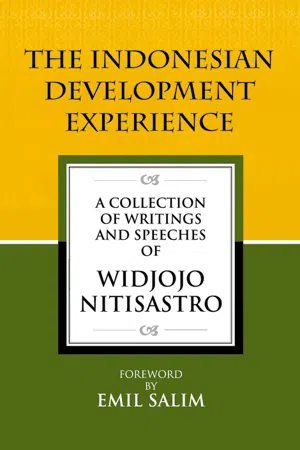
The Indonesian Development Experience
A Collection of Writings and Speeches
- 375 pages
- English
- PDF
- Available on iOS & Android
eBook - PDF
Information

3
1
ECONOMIC
ANALYSIS
AND
DEVELOPMENT
PLANNING
(1963)
1
Introductory
Note:
At
the
beginning
of
the
1960,
the
Indonesian
economy
was
in
a
tragic
state.
The
standards
of
living
in
society
were
very
low
and
were
undergoing
setbacks
from
year
to
year.
One
of
the
main
sources
of
this
situation
was
the
strong
government
opinion
at
the
time
that
economic
affairs
were
unimportant.
There
was
also
the
firm
notion
in
government
circles
at
the
time
that
economics
was
completely
useless;
it
was
even
considered
a
cause
of
social
degradation.
There
was
a
strong
view
among
the
public
at
that
time
that
the
science
of
economics
was
totally
useless
textbook
thinking.
Some
even
viewed
this
science
as
something
that
could
harm
the
way
of
life
of
the
people.
In
1962,
I
was
appointed
professor
of
economics
at
the
School
of
Economics,
University
of
Indonesia.
As
normally
practiced
by
colleges
in
Indonesia,
a
new
professor
is
expected
to
deliver
an
inaugural
speech
in
the
relevant
discipline.
The
core
of
my
inaugural
lecture
in
1963
was
that
the
economy
was
important
to
public
welfare
and
had
to
be
built
through
planning.
For
this
development
planning,
economic
analysis
was
required.
This
statement
was
a
stark
contrast
to
the
prevailing
and
dominant
view
among
government
officials
and
a
certain
section
of
the
society.
Table of contents
- Contents
- Foreword
- Introduction
- Part I. PLANNING OF INDONESIA’S DEVELOPMENT
- 1. Economic Analysis and Development Planning (1963)
- 2. Imprudent Economic and Financial Policies (1966)
- 3. Restructuring Indonesian Economic Fundamentals with 25 Economic Principles (1966)
- 4. Contribution of Ideas of the Faculty of Economics, University of Indonesia to the Session of the Provisional People’s Consultative Assembly (MPRS) (1966)
- 5. Comparison between Articles of the Contribution of Ideas of the Faculty of Economics, University of Indonesia to the Decision of the Provisional Consultative Assembly No: XXIII/MPRS/1966 (1966)
- 6. The Essence and Consequences of MPRS Decree No. XXIII, Year 1966, on Economic, Financial and Development Matters (1966)
- 7. Challenges in Increasing Food Production in Indonesia (1968)
- 8. The Basic Framework of the Five-Year Development Plan (REPELITA) (1968)
- Part II. IMPLEMENTATION OF INDONESIA’S DEVELOPMENT
- 9. Progress and Challenges of Indonesia’s Development (1990)
- 10. Some Features of Indonesia’s Economic Development During the Last Twenty-Five Years (1993)
- 11. Oil and the Indonesian Economy (1985)
- 12. Making Tough and Painful Decisions (1991)
- 13. Responding to Various Development Proposals (1997)
- Part III. FACING VARIOUS ECONOMIC CRISES
- 14. The International Monetary Crisis (1971)
- 15. Food Crisis (1972)
- 16. PERTAMINA Crisis (1975)
- 17. Devaluation of the Rupiah (1978)
- 18. Fuel Price Increase (1982)
- 19. World’s Oil-based Fuel Prices Dived (1986)
- Part IV. SETTLEMENT OF FOREIGN DEBT
- 20. Old and New Debts (1969)
- 21. A Once-And-For-All Settlement of Indonesia’s Foreign Debt (1970)
- Part V. EQUITABLE DEVELOPMENT
- 22. Equitable Distribution Programme (1979)
- 23. Fostering Small Scale Enterprises (1977)
- 24. Food, Family Nutrition and Intersectoral Cooperation (1978)
- 25. Reduction of Poverty: The Indonesian Experience (1994)
- Part VI. INDONESIA AND THE WORLD
- 26. In the Mutual Interest of Rich and Poor Nations (1982)
- 27. Indonesia Chaired the OPEC Conference in Bali at a Time When Iran and Iraq were at War (1980)
- 28. Fifteen World Economic Phenomena That Stood Out During the Decade of the 1980s (1989)
- 29. Perception of Interdependence But Lack of Meaningful Action (1984)
- 30. Advancing Mutual Understanding and Mutual Confidence (1996)
- Index
- About the Author
Trusted by 375,005 students
Access to over 1.5 million titles for a fair monthly price.
Study more efficiently using our study tools.
Frequently asked questions
Yes, you can cancel anytime from the Subscription tab in your account settings on the Perlego website. Your subscription will stay active until the end of your current billing period. Learn how to cancel your subscription
No, books cannot be downloaded as external files, such as PDFs, for use outside of Perlego. However, you can download books within the Perlego app for offline reading on mobile or tablet. Learn how to download books offline
Perlego offers two plans: Essential and Complete
- Essential is ideal for learners and professionals who enjoy exploring a wide range of subjects. Access the Essential Library with 800,000+ trusted titles and best-sellers across business, personal growth, and the humanities. Includes unlimited reading time and Standard Read Aloud voice.
- Complete: Perfect for advanced learners and researchers needing full, unrestricted access. Unlock 1.5M+ books across hundreds of subjects, including academic and specialized titles. The Complete Plan also includes advanced features like Premium Read Aloud and Research Assistant.
We are an online textbook subscription service, where you can get access to an entire online library for less than the price of a single book per month. With over 1.5 million books across 990+ topics, we’ve got you covered! Learn about our mission
Look out for the read-aloud symbol on your next book to see if you can listen to it. The read-aloud tool reads text aloud for you, highlighting the text as it is being read. You can pause it, speed it up and slow it down. Learn more about Read Aloud
Yes! You can use the Perlego app on both iOS and Android devices to read anytime, anywhere — even offline. Perfect for commutes or when you’re on the go.
Please note we cannot support devices running on iOS 13 and Android 7 or earlier. Learn more about using the app
Please note we cannot support devices running on iOS 13 and Android 7 or earlier. Learn more about using the app
Yes, you can access The Indonesian Development Experience by Widjojo Nitisastro in PDF and/or ePUB format, as well as other popular books in Economics & Economic History. We have over 1.5 million books available in our catalogue for you to explore.