The world isn'Äôt coming to an end, contrary to what you may have heard. But the media'Äôs near-exclusive focus on conflict and disaster means that the progress and everyday acts of brilliance taking place across the globe go unnoticed.
Jurriaan Kamp shows that optimism'Äîintelligent optimism, not a rose-colored-glasses brand of wishful thinking'Äîis good for not only your mind but your body too. He details a whole host of health problems that can actually be linked to pessimism. Moreover, there is good reason for optimism: Kamp proves that on the whole we'Äôre living longer, becoming smarter, working less, and growing richer. Not only that, democracy is on the rise, and violence is declining. This book will help you tune out the media'Äôs focus on sensationalism and negativity and turn on your natural optimism so you'Äôll drop into a 'Äúreal world'Äù that'Äôs richer than you ever imagined.
eBook - ePub
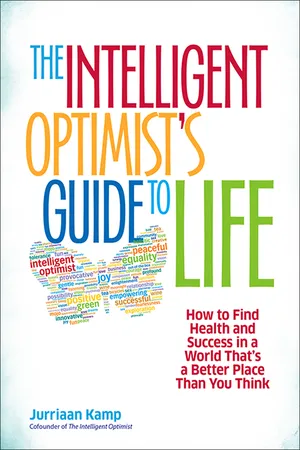
The Intelligent Optimist's Guide to Life
How To Find Health and Success in a World That's a Better Place Than You Think
- 112 pages
- English
- ePUB (mobile friendly)
- Available on iOS & Android
eBook - ePub
The Intelligent Optimist's Guide to Life
How To Find Health and Success in a World That's a Better Place Than You Think
About this book
Information
Topic
Personal DevelopmentSubtopic
Personal Success[chapter 1]
THE BEST WAY TO LIVE
Pessimism and optimism are strategies. We create
pessimism as a response to what happens to us.
But we can also respond with optimism to the
events in our life. And that’s much more rewarding.
pessimism as a response to what happens to us.
But we can also respond with optimism to the
events in our life. And that’s much more rewarding.
BAD WEATHER AND UNFOUNDED OPTIMISM
In high school, my week revolved around the field hockey game on Saturday. Back then, we still played on real grass. Hence, as the week progressed, a striking parallel arose between my mood and darkening skies. Too much rain would force the game to be canceled, which routinely happened in the fall and winter. My grumbling started well in advance. If it were raining cats and dogs on a Friday afternoon, my dear mother would try to cheer me up by looking out the window and pointing at a random piece of sky. “Look,” she’d exclaim, “it’s already clearing up over there!”
That unfounded optimism always infuriated me.
Yet she had a point. After the rain there will always be sunshine. Yes, bad things happen. But it is our choice to accept the rain and look beyond it to the coming sunshine. We create pessimism by our focus on the bad. At the same time we create optimism by focusing on the good. And, as we shall see, optimism is a much more rewarding strategy.
Optimism doesn’t mean denying reality. According to the dictionary, the everyday meaning of optimism is “hopefulness and confidence about the future or the success of something.” But the root of the word comes from Latin (optimum) and the more precise definition of optimism is “the doctrine that this world is the best of all possible worlds.”
Optimism is a fundamental attitude. It’s not an opinion about reality; it’s a starting point for dealing with reality. At every moment, you can decide that you’re in the best situation to handle a given challenge. That is optimism. Optimism is searching for the yes in every situation and finding it. Or as someone once aptly described that attitude: “If there’s no solution, then there’s no problem.”
PESSIMISM: A GIGANTIC ROADBLOCK
“This pessimism is lying across modern civilization like some enormous fallen tree and somehow we’ve got to get a bulldozer and shift it out of the way,” said the English writer and “the first philosopher of optimism in European history” Colin Wilson.1
According to Wilson, the roots of the pessimism epidemic go back to the Romantics of the early nineteenth century whose message was that humans could only briefly experience “exquisite happiness,” but it was not meant to be forever and life was supposed to be miserable. “Most people still don’t understand what has happened in Western culture over the past two centuries. How the long defeatist curve that originated in the early 19th century continues to cloud our way of thinking,” said Wilson.
Human beings have a unique capacity to find new answers through the expansion of their consciousness. That’s why optimism, the art of finding solutions, is a more logical way of life than the, in intellectual circles, still dominant—pessimistic—worldview that was “invented” by a few poets 200 years ago.
Life will inevitably deal us some bad hands from time to time. Life is not simple. That it should be is a contemporary misconception fed by modern consumerism, which offers a quick solution for every inconvenience. An increasing stream of gurus have extrapolated from that material prosperity to claim that life can be, should be, an effortless affair.
All those messages seem to have made us less of a match for life. Our ancestors trekked across the steppes and savannas. They knew they were continually in danger. They didn’t know life could be anything but challenging. Our reality consists of hospitals, insurance policies, and benefit payments when things go wrong. The welfare state has strongly influenced our expectations, but it still doesn’t preclude bad things from happening.
In 1978, psychiatrist M. Scott Peck wrote The Road Less Traveled. The book begins like this: “Life is difficult. This is a great truth, one of the greatest truths. It is a great truth because once we truly see this truth, we transcend it. Once we truly know that life is difficult—once we truly understand and accept it—then life is no longer difficult. Because once it is accepted, the fact that life is difficult no longer matters.”
Every religion and philosophy of life teaches that the meaning of life lies in our responses to the challenges we encounter. Our life lessons are the essence of our existence. That’s why the way we face those lessons is so important. “Pain is inevitable, suffering is optional,” Buddhists say. Optimism turns out to be the most promising and fulfilling strategy, because the optimist accepts reality and then does something about it.
RESILIENCE IS MORE USEFUL THAN SUSTAINABILITY
In more and more environmental dialogues the word resilience begins to replace the word sustainability. Sustainability means keeping things intact. It means avoiding causing damage. It’s about preventing change. Sustainability is a static concept.
Resilience, though, is dynamic. “The capacity to recover quickly from difficulties,” says one definition. Resilience is part of ongoing change. The world today is not the same as the world of 5,000 years ago. Nor will the world of the future much resemble our current reality. That’s why sustainability is not a helpful concept in a world of continual and rapid change.
The same applies to our daily lives. They will never be sustainable in the static sense. We can only frustrate ourselves by not accepting the changes we cannot escape. That frustration is at the root of much pessimism. The optimist is resilient. She evolves with circumstances and times.
Bad days will come. But the point is, they will go as well. So the challenge is to go as untouched as possible through the bad days. That’s where resilience comes in. But untouched does not mean “disconnected.” Resilience means remaining part of the circumstances and adapting, taking the fact in, learning the lesson—understanding and accepting—and moving on.
The focus of the optimist is on the potential change. She embraces yes and fights against no. The optimist makes the conscious choice to endure in times of hardship. It is illuminating that the Chinese use the same character for endurance as for patience: the patience required to wait for the moment when you can once again act effectively. That wise patience is also evident in theologian Reinhold Niebuhr’s famous prayer: “Grant me the serenity to accept the things I cannot change, the courage to change the things I can, and the wisdom to know the difference.”
Optimism, persistence, and resilience go hand in hand. You can’t find answers or solutions if you aren’t prepared to keep searching and digging. At the same time, you can’t find them if you don’t first accept the truth at the deepest level. That’s often a painful process. Optimism isn’t always fun and happy.
You don’t want to sustain your life as it is; you want it to be resilient and adaptable to the ever-ongoing change around you.
THERE IS NO BAD WEATHER, ONLY INAPPROPRIATE CLOTHING
Boston Philharmonic conductor Benjamin Zander and his former wife psychotherapist Rosamund Stone Zander wrote a bestselling book: The Art of Possibility. It is an art that every optimist has to master. Zander precisely distinguishes living in possibility from aiming for the possible, or hoping, or positive thinking:
“The possible is what you can achieve. Politics is the art of the possible. Possibility is not hope either. Hope comes from not being able to deal with the present. It is not positive thinking. I hate that. You can always tell that positive thinkers don’t want to deal with the negative. It is not possibilities, plural. That’s about our options, our choices. Possibility, however, is a domain. In every experience there is possibility. It is available to us every moment of the day. It is about one choice: To be in the present, and … ”2
… and in that moment the future can unfold and the answer can come.
Zander’s penchant for possibility started early. He speaks passionately about his father, who inspired his children with a Scandinavian proverb: “There is no such thing as bad weather, only inappropriate clothing.”
“Possibility is a place of imagination and response. Human beings have a capacity to accept and react. To say: Great! What’s next?,” says Zander.
We suffer a lot of unnecessary pain because we don’t say, “Great! What’s next?” We don’t respond, and we judge too early. Zhou Enlai, the Chinese leader, was asked in the early 1970s about the impact of the French Revolution. “Too early to tell,” Zhou Enlai is supposed to have answered.
Zhou likely misunderstood his interpreter. However, the anecdote points to an important message. If we are really smart when something happens to us, we won’t immediately judge and say it’s good or bad. So often a painful loss opens the door to a new and deeply meaningful experience that could not have happened without the preceding loss. The circle of life requires a rigorous discipline to stay in the state of mind of possibility and resilience. It is indeed too early to tell.
SCHOOLS BREED PESSIMISTS
In studies on happiness, the French consistently rack up the lowest scores in the Western world. The material quality of their lives is comparable to that of people in neighboring countries. Measured over long time periods, French economic growth is consistent with European averages. Yet the French are more pessimistic. Far more than other Europeans, they expect their lives to get worse, and they are the top consumers of antidepressants. Why is that?
Writing in the Financial Times, Claudia Senik, a professor of economics at the Sorbonne in Paris, indicated a possible source of French pessimism: the educational system. The French system assumes all students will achieve the same top outcome. In reality, of course, they cannot all enjoy the finest educations at the best universities. As a result, the system undermines the self-confidence of French teenagers, according to Senik. High school students feel powerless.
Powerlessness is the root of pessimism. We are all born optimists. Who has ever met a pessimistic four-year-old? A child who fell on the playground and, after having her tears dried and the scratch on her knee bandaged, decided never to run again? Those children don’t exist. Children get up, try again, and keep laughing, even through their tears. Every child has the instinctive intelligence to keep trying. Young children don’t feel powerless.
A lot of optimism gets lost in high school, and not just in France. Expectations increase. Exams and grades multiply. This creates a hierarchy within which the student is judged. No one used to count who had the bloodiest knees; suddenly, failing grades are tallied. The system strongly implies that people with higher grades lead better, more successful lives. That is an illusion of control. Those with poor scores have less control; they are more powerless; and they become more pessimistic. Education is supposed to be about opening children’s hearts and minds to new experiences. However, grades stand in the way. The educational system is a devastating experience for many children. It is a factory that produces pessimists.
WE NEED VICTORIES—VICTORIES FOR ALL
Like pessimism, optimism can be created. And we do so through our victories. There’s plenty of research that shows that we need victories in our lives. Success is good for us. Success gives us energy. Defeat takes energy away. But if we judge too early, we may misjudge an event as a defeat. Later on it may turn out to be a victory. Many athletes say that they had to endure difficult losses to build the strength to become great champions. At the same time we sometimes need to keep losing to make us see that we need to radically change a direction in our life—that our victory lies somewhere else.
After breaking his legs three times within two years, one of Germany’s most promising young skiers was forced to quit his favorite sport. Because he did, he went to medical school and became a doctor who discovered a new, innovative healing therapy. His “failure” at skiing bred his success as a doctor. Looking back, he’s grateful that he missed the medals but found the mission that fulfills his life. With his broken legs he felt a loser. Now, looking back, he feels a victor.
Optimism is not a zero-sum game. Optimism just produces life, ever more life. The optimist is not the winner in the traditional sense. The optimist is not the one who defeats the pessimist. Optimism has nothing to do with the culture of competition that so deeply undermines modern society. There’s a big difference between competing at the expense of another and overcoming challenges that make you a wiser, more loving, more compassionate, and more whole human being. The battle is with yourself, not with the other. The optimist is the winner in that personal battle. And her hard-fought victory of resilience, her gain of wisdom and understanding is a victory for all.
In the game of life, all of us can be victors. No one is destined to only lose in life. And we need much more of such victories in our interconnected world where failure in one country—or even of one company—can bring down the entire global system. We have entered a world where we can flourish only if we all win. That united winning requires the discipline of optimism. The more of us who commit to their personal victories, the more of us will benefit. Optimism is a strategy that enhances life and serves us all.
RESPONSE-ABILITY
The word responsibility can be neatly parsed: response-ability, the ability to provide a response. That ability forms the core of the optimistic lifestyle. Back to the stumbling preschooler: We don’t fail when we fall; we fail when we don’t get back up. Getting back up, one way or another, is always an option. That’s response-ability.
The most striking example of this vision is the book Man’s Search for Meaning by Austrian psychiatrist Viktor Frankl. Frankl wrote the book in the days after he was freed from a concentration camp in 1945. The original German title reveals more about the book’s message. Trotzdem Ja zum Leben sagen means “yes to life despite everything.” When Frankl was sent to the concentration camp, he decided to put his psychiatric training to the ultimate test: How does the human mind work in extremely challenging, dehumanizing circumstances? He observed what kept some people going and what pulled the rug out from under others and wrote, “Everything can be taken from a man but one thing, the last of the human freedoms: to choose one’s attitude in any given set of circumstances, to choose one’s own way.”
The optimist knows he is not in control of all that happens in his life, but that he does determine his response to it. The pessimist feels like a victim; the optimist searches for solutions.
And there is always a solution, or at least the beginning of one. After actor Michael J. Fox developed Parkinson’s disease, he related in a television interview how he finally came to terms with it: “The answer had nothing to do with protection and ev...
Table of contents
- Cover Page
- Title Page
- Copyright Page
- Dedication
- Contents
- A Note from the Author
- [Introduction] Stories, News, and the Challenge of Optimism
- [1] The Best Way to Live
- [2] A Key to Health, Happiness, and Success
- [3] How to Become an (Even Better) Optimist
- [4] The World Is a Better Place Than You Think
- [5] Welcome to the Age of Optimism
- Checklist for Optimists
- Life Orientation Test Scoring
- Notes
- Resources
- Acknowledgments
- Index
- About the Author
- About The Intelligent Optimist
Trusted by 375,005 students
Access to over 1.5 million titles for a fair monthly price.
Study more efficiently using our study tools.
Frequently asked questions
Yes, you can cancel anytime from the Subscription tab in your account settings on the Perlego website. Your subscription will stay active until the end of your current billing period. Learn how to cancel your subscription
No, books cannot be downloaded as external files, such as PDFs, for use outside of Perlego. However, you can download books within the Perlego app for offline reading on mobile or tablet. Learn how to download books offline
Perlego offers two plans: Essential and Complete
- Essential is ideal for learners and professionals who enjoy exploring a wide range of subjects. Access the Essential Library with 800,000+ trusted titles and best-sellers across business, personal growth, and the humanities. Includes unlimited reading time and Standard Read Aloud voice.
- Complete: Perfect for advanced learners and researchers needing full, unrestricted access. Unlock 1.5M+ books across hundreds of subjects, including academic and specialized titles. The Complete Plan also includes advanced features like Premium Read Aloud and Research Assistant.
We are an online textbook subscription service, where you can get access to an entire online library for less than the price of a single book per month. With over 1.5 million books across 990+ topics, we’ve got you covered! Learn about our mission
Look out for the read-aloud symbol on your next book to see if you can listen to it. The read-aloud tool reads text aloud for you, highlighting the text as it is being read. You can pause it, speed it up and slow it down. Learn more about Read Aloud
Yes! You can use the Perlego app on both iOS and Android devices to read anytime, anywhere — even offline. Perfect for commutes or when you’re on the go.
Please note we cannot support devices running on iOS 13 and Android 7 or earlier. Learn more about using the app
Please note we cannot support devices running on iOS 13 and Android 7 or earlier. Learn more about using the app
Yes, you can access The Intelligent Optimist's Guide to Life by Jurriaan Kamp in PDF and/or ePUB format, as well as other popular books in Personal Development & Personal Success. We have over 1.5 million books available in our catalogue for you to explore.