Cultures in Motion
eBook - PDF

Cultures in Motion

Mapping Key Contacts and Their Imprints in World History

  1. 128 pages
  2. English
  3. PDF
  4. Available on iOS & Android
eBook - PDF

Cultures in Motion

Mapping Key Contacts and Their Imprints in World History

About this book

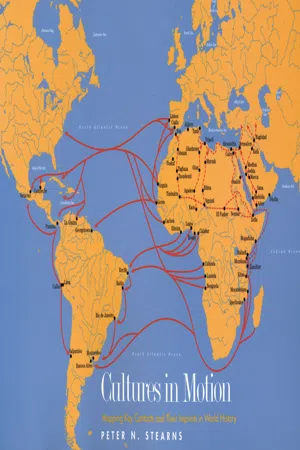
When different cultures come in contact with one another, the impact on the course of history can be dramatic and unexpected. Encounters between separate societies or civilizations have resulted in the spread of major religions, vast migrations, scientific breakthroughs, the dissemination of powerful political notions, and many other transformations. This unique book brings to life key episodes of cultural contact in world history, from the beginnings of civilization to the present. Through a combination of vivid case studies and imaginative color maps, award-winning history professor Peter Stearns shows how we can better understand world history by examining what happens when culture meets culture.

One culture’s new contact with another can lead to assimilation, rejection, or--most often--a merging of elements from both cultures. Stearns focuses on fourteen important historical examples of intercultural exchange from around the globe. He considers:
• the spread of major religions, such as Buddhism and Islam
• voluntary and forced migrations, such as the Jewish and African diasporas
• the dissemination of modern forces, including nationalism and Marxism
• the impact of European colonial rule on gender relations in India and in Africa
• recent international diffusion of consumer culture
• and much more

For each example, original maps reveal geographic patterns and provide a clear sense of the impact of that particular meeting of cultures.

Frequently asked questions

Yes, you can cancel anytime from the Subscription tab in your account settings on the Perlego website. Your subscription will stay active until the end of your current billing period. Learn how to cancel your subscription.
No, books cannot be downloaded as external files, such as PDFs, for use outside of Perlego. However, you can download books within the Perlego app for offline reading on mobile or tablet. Learn more here.
Perlego offers two plans: Essential and Complete
  • Essential is ideal for learners and professionals who enjoy exploring a wide range of subjects. Access the Essential Library with 800,000+ trusted titles and best-sellers across business, personal growth, and the humanities. Includes unlimited reading time and Standard Read Aloud voice.
  • Complete: Perfect for advanced learners and researchers needing full, unrestricted access. Unlock 1.4M+ books across hundreds of subjects, including academic and specialized titles. The Complete Plan also includes advanced features like Premium Read Aloud and Research Assistant.
Both plans are available with monthly, semester, or annual billing cycles.
We are an online textbook subscription service, where you can get access to an entire online library for less than the price of a single book per month. With over 1 million books across 1000+ topics, we’ve got you covered! Learn more here.
Look out for the read-aloud symbol on your next book to see if you can listen to it. The read-aloud tool reads text aloud for you, highlighting the text as it is being read. You can pause it, speed it up and slow it down. Learn more here.
Yes! You can use the Perlego app on both iOS or Android devices to read anytime, anywhere — even offline. Perfect for commutes or when you’re on the go.
Please note we cannot support devices running on iOS 13 and Android 7 or earlier. Learn more about using the app.
Yes, you can access Cultures in Motion by Peter N. Stearns in PDF and/or ePUB format, as well as other popular books in History & World History. We have over one million books available in our catalogue for you to explore.

Information

Year
2008
eBook ISBN
9780300128284
Edition
1
Topic
History
Index
History

Table of contents

  1. Acknowledgments
  2. Introduction
  3. Part I. Early Cultural Contacts Through the Classical Period
  4. Part II. Postclassical and Early Modern Periods, 450–1750 CE
  5. Part III. The Modern Centuries
  6. Bibliography
  7. Index