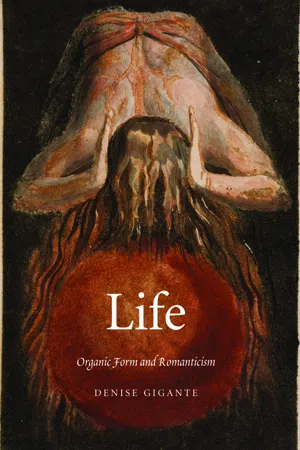
What makes something alive? Or, more to the point, what is life? The question is as old as the ages and has not been (and may never be) resolved. Life springs from life, and liveliness motivates matter to act the way it does. Yet vitality in its very unpredictability often appears as a threat. In this intellectually stimulating work, Denise Gigante looks at how major writers of the Romantic period strove to produce living forms of art on an analogy with biological form, often finding themselves face to face with a power known as monstrous. The poets Christopher Smart, William Blake, Percy Bysshe Shelley and John Keats were all immersed in a culture obsessed with scientific ideas about vital power and its generation, and they broke with poetic convention in imagining new forms of life. In 'Life: Organic Form and Romanticism', Gigante offers a way to read ostensibly difficult poetry and reflects on the natural-philosophical idea of organic form and the discipline of literary studies.
- 332 pages
- English
- PDF
- Available on iOS & Android
eBook - PDF
About this book
Information
Table of contents
- Contents
- Acknowledgments
- Abbreviations
- 1. Introduction
- 2. Smart’s Powers: Jubilate Agno
- 3. Blake’s Living Form: Jerusalem
- 4. Shelley’s Vitalist “Witch”
- 5. Keats’s Principle of Monstrosity: Lamia
- Notes
- Index
Trusted by 375,005 students
Access to over 1.5 million titles for a fair monthly price.
Study more efficiently using our study tools.
Frequently asked questions
Yes, you can cancel anytime from the Subscription tab in your account settings on the Perlego website. Your subscription will stay active until the end of your current billing period. Learn how to cancel your subscription
No, books cannot be downloaded as external files, such as PDFs, for use outside of Perlego. However, you can download books within the Perlego app for offline reading on mobile or tablet. Learn how to download books offline
Perlego offers two plans: Essential and Complete
- Essential is ideal for learners and professionals who enjoy exploring a wide range of subjects. Access the Essential Library with 800,000+ trusted titles and best-sellers across business, personal growth, and the humanities. Includes unlimited reading time and Standard Read Aloud voice.
- Complete: Perfect for advanced learners and researchers needing full, unrestricted access. Unlock 1.5M+ books across hundreds of subjects, including academic and specialized titles. The Complete Plan also includes advanced features like Premium Read Aloud and Research Assistant.
We are an online textbook subscription service, where you can get access to an entire online library for less than the price of a single book per month. With over 1.5 million books across 990+ topics, we’ve got you covered! Learn about our mission
Look out for the read-aloud symbol on your next book to see if you can listen to it. The read-aloud tool reads text aloud for you, highlighting the text as it is being read. You can pause it, speed it up and slow it down. Learn more about Read Aloud
Yes! You can use the Perlego app on both iOS and Android devices to read anytime, anywhere — even offline. Perfect for commutes or when you’re on the go.
Please note we cannot support devices running on iOS 13 and Android 7 or earlier. Learn more about using the app
Please note we cannot support devices running on iOS 13 and Android 7 or earlier. Learn more about using the app
Yes, you can access Life by Denise Gigante in PDF and/or ePUB format, as well as other popular books in Literature & Gothic, Romance, & Horror Literary Criticism. We have over 1.5 million books available in our catalogue for you to explore.