eBook - PDF
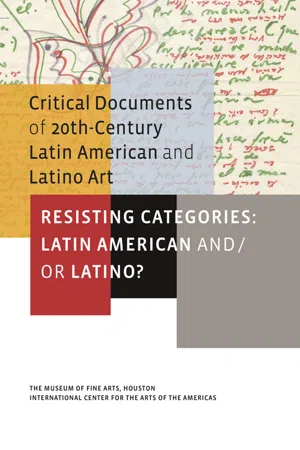
Resisting Categories: Latin American and/or Latino?
- 1,160 pages
- English
- PDF
- Available on iOS & Android
eBook - PDF
Resisting Categories: Latin American and/or Latino?
Information
Topic
ArtSubtopic
Art GeneralTable of contents
- TABLE OF CONTENTS
- Foreword
- Funders of the ICAA Digital Archive Project and Book Series
- Acknowledgments
- Critical Documents of 20th-Century Latin American and Latino Art: A DIGITAL ARCHIVE AND PUBLICATIONS PROJECT AT THE MUSEUM OF FINE ARTS, HOUSTON
- Project Administration, Staff, and Consultants
- A Brief Guide to Using Volume I: NOTES ON THE SELECTION, PRESENTATION, EDITING, AND ANNOTATION OF TEXTS
- Resisting Categories
- I. THE CONTINENTAL UTOPIA
- The Continental Utopia
- I.1 AMERICA AS A UTOPIAN REFRACTION
- I.1.1 Concerning the Islands Recently Discovered in the Indian Sea
- I.1.2 Utopia
- I.1.3 New Atlantis
- I.1.4 Machu Picchu: The Discovery
- I.1.5 The Christening of America
- I.1.6 The March of Utopias
- I.1.7 The Invention of America
- I.2 THE INVENTION OF AN OPERATIVE CONCEPT
- I.2.1 The Latin American States
- I.2.2 Ancient and Modern Mexico
- I.2.3 The Latin Democracies in America
- I.2.4 To what extent is there a Latin America?
- I.2.5 Latin America
- I.2.6 Does Latin America Exist?
- I.2.7 Luis Alberto Sánchez’s Book: Is There Just One Latin America?
- I.2.8 Latin American Unity
- I.2.9 Does Latin America Exist?
- I.2.10 The Invention of an Operative Concept: The Latin-ness of America
- I.2.11 Latin America: An Introduction to Far-Western Identity
- I.3 NUESTRA AMÉRICA, THE MULTI-HOMELAND
- I.3.1 Letter from Lope de Aguirre, Rebel, to King Philip of Spain
- I.3.2 Reply of a South American to a Gentleman of this Island (Jamaica)
- I.3.3 The Latin American Multi-Homeland
- I.3.4 Our America
- I.3.5 Latin America—Evils of Origin (Summary)
- I.3.6 Latin American Perspectives
- I.3.7 The Creation of a Continent
- I.3.8 Letter to the Youth of Colombia
- I.3.9 The Beginnings of an American Culture
- I.4 IS AMÉRICA A NO-PLACE?
- I.4.1 Latin America—Evils of Origin (Conclusion)
- I.4.2 Indology
- I.4.3 First Message to Hispanic America
- I.4.4 Guardians of the Quill
- I.4.5 The Destiny of America
- I.4.6 The Actual Function of Philosophy in Latin America
- I.5 TENSIONS AT STAKE
- I.5.1 Latin America
- I.5.2 Toward an Efficient Latin America
- I.5.3 Barren Imperialism
- I.5.4 Which Culture Will Create Latin America: The Mexican Parameter or the Argentinean One?
- I.5.5 Autochtonism and Europeanism
- I.5.6 Americanism and Peruvianism
- I.5.7 The Anthropophagous Manifesto
- I.6 DOES BRAZIL BELONG TO LATIN AMÉRICA?
- I.6.1 Brazil in the Americas
- I.6.2 The Disconnection of America
- I.6.3 The Cordial Man, an American Product
- I.6.4 The Roots of Brazil: Frontiers of Europe
- I.6.5 The Roots of Brazil: The Sower and the Bricklayer
- I.6.6 What Does Latin America Mean?
- I.6.7 Brazilians and Our America
- II. A NEW ART
- A New Art
- II.1 A NEW ART FOR A NEW CONTINENT
- II.1.1 A Visit to the Exhibition at [The School] of Fine Arts
- II.1.2 Three Appeals for the Current Guidance of the New Generation of American Painters and Sculptors
- II.1.3 Eurindia
- II.1.4 Art Interpretations
- II.1.5 The New Art
- II.1.6 New World, New Races, New Art
- II.1.7 Lesson 132: The American Man and the Art of the Americas
- II.2 SURVEYS CONCERNING A CONTINENTAL ATTITUDE
- II.2.1–II.2.7 A SURVEY: WHAT SHOULD AMERICAN ART BE? (1928–29)
- II.2.1 Response to revista de avance Survey
- II.2.2 Response to revista de avance Survey
- II.2.3 Response to revista de avance Survey
- II.2.4 Response to revista de avance Survey
- II.2.5 Response to revista de avance Survey
- II.2.6 Response to revista de avance Survey
- II.2.7 State of an Investigation
- II.2.8 Apex of the New Taste
- II.2.9 Our Surveys: Painting in Latin America, What Luis Felipe Noé has to Say
- II.3 HARBINGERS OF THE NEW ART
- II.3.1–II.3.2 XUL SOLAR ON PETTORUTI
- II.3.1 Pettoruti and His Works
- II.3.2 Pettoruti
- II.3.3–II.3.4 ON CARLOS MÉRIDA
- II.3.3 Images of Guatemala
- II.3.4 Carlos Mérida: Essay on the Art of the Tropics
- II.3.5 Pablo Picasso: First Spiritual Unifier of Latin America
- II.3.6 Modern Mexican Painting
- II.3.7 Sabogal in Mexico
- III. THE GOOD NEIGHBORHOOD AND BAD TIMES
- The Good Neighborhood and Bad Times
- III.1 THE MONROE DOCTRINE: A PRECURSOR TO PAN AMERICANISM
- III.1.1 Annual Message: The Monroe Doctrine
- III.1.2 The American Illusion
- III.1.3 The Ailing Continent
- III.1.4 Europe and Latin America: Current Opinion and Consequences of European Malevolence
- III.1.5 Landings: Culture and Hispano-Americanism
- III.1.6 Bolivár-ism and Monroe-ism: Hispanic-Americanism and Pan Americanism
- III.1.7 The Latin American Essays: Newton Freitas
- III.1.8 The Puerto Rican Personality in the Commonwealth
- III.2 HALF-WORLDS IN CONFLICT
- III.2.1 Ariel: The Idea of Nordomania
- III.2.2 The American Half-Worlds
- III.2.3 Americanism and Hispanicism
- III.2.4 Edward Weston and Tina Modotti
- III.2.5 Art and Pan Americanism
- III.2.6 Latin American Unity: A Battle Of Diplomacy in San Francisco
- III.2.7 Caliban: A Question
- III.3 INSIGHTS FROM LATIN AMERICA ON U.S. ART AND SOCIETY
- III.3.1 Art in the United States
- III.3.2 Comrades in Chicago
- III.3.3 My Opinion on the North American Artists’ Exhibition
- III.3.4 Impressions from My Visit to the United States of North America
- III.3.5 Letter from New York
- III.4 THE UNITED STATES “PRESENTS” AND “COLLECTS” LATIN AMERICAN ART
- III.4.1 – III.4.2 CONFERENCE ON INTER-AMERICAN RELATIONS IN THE FIELD OF ART
- III.4.3 – 4.5 LATIN AMERICAN EXHIBITION OF FINE ARTS, 1940
- III.4.3 Message to the Latin American Exhibition of Fine Arts
- III.4.4 Introduction to Latin American Exhibition of Fine Arts
- III.4.5 Foreword to Latin American Exhibition of Fine Arts
- III.4.6 The Latin American Collection of the Museum of Modern Art
- III.4.7 – 4.8 PROCEEDINGS OF A CONFERENCE HELD AT THE MUSEUM OF MODERN ART, MAY 28–31, 1945
- III.4.7 Problems of Research and Documentation in Contemporary Latin American Art
- III.4.8 Contemporary Regional Schools in Latin America
- III.4.9 Traveling Exhibitions of Latin American Art Available for Circulation in the United States
- III.4.10 The United States Collects Pan American Art
- IV. LONGING AND BELONGING
- Longing and Belonging
- IV.1 STRADDLING A CULTURAL DOCTRINE
- IV.1.1 Introduction: “La Plebe”
- IV.1.2 The Cosmic Race: Grounds for a New Civilization
- IV.1.3 The Historical and Intellectual Presence of Mexican-Americans
- IV.1.4 Chicano Art
- IV.2 A DOSE OF SKEPTICISM
- IV.2.1–IV.2.2 MARTA TRABA
- IV.2.1 What Does “A Latin American Art” Mean?
- IV.2.2 Art’s Problems in Latin America
- IV.2.3 The Emergent Decade: Latin American Painters and Painting in the 1960s
- IV.2.4 Art of Latin America Since Independence
- IV.2.5– IV.2.6 THE “QUESTION” CONCERNING LATIN AMERICAN ART
- IV.2.5 The Question of Latin American Art: Does It Exist?
- IV.2.6 “The Question” 17 Years Later
- IV.2.7– IV.2.8 ARTES VISUALES ASKS: “WHEN WILL THE ART OF LATIN AMERICA BECOME LATIN AMERICAN ART?”
- IV.2.7 In Reply to A Question: “When will the art of Latin America become Latin American art?”
- IV.2.8 Comments on the Article by Damián Bayón
- IV.2.9 Why a Latin American Art?
- IV.3 OUR JANUS-FACED DILEMMA: IDENTITY OR MODERNITY?
- IV.3.1 The Problem of the “Existence” of the Latin American Artist
- IV.3.2 Identity or Modernity?
- IV.3.3 The Invention of Latin American Art
- IV.3.4 The Visual Arts in a Consumer Society
- IV.3.5 Toward a New Artistic Problem in Latin America
- IV.3.6 The Specificity of Latin American Art
- IV.3.7 The Nostalgia for History in the Visual Imagination of Latin America
- IV.3.8 Modern Art in Latin America
- IV.4 DEBATING IDENTITY ON A CONTINENTAL SCALE
- IV.4.1– IV.4.3 SPEAK OUT! CHARLA! BATE-PAPO!: CONTEMPORARY ART AND LITERATURE IN LATIN AMERICA, SYMPOSIUM AT THE UNIVERSITY OF TEXAS AT AUSTIN, OCTOBER 1975
- IV.4.1 Latin American Art Today Does and Does Not Exist as a Distinct Expression
- IV.4.2 Latin America: A Culturally Occupied Continent
- IV.4.3 We Are Latin Americans: The Way of Resistance
- IV.4.4– IV.4.7 THE ETSEDRÓN DEBATE: THE 13TH SÃO PAULO BIENNIAL, OCTOBER 1975
- IV.4.4 Etsedrón: A Form of Violence
- IV.4.5 Etsedrón: Comments on the Article by Aracy A. Amaral
- IV.4.6 Etsedrón, or the Lack of Libidinous Interest in Reality
- IV.4.7 The Necessary Plurality of Latin American Art
- IV.4.8– IV.4.9 CONTROVERSIES AND PAPERS: SYMPOSIUM OF THE FIRST LATIN AMERICAN BIENNIAL OF SÃO PAULO
- IV.4.8 First Latin American Biennial of São Paulo
- IV.4.9 Why Do We Fear Latin Americanism?
- IV.4.10–IV.4.11 A FIRST CRITICAL ENCOUNTER WITH ARTISTS AND THE VISUAL ARTS: AN INTERNATIONAL COLLOQUIUM, MUSEO DE BELLAS ARTES, JUNE 1978
- IV.4.10 Alternatives for Current Latin American Painting
- IV.4.11 Questions
- V. DESTABILIZING CATEGORIZATIONS
- Destabilizing Categorizations
- V.1 EXHIBITING ENTRENCHED REPRESENTATIONS
- V.1.1–V.1.2 HISPANIC AMERICAN ART IN CHICAGO, CHICAGO STATE UNIVERSITY GALLERY, 1980
- V.1.1 Hispanic-American Art in Chicago
- V.1.2 Some Thoughts Concerning the Exhibit of Hispanic Art in Chicago
- V.1.3–V.1.7 HISPANIC ART IN THE UNITED STATES: THIRTY CONTEMPORARY PAINTERS AND SCULPTORS, MUSEUM OF FINE ARTS, HOUSTON, 1987
- V.1.3 Hispanic Art in the United States
- V.1.4 Art And Identity: Hispanics in the United States
- V.1.5 Homogenizing Hispanic Art
- V.1.6 The Poetics and Politics of Hispanic Art: A New Perspective
- V.1.7 Minorities and Fine-Arts Museums in the United States
- V.1.8 The Latin American Spirit
- V.1.9 Art of the Fantastic
- V.1.10 Latin American Artists of the Twentieth Century
- V.2 QUESTIONING STEREOTYPES
- V.2.1 Mexican, Mexican American, Chicano Art: Two Views
- V.2.2 Turning It Around: A Conversation
- V.2.3 On Our Own Terms
- V.2.4 Latin American Art’s U.S. Explosion: Looking A Gift Horse in the Mouth
- V.2.5 “Fantastic” are the Others
- V.2.6 Beyond “The Fantastic”: Framing Identity in U.S. Exhibitions of Latin American Art
- V.2.7 Latin American Cultures: Mimicry or Difference
- VI. THE MULTICULTURAL SHIFT
- The Multicultural Shift
- VI.1 IDEOLOGY BETWEEN TWO WATERS
- VI.1.1 Border Culture: The Multicultural Paradigm
- VI.1.2 Mixing
- VI.1.3 Living Borders/Buscando América: Languages of Latino Self-Formation
- VI.1.4 Between Two Waters: Image and Identity in Latino-American Art
- VI.1.5 Multi-Correct Politically Cultural
- VI.1.6 The Chicano Movement/The Movement Of Chicano Art
- VI.1.7 Barricades of Ideas: Latino Culture, Site Specific Installation and the U.S. Art Museum
- VI.1.8 Aesthetic Moments of Latin Americanism
- VI.2 THE TRANSNATIONAL MISE-EN-SCÈNE
- VI.2.1 Facing the Americas
- VI.2.2–VI.2.3 CARTOGRAPHIES
- VI.2.2 Latin America: Another Cartography
- VI.2.3 Incomplete Glossary of Sources of Latin American Art
- VI.2.4 Signs of a Transnational Fable
- VI.2.5 Latin American Art’s International Mise-En-Scène: Installation and Representation
- VI.2.6 Empowering the Local
- VI.2.7 From Latin American Art to Art from Latin America
- EDITORS’ BIOGRAPHIES
- RESEARCHER AND TRANSLATOR CREDITS
- INDEX
- COPYRIGHT CREDITS
Trusted by 375,005 students
Access to over 1.5 million titles for a fair monthly price.
Study more efficiently using our study tools.
Frequently asked questions
Yes, you can cancel anytime from the Subscription tab in your account settings on the Perlego website. Your subscription will stay active until the end of your current billing period. Learn how to cancel your subscription
No, books cannot be downloaded as external files, such as PDFs, for use outside of Perlego. However, you can download books within the Perlego app for offline reading on mobile or tablet. Learn how to download books offline
Perlego offers two plans: Essential and Complete
- Essential is ideal for learners and professionals who enjoy exploring a wide range of subjects. Access the Essential Library with 800,000+ trusted titles and best-sellers across business, personal growth, and the humanities. Includes unlimited reading time and Standard Read Aloud voice.
- Complete: Perfect for advanced learners and researchers needing full, unrestricted access. Unlock 1.5M+ books across hundreds of subjects, including academic and specialized titles. The Complete Plan also includes advanced features like Premium Read Aloud and Research Assistant.
We are an online textbook subscription service, where you can get access to an entire online library for less than the price of a single book per month. With over 1.5 million books across 990+ topics, we’ve got you covered! Learn about our mission
Look out for the read-aloud symbol on your next book to see if you can listen to it. The read-aloud tool reads text aloud for you, highlighting the text as it is being read. You can pause it, speed it up and slow it down. Learn more about Read Aloud
Yes! You can use the Perlego app on both iOS and Android devices to read anytime, anywhere — even offline. Perfect for commutes or when you’re on the go.
Please note we cannot support devices running on iOS 13 and Android 7 or earlier. Learn more about using the app
Please note we cannot support devices running on iOS 13 and Android 7 or earlier. Learn more about using the app
Yes, you can access Resisting Categories: Latin American and/or Latino? by Mari Carmen Ramírez, Tomas Ybarra-Frausto, Héctor Olea in PDF and/or ePUB format, as well as other popular books in Art & Art General. We have over 1.5 million books available in our catalogue for you to explore.