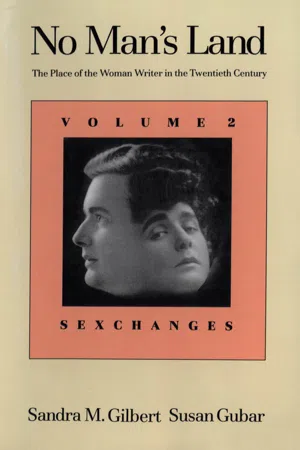
What might sex be, and what could sex roles be, in the midst of a war between men and women? What is a "woman," a "man," an "androgyne"? Such questions haunt the works Gilbert and Gubar study in Sexchanges, the second volume of their landmark trilogy No Man's Land. Investigating the connections between the feminine and the modern made by writers from Rider Haggard, Olive Schreiner, and Kate Chopin to Edith Wharton, Willa Cather, D.H. Lawrence, Virginia Woolf, T.S. Eliot, and Caryl Churchill, they show that the "no man's land" of the Great War became a metaphor for a crisis of masculinity—a crisis that was already associated with the decline of imperialism and the rise of the femme fatale at the fin de siecle, with the newly visible lesbian literary community that was formed in those years and with what many thinkers increasingly understood to be the artifice of gender. Throughout this century, the therefore argue, images of sexchanges - explored in fictions about transvestism and transsexualism - constituted a set of striking tropes through which male and female writers sought to combat one another's conceptions of the relation between anatomy and destiny.
- 475 pages
- English
- PDF
- Available on iOS & Android
eBook - PDF
No Man's Land
About this book
Information
Table of contents
- Contents
- Preface
- I. Feminism and Fantasy
- II. Feminization and Its Discontents
- III. Reinventing Gender
- Notes
- Index
Trusted by 375,005 students
Access to over 1.5 million titles for a fair monthly price.
Study more efficiently using our study tools.
Frequently asked questions
Yes, you can cancel anytime from the Subscription tab in your account settings on the Perlego website. Your subscription will stay active until the end of your current billing period. Learn how to cancel your subscription
No, books cannot be downloaded as external files, such as PDFs, for use outside of Perlego. However, you can download books within the Perlego app for offline reading on mobile or tablet. Learn how to download books offline
Perlego offers two plans: Essential and Complete
- Essential is ideal for learners and professionals who enjoy exploring a wide range of subjects. Access the Essential Library with 800,000+ trusted titles and best-sellers across business, personal growth, and the humanities. Includes unlimited reading time and Standard Read Aloud voice.
- Complete: Perfect for advanced learners and researchers needing full, unrestricted access. Unlock 1.5M+ books across hundreds of subjects, including academic and specialized titles. The Complete Plan also includes advanced features like Premium Read Aloud and Research Assistant.
We are an online textbook subscription service, where you can get access to an entire online library for less than the price of a single book per month. With over 1.5 million books across 990+ topics, we’ve got you covered! Learn about our mission
Look out for the read-aloud symbol on your next book to see if you can listen to it. The read-aloud tool reads text aloud for you, highlighting the text as it is being read. You can pause it, speed it up and slow it down. Learn more about Read Aloud
Yes! You can use the Perlego app on both iOS and Android devices to read anytime, anywhere — even offline. Perfect for commutes or when you’re on the go.
Please note we cannot support devices running on iOS 13 and Android 7 or earlier. Learn more about using the app
Please note we cannot support devices running on iOS 13 and Android 7 or earlier. Learn more about using the app
Yes, you can access No Man's Land by István Bibó, Péter Pásztor, Iván Zoltán Dénes in PDF and/or ePUB format, as well as other popular books in Literature & English Literary Criticism. We have over 1.5 million books available in our catalogue for you to explore.