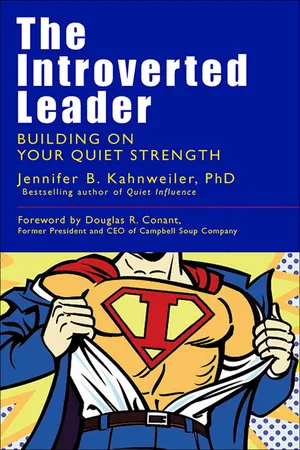
Succeeding in an Extroverted Business WorldIn our extroverted business culture, introverts can feel excluded, overlooked, or misunderstood. But being an introvert doesn't mean you can't be a great leader. Citing examples of highly successful leaders like Bill Gates and Warren Buffett, Jennifer Kahnweiler shows that introverts can build on their quiet strength and make it a source of great power. After highlighting the common challenges introverts face at work, such as stress, invisibility, and perception gaps, the book details a straightforward four-step process to handle work situations such as managing up, leading projects, public speaking, and many more. Kahnweiler provides numerous examples and leadership tips as well as a revealing Introverted Leader Quiz that pinpoints where focused attention will produce maximum results, The Introverted Leader will teach you to embrace your natural work style in order to advance your career, get the most out of the people around you, and add value to your organization. "Finally, a book that recognizes the immense value that introverts bring to the workplace. You'll learn how to lead with quiet confidence through powerful personal examples and practical tools."—Daniel H. Pink, author of A Whole New Mind"This thoughtful process offers to improve the leadership potential of many who make a significant contribution to the people around them, and, by extension, our society at large."—Edward T. Reilly, President and CEO, American Management Association International"The Introverted Leader offers a straightforward and practical approach to business communication and leadership that will allow introverts to cut through the noise of an extroverted world and have their invaluable voices heard."—Carol A. DiBattiste, Senior Vice President, Privacy, Security, Compliance, and Government Affairs, LexisNexis Group
- 192 pages
- English
- ePUB (mobile friendly)
- Available on iOS & Android
eBook - ePub
About this book
Information
Chapter 1
Four Key Challenges
“It’s not easy being green,” sang Kermit the Frog on The Muppet Show. Substitute “introverted” for “green.” Although you may have buzzed along pretty smoothly in your role as individual contributor, once you decide to move your career forward, or after your organization taps you for more responsibility, life can become more complex if you are withdrawn.
Let’s look at key challenges that can result from being an introverted professional.
The Challenges
Understanding what challenges can occur in your life as an introvert at work helps you realize what behaviors to change. We tend to make adjustments when the pain of doing things the same old way is great enough. When we encounter roadblocks while driving, we are forced to find alternative routes. Similarly, these workplace barriers can be enlightening. A number of my introverted coaching clients have had light bulbs go off when we have discussed the following four common challenges. Giving a name to what they’ve experienced often gives them an impetus to change. Let’s look at the four major categories of challenges introverted leaders encounter at work. They are (1) stress, (2) perception gaps, (3) career derailers, and (4) invisibility.
1. Stress
Work overload, physical symptoms, and people exhaustion are all negative consequences that can hit introverts hard in the workplace. Here are some examples of each.
Work Overload
Recently out of school, a woman I know named Mady landed a plum job as a staff accountant at a large health care organization. She was looking forward to learning a lot and using her education. The honeymoon period of the first few weeks flew by, and her manager was pleased with her work. Unfortunately, a few weeks later, the picture had changed dramatically. Mady was getting into the office at 6:30 A.M. and leaving after 7:00 P.M. Her schedule was causing friction with her boyfriend and friends.
What happened in the interim? Mady had been pulled onto a few projects, and word got out that she was a sharp employee. When asked to join a project, she didn’t say no. Afraid that people would think she was not capable or willing, Mady ended up drowning in a sea of projects and deadlines. In the end, she struggled to deliver on all her commitments. Her boss was not even aware of all her work, or he might have put the brakes on his overeager employee.
Have you ever found yourself unable to say no to a work request? For introverted people, lacking the self-assurance and confidence to assert themselves in social situations can affect not only their performance, but even more importantly, their health. It is not as much stress (which will always be there) but our reaction to it that causes problems. Mady’s inability to set limits and ask for some direction from her boss created work/life balance issues that were destined to get worse.
Physical Symptoms
At a recent seminar, I was talking with two withdrawn men who both acknowledged that they stuttered at meetings when called on to speak. In more relaxed surroundings, like the class, they were fine, but in this work situation they froze up. These participants illustrated that there is most likely a mind-body connection to stress. Symptoms like headaches, stomachaches, and back problems can also be correlated with stress reactions. Even the awkwardness that introverted people sometimes feel with people can take its toll. Holding feelings inside when we are frustrated makes it highly likely that these types of physical symptoms will occur.
People Exhaustion
It is also common for introverted leaders to become very tired when they are forced to continually be with people. Fatigue and a sense of dread can set in before a social event, and these get-togethers are endured with clenched teeth. One of my introverted colleagues left a convention a day early because of her exhaustion from being around “so many happy, talkative people.” Another asked me if I had heard the joke about the introverted manager who said he would rather stay home with a bad book that he had already read than face one of those awful cocktail receptions.
One of the ways you can tell if you are introverted is that you need time to recharge your batteries and decompress after you spend time with others. The author of Mars and Venus in the Workplace, John Gray, PhD, portrays a “cave” as a metaphor for a man’s place of retreat, where he can take a needed break from the opposite sex.1 Many introverts tell me that a similar type of escape is essential to recover from the utter exhaustion they feel from being surrounded by extroverts.
I have some empathy. I was on a relaxing beach vacation recently when one of the hotel guests caused me to experience a stress reaction. He seemed like a nice guy at the beginning of our conversation. After he did not shut up for the next 45 minutes, and after I tried several times to interject a comment or a question, I felt tired and not heard. This is what I believe introverts must feel daily.
Sometimes, being surprised can create stress. Paul Otte, an IT project manager at IBM with more than 15 years of experience, said that he experiences stress when he is called on to respond quickly and does not have an answer. He described it as feeling “naked.” He worries most about the people he calls “snipers,” the folks who use some esoteric piece of data to discredit his point.
Forcing yourself to play a visible management role can also take its toll. Being outgoing, conversational, and engaged is something that Sid Milstein does as a leader. He also finds that he can become mentally exhausted from the role playing, not the discussion. Sid told me, “It can take the form of a headache, the need to be alone to reflect upon ‘what I’ve just done.’ It’s no different than what I might feel after a physical workout. . . . Of course in the continuing acting role, I have to disguise this from everyone else, which keeps my stress level up.” Adapting their behavior can become easier over time, but it will never be their natural style. Introverted professionals have to be self-aware on a continual basis, and this takes a great deal of energy.
2. Perception Gaps
There are often key differences between how we think people see us and how they actually do. You have heard the phrase, “perception is reality.” In his book Cracking the Code, Thom Hartman says, “The meaning of communication is the response you get.”2 It can be helpful for introverted professionals to understand the nature and results of this disconnect between their intended message and what comes across. Negative impressions, and possibly being labeled as slow thinkers or as having no backbone are some of the negative perceptions that introverted leaders may face. Let’s take a closer look at each of these.
Negative Impressions
Introverted people do not intend to create a negative impression. Yet, they often do with others who are more outgoing. They want to be seen as competent and confident in their work environments, but along the way, this can get derailed. Their silence and sparse words can create the impression that they are withdrawn, gruff, insensitive, or even rude. This prompts others to ask, “What’s wrong?” when introverts don’t feel that anything is the matter. Jonathon Rauch wrote a terrific article for The Atlantic Monthly called “Caring for Your Introvert.”3 He said that introverts are often asked if they are okay, and also told they are too serious. He went on to discuss the disconnect between extroverts and introverts in this way: “Extroverts have little or no grasp of introversion. They assume that company, especially their own, is always welcome. They cannot imagine why someone would need to be alone; indeed they often take umbrage at the suggestion. As often as I have tried to explain the matter to extroverts, I have never sensed that any of them really understood. They listen for a moment and then go back to barking and yipping. Impressions are formed early on in a relationship and though they don’t intend to be seen as angry or curmudgeons, introverted people are often perceived this way. Unfortunately, these impressions tend to stick.”
Self-expression can also lead to misunderstandings in others. The Infinite Mind, a radio show on public radio, covered the topic of shyness in a recent episode. Though shyness is associated with a lack of confidence and anxiety, and is different from introversion, the following comment is still relevant. One of the subjects interviewed spoke of having a distinctive voice that people commented on: “All of a sudden I knew that they noticed something about me. And I guess it’s that feeling of being noticed. It’s like people getting the wrong impression. People don’t really understand who you are because your outside presents something very different. But inside, you could be really strong, very aware, and very bright, and . . . because you are a little bit introverted or intimidated you come across as this fumbling, kind of high-voiced silly girl.”4
In the absence of words, sinister assumptions can be formed by others and projected onto the quiet person. One introvert found that others on his IT work team thought that he was plotting some scheme and manipulating the boss. Why? It was simply because he was quiet at meetings. The office politics became pretty ugly, and misunderstandings accumulated from this wrong perception.
Slow Thinkers
Another misperception is that introverted people lack quick thinking. If they don’t share their ideas immediately they are not seen as contributors. Martin Schmidler, vice president, information technology at a food service distribution company, shared comments representative of many introverts. “I like to listen, hear all the facts, all the different points of view and I like to process them.” He went on to say that often, pausing to offer a carefully considered response can be perceived as either not being quick enough, being a procrastinator, or even being indecisive, a major faux pas for those on the leadership track. People who listen first are seen as not being able to think on their feet, another major liability in many organizational cultures. Martin, by the way, did learn to close this perception gap by taking deliberate steps addressed later in this chapter.
No Backbone
Quieter people can also be seen as weak, with no backbone, especially when many leaders around them adopt more aggressive stances. Others are jockeying for position, and when the introvert does not push back, the more reserved personality can easily be manipulated. As a result, you may get assigned roles you didn’t choose and, like Mady, who was described earlier, an overloaded plate. Unless you develop more assertive behaviors, this pattern continues and can make it very difficult for you as a quieter individual to be seen as a strong leader.
3. Career Derailers
It requires more than technical or subject matter expertise to get people motivated and achieve results. Interpersonal skills are key as you take on leadership roles. When you are achieving results for your company and developing relationships, career possibilities open up both in your organization and in your field. Introverted people inevitably hit a wall in their careers when they don’t attend to the relationships side of the equation. These “soft skills,” as they used to be called, are now taking center stage as necessary competencies. Hence, there has been tremendous investment in training and coaching for professionals, and leadership development programs have mushroomed in recent years. Some career derailers are the undersell, missed connections, avoiding politics, and working harder not smarter.
The Undersell
Careers are made or broken by what people know about you and your accomplishments. Southerners in the United States have an expression, “Don’t brag on yourself.” In other words, be humble. Unfortunately, the world of work doesn’t go by these rules. You can’t expect people to be mind readers, so by not highlighting the results you have obtained, you can stay stagnant in your role. Other missed opportunities may include promotions, choice assignments, and opportunities to do something that is new and different. Sid Milstein said, “An extrovert might easily sell themselves in a favorable light, but I keep waiting for that phone call.”
If you don’t talk about what you do, people don’t know about either your skills or your potential. So, if you don’t “brag on yourself,” you can miss out on the challenging job and project opportunities that occur in fluid organizational structures.
When project leaders are looking for the right person to take charge, you are not on their radar screen. It can also have serious consequences for your career progression. Not selling themselves was a an often-lamented regret of the people I interviewed for this book.
Missed Connections
“It is not what you know, but who you know,” goes the old expression. This still rings true today. Mary Toland said a missed opportunity to build relationships earlier in her career greatly impacted her career progression. She didn’t realize until later that it would make sense to stop in and chat with her bosses about their families, sports, etc. In her company’s culture, it was important to forge relationships to further your career.
People hire people they know and trust. I joined one organization that discouraged the exchanging of business cards at events. Members got to know each other through working together on projects in the community. From that type of real experience of interacting with each other, you learned whether you wanted to engage in business together. Today, I consider some of these folks (a number of introverts among them) key members of my own personal advisory board.
If you are hesitant to branch out of your comfort zone, and fail to expand your network in and out of work, you will never forge the kind of relationships that make you a visible and valuable asset to your organization and profession.
Avoiding Politics
Most people think of office politics as a negative, nasty game. Gossip, rumors, innuendo, and backstabbing are certainly part of the mix. For quieter people, laying low can keep them focused and more productive, especially during times of crisis. However, much of the political game is natural and not necessarily negative.
Politics (the good kind) is also about putting political capital in the bank, where it builds with compound interest over time. This means connecting with the right people, who are not necessarily the most senior members of the organization, but are often the people others respect and who are well-networked themselves. Making deposits of this political capital involves spending time with these people, finding out their critical priorities and needs, and determining where the organization is headed. Learning more about the culture from your network helps you to craft your goals.
Working Harder Not Smarter
I teach management seminars for mid-level and aspiring leaders. The seminars, which cover communication and business skills, are typically filled with professionals who deal with data or information. People come from areas such as accounting, finance, engineering, and IT. They are researching pharmaceuticals that may save members of my family. They are planning bridges and helping their companies stay in compliance with complex regulations. Most are high performers, or their companies would not be investing thousands of dollars a year in their development. They are not slackers. However, many lack critical people skills.
Are you occasionally getting out of your cube like the extroverts do in order to have these critical conversations? Many introverts avoid these relationship-building discussions altogether. It is natural to retreat to your office, or if you are telecommuting, to rarely check in. Avoiding people and working hard at your job can be effective for a while. In many fast-paced organizations, where lots of interpersonal interaction is required, it can take so much energy that little is left to devote to the job. Being an “actor,” as many introverts have expressed, takes everything you have. As one person told me, “It is painful sometimes to put on a happy face.” We only have a certain amount of energy. If you don’t learn effective ways of getting comfortable being with people, then you come to work geared up for battle, tensed up, and just trying to survive the day. With this approach, it is highly likely that your performance will be affected. When the next promotion, or new and exciting assignment, comes around, it very well may not be yours.
4. Invisibility
Not being front and center is another trait that can create problems for introverts in the workplace. The key impact...
Table of contents
- Cover Page
- Title Page
- Copyright Page
- Dedication
- Contents
- Foreword
- Preface
- Introduction: What Is an Introverted Leader?
- Chapter 1: Four Key Challenges
- Chapter 2: Unlocking Success: The 4 P’s Process
- Chapter 3: Strengths and Soft Spots
- Chapter 4: Public Speaking
- Chapter 5: Managing and Leading
- Chapter 6: Heading Up Projects
- Chapter 7: Managing Up
- Chapter 8: The Meeting Game
- Chapter 9: Building Relationships
- Chapter 10: Wins from Using the 4 P’s Process
- Chapter 11: What’s Next? Moving Toward Success
- Notes
- Acknowledgments
- Index
- About the Author
Trusted by 375,005 students
Access to over 1.5 million titles for a fair monthly price.
Study more efficiently using our study tools.
Frequently asked questions
Yes, you can cancel anytime from the Subscription tab in your account settings on the Perlego website. Your subscription will stay active until the end of your current billing period. Learn how to cancel your subscription
No, books cannot be downloaded as external files, such as PDFs, for use outside of Perlego. However, you can download books within the Perlego app for offline reading on mobile or tablet. Learn how to download books offline
Perlego offers two plans: Essential and Complete
- Essential is ideal for learners and professionals who enjoy exploring a wide range of subjects. Access the Essential Library with 800,000+ trusted titles and best-sellers across business, personal growth, and the humanities. Includes unlimited reading time and Standard Read Aloud voice.
- Complete: Perfect for advanced learners and researchers needing full, unrestricted access. Unlock 1.5M+ books across hundreds of subjects, including academic and specialized titles. The Complete Plan also includes advanced features like Premium Read Aloud and Research Assistant.
We are an online textbook subscription service, where you can get access to an entire online library for less than the price of a single book per month. With over 1.5 million books across 990+ topics, we’ve got you covered! Learn about our mission
Look out for the read-aloud symbol on your next book to see if you can listen to it. The read-aloud tool reads text aloud for you, highlighting the text as it is being read. You can pause it, speed it up and slow it down. Learn more about Read Aloud
Yes! You can use the Perlego app on both iOS and Android devices to read anytime, anywhere — even offline. Perfect for commutes or when you’re on the go.
Please note we cannot support devices running on iOS 13 and Android 7 or earlier. Learn more about using the app
Please note we cannot support devices running on iOS 13 and Android 7 or earlier. Learn more about using the app
Yes, you can access The Introverted Leader by Jennifer B. Kahnweiler Ph.D. in PDF and/or ePUB format, as well as other popular books in Business & Leadership. We have over 1.5 million books available in our catalogue for you to explore.