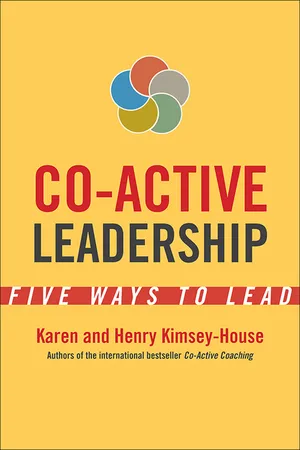
A Multidimensional Approach to Leadership Top-down, one-dimensional leadership models are hopelessly outmoded in today's rapidly changing world, and they waste the leadership ability that is present throughout an organization. In this visionary book, Karen and Henry Kimsey-House provide a model that harnesses the possibility of many rather than relying on the power of one. Their revolutionary five-dimensional approach recognizes that leadership has to be fluid and flexible and that the roles leaders and followers play must shift to suit the situation. Co-Active Leadership invites all of us to share our expertise and allows collaborative solutions to emerge that would never have been possible otherwise.
- 128 pages
- English
- ePUB (mobile friendly)
- Available on iOS & Android
eBook - ePub
About this book
Information
1
A New Leadership Story
On October 17, 1989, the workday in San Francisco was just coming to a close. South of the city in Candlestick Park, thousands had gathered to watch game three of the World Series. At 5:04 p.m., the Loma Prieta earthquake struck, shaking the earth, shattering windows, knocking down buildings and overpasses, and kicking up huge clouds of dust. Electricity was out throughout the San Francisco Bay Area, and it was difficult to find out what had really happened. People flooded out of the downtown Financial District, intending to walk home or make their way through a tangle of automobiles and cable cars, as all the traffic lights were out.
At Kearny and Pine, however, traffic was flowing freely. A homeless man, well known for his presence on one of the corners of this particular intersection, was directing traffic. He had placed himself in the center of the intersection and was managing the flow with great care and panache. He stood tall as he waved cars forward from one direction and held his hand up firmly as he instructed others to stop and wait. Attorneys, stockbrokers, and other highly paid executives all followed his direction without question. People who just the day before had walked by the homeless man without a second glance now honked, waved, and blew him kisses.
No one had told the homeless fellow that he was the one to step up and lead. He didn’t need to wait for the authorities to arrive and give him a title. He just saw the need and decided that he was the man for the job. Those who were following his directions did not need to see a résumé to determine whether he had the requisite training. They immediately became dedicated co-leaders, eager to serve and support in whatever way they could.
Amid the chaos and disruption of the earthquake, at the intersection of Kearny and Pine, leadership was flowing freely. There were no fancy titles and no one was elected. People did not give a great deal of thought to what was in it for them or if they were interested in being responsible. They just acted from their own humanity and heart, providing whatever was needed in the moment in a variety of different ways.
Our current view of leadership tends to be one-dimensional, with leadership being the responsibility of one or two people at the top. As the story above demonstrates, this viewpoint is not particularly accurate.
In reality, leadership is multidimensional. In any project or community there are many different leaders, each leading in different ways, with people changing roles fluidly. In any given day, each of us moves through a range of different leadership dimensions. We are all leaders in one way or another, and when we choose to be responsible for what is happening around us, we are able to work together in a way that includes and utilizes the unique talents of everyone.
Take our friend John, who is on his way to work as a legal secretary at a widely respected law firm. John is grateful for his life. While he understands that he is not perfect by a long shot, he does his best to live with integrity. He began the day as he does most others, with a short meditation and some reading to connect to his purpose and values. He leaves his apartment feeling present, alive, and ready to meet the day.
As John walks along, he sees a small child totter out into a busy roadway. Without a moment’s hesitation, he leaps forward and snatches the child back to safety, taking a few extra moments to ensure that the child is returned to the care of his grateful parents.
Enjoying the spring sunshine, John mulls over a project that has become stalled. What’s the big picture? he wonders. What is bogging things down? He senses that there are some things that are unspoken among the team members and badly need to be said. He makes a mental note to encourage a deeper conversation at the next team meeting.
Once at work, John leaves a sticky note on his boss’s desk. His boss is up for a big promotion, and John wants to let her know that he’s rooting for her and believes in her 100 percent.
In the kitchen, John runs into his co-worker Shayna. They are co-leading a game night for the staff the following evening, and they take a moment to work out a few of the details.
John has just been a leader in five different ways, and his workday hasn’t even officially begun!
The purpose of this book is to offer a simple model of multidimensional leadership that can by accessed by anyone to generate more aliveness and ownership of one’s world and one’s life.
In this more accurate multidimensional view of leadership, everyone has the capacity to be a leader by moving fluidly through five different dimensions of leadership as the circumstances and the situation require. These dimensions are Leader Within, Leader in Front, Leader Behind, Leader Beside, and Leader in the Field.
For each dimension, the key to success is balancing our essence and our action, our being and our doing. This is the foundation of Co-Active Leadership.
What Is Co-Active?
At its most basic, Co-Active means simply being in action . . . together. Or perhaps it might be more appropriate to say being together . . . in action.
The co represents the relational and receptive aspects of our world. The active follows and represents the action-oriented aspects.
As the pace of our lives has quickened, we have become increasingly action oriented and results driven. It seems expedient to dispense with all the “soft” stuff of being and just push to get the job done that is right in front of us. Unfortunately, this leaves us feeling disconnected and desperate for meaning and belonging. We wind up with what we might call “the hamster wheel” experience of life as we run around alone in circles desperately trying to get things done, only to find ourselves right back where we started.
This is why it is so important to begin with the co. Action arising from this place of being and receptivity is whole and integrated rather than disconnected and driven. In order for us to experience life as whole, action must be grounded in being and our sense of connection to a larger wholeness. When the co and the active go together, the action of our life is nourishing and fulfilling.
Karen, one of the authors of this book, was teased by her colleagues because they saw her smiling as she responded to emails. When asked why she was smiling, Karen responded, “Well, I’m thinking about the people who will be reading this e-mail and the things I enjoy about them. I imagine the relationship between us, and it makes me smile.” Thus a task that could be dreary and isolating became joyful because it held a balance of both co and active, even though Karen was physically alone.
The hyphen in Co-Active is very important because it holds both the interrelatedness and the balance between co and active. The hyphen represents the paradox of “both and” rather than “either/or.”
Generally, we tend to live in an either/or world. Either we can be effective and get the job done, or we can care for the people in our lives. Either we can take a break and attend to our well-being, or we can work hard and accomplish things.
Yet, everything in our natural world teaches us that these two energies of co and active weave together in every moment. So, like the yin and yang of ancient Chinese Taoist philosophy, co and active dance together to create wholeness and balance.
Everyone Is a Leader
In this multidimensional model of leadership, everyone has within them the capacity to lead, and any organization or community is most dynamic, most alive, and most productive when there is a commitment to leadership at every level. We all share full responsibility for the experience we generate, and our sense of personal power and fulfillment is directly commensurate with the level of ownership we are able to take for what happens to and around us.
We don’t have much to say about the challenges, hardships, and disasters (natural and otherwise) that befall us. This is the stuff that our lives are made of. However, we do have everything to say about how we engage and who we are in the events of our lives, about whether we offer ourselves or put our heads in the sand, about whether we seek to serve or give way to blame. We get to choose whether we will take responsibility for the world we are creating.
In this way, we have a kind of power that cannot be given to us and therefore cannot be taken away. Life is no longer just happening to us—we are co-creators and we share in the challenge and joy of shaping our world to reflect our own values and purpose.
We Create Our World.
Together.
Every Day.
Everyone has the capacity to contribute and to choose responsibility. Everyone has the capacity to lead. Leadership is a choice, and it begins with one’s willingness to be responsible for what is happening in one’s world.
A New Definition of Leadership
In order to set leadership free from a one-dimensional view, we would offer that rather than being defined by position or title, leaders are those who are responsible for their world.
What does it mean to be responsible? The word responsibility is often associated with burden, with something that is mandated. The dictionary defines responsibility as “the state or fact of having a duty to deal with something” and “the state or fact of being accountable or to blame for something.” Responsibility feels heavy, significant, dutiful, and perhaps a bit scary.
We’d like to offer a more expansive definition of responsibility. What if responsibility existed outside of the burden of the task, of getting the job done? What if we interpreted responsibility as a choice rather than a burden? What if the choice of responsibility generated a context of ownership and self-authorship beyond the immediate task at hand? In this new context, responsibility becomes generative and nourishing rather than weighty and burdensome.
As we choose responsibility, we immediately have more freedom and creativity. We are able to shift from being a passenger with things happening to us and instead be open to the challenges of our lives and allow them to shape and grow us. We are able to break free from our ego’s fears and need for approval and instead meet our world with power and with love. Life is just more fun when we are choosing to be responsible. We experience our life as an unfolding adventure rather than something to be endured. The difference is as dramatic as the difference between eating the white pith of an orange and savoring a burst of the sweet juice.
In Co-Active Leadership, responsibility has two important parts. The first part is to be response-able: able to respond. In other words, we must have the awareness to notice what is needed in the moment and the agility to respond from a wide palette of creative choices rather than from an entrenched system of patterned and predictable reactions. This is the co of responsibility.
The active aspect of responsibility entails choosing to be responsible as cocreators of our lives and our world. The circumstances of life will come and go, from birth to death with the full range of human experience in between. These ups and downs are a given in our human journey.
However, we have everything to say about how we respond to these circumstances. We have the choice to react in a patterned way, blaming someone else for what is happening, or to create from those same circumstances, using whatever happens as an opportunity to evolve and grow ourselves and the people around us.
When we choose to be responsible and creative rather than reactive, we stop being victims of our lives. We cease to feel as if we are running down a hill after our life, trying to catch up. Instead, the choice of responsibility puts us squarely in the driver’s seat of our life. We become coauthors and cocreators of our lives rather than merely passengers. Now we are aware and alert enough to respond to circumstances, and we have enough self-authority to be creative and expand our range by consciously choosing to act from a full menu of options.
Leadership development, then, becomes about growing the size of the world for which one is able to be responsible. Sometimes this area is very small. Some people are not able to be responsible even for the world of themselves, and they move through life unconsciously, bumping into different people and experiences without self-awareness.
This understandably creates concern about the concept of anyone being capable of choosing leadership. What about the people who are unconscious, who don’t want to be responsible and choose instead to hide from responsibility? Don’t these people have to be prodded and controlled and told what to do?
And what about all those other people who are selfish and dominating and don’t care at all about other people? Don’t we need to guard against these people? How can we possibly hold these people as capable of leadership? Doesn’t that just lower the bar and weaken the power of leadership for everyone else?
We would maintain that the capacity to grow both our self-awareness and our ability to be responsible is available to anyone. It’s important to be present with people wherever they are (co) and at the same time provide them with opportunities to choose responsibility and act powerfully (active). When we adopt a Co-Active framework for leadership, we are available to be receptive to people while at the same time holding them accountable for their actions.
In our experience, people generally want to do well. The more we look for a demonstration of responsibility, the more we will find it. If you believe that people are broken and in need of fixing, they will likely perform to your expectations. If you view people as generally creative and resourceful, it’s more likely that you will find those qualities in others. As we create our world together, every day, it’s important to pay attention to where we are placing our attention. So often, people feel powerless and ineffective because they have been told that they are wrong and that they don’t have what it takes to lead effectively.
For several years, Karen had the opportunity to work with inmates of several prisons. This was a real gift, as it taught her a great deal about how people are trained from a very early age to view themselves as unworthy. The men that Karen worked with knew for certain that they were not leaders. They had begun life as “problem children.” As teenagers, they graduated to being “juvenile delinquents,” and as adults, they moved on to be criminals and convicts. Their view of themselves as defective had been consistently reinforced for much of their lives.
Karen and her co-leaders remained committed to viewing these men as valuable human beings who were capable of goodness and wholeness. While firmly believing that they should be held accountable for their actions and for the crimes that they had committed, Karen and her co-leaders also maintained that they were whole and resourceful human beings, capable of learning and responsibility and worthy of respect and love.
Over time, the men began to turn toward this positive regard like sunflowers toward the sun. Many began to change the way they dressed and talked. Others reached out to repair relationships with family members and loved ones. Some began to talk about how they could make a difference in the world and how they might be able to prevent others from making the kinds of choices that had cost them so much.
Not all the men opened up. For some, that creative leader within was buried so deeply that it might never see the light of day. Some remained inaccessible, lost in a haze of drugs or alcohol or mental illness.
Still, there was a considerable change in many of the men, and for Karen it fortified the certainty that we don’t really know what has happened to people and why they act as they do. While people must be held to account for their actions, they are still human beings worthy of respect and even love.
If we can respect the being of people (co) while at the same time enforcing accountability for action (active), and if we can support a multidimensional understanding of leadership, all kinds of change become possible.
2
The Co-Active Leadership Model
One-dimensional models of leadership do not have the range to celebrate and honor different expressions of leadership. To be truly effective, communities—whether in the family or in the workplace—need a model that is multidimensional and inclusive. This allows leadership to be a flexible system in which everyone can assume leadership regardless of his or her role or title and move flu-...
Table of contents
- Cover Page
- Title Page
- Copyright Page
- Dedication
- Contents
- Preface
- 1: A New Leadership Story
- 2: The Co-Active Leadership Model
- 3: Co-Active Leader Within
- 4: Co-Active Leader in Front
- 5: Co-Active Leader Behind
- 6: Co-Active Leader Beside
- 7: Co-Active Leader in the Field
- 8: The Dance of the Dimensions
- 9: The Good Life
- Notes
- Acknowledgments
- Index
- About the Authors
Trusted by 375,005 students
Access to over 1.5 million titles for a fair monthly price.
Study more efficiently using our study tools.
Frequently asked questions
Yes, you can cancel anytime from the Subscription tab in your account settings on the Perlego website. Your subscription will stay active until the end of your current billing period. Learn how to cancel your subscription
No, books cannot be downloaded as external files, such as PDFs, for use outside of Perlego. However, you can download books within the Perlego app for offline reading on mobile or tablet. Learn how to download books offline
Perlego offers two plans: Essential and Complete
- Essential is ideal for learners and professionals who enjoy exploring a wide range of subjects. Access the Essential Library with 800,000+ trusted titles and best-sellers across business, personal growth, and the humanities. Includes unlimited reading time and Standard Read Aloud voice.
- Complete: Perfect for advanced learners and researchers needing full, unrestricted access. Unlock 1.5M+ books across hundreds of subjects, including academic and specialized titles. The Complete Plan also includes advanced features like Premium Read Aloud and Research Assistant.
We are an online textbook subscription service, where you can get access to an entire online library for less than the price of a single book per month. With over 1.5 million books across 990+ topics, we’ve got you covered! Learn about our mission
Look out for the read-aloud symbol on your next book to see if you can listen to it. The read-aloud tool reads text aloud for you, highlighting the text as it is being read. You can pause it, speed it up and slow it down. Learn more about Read Aloud
Yes! You can use the Perlego app on both iOS and Android devices to read anytime, anywhere — even offline. Perfect for commutes or when you’re on the go.
Please note we cannot support devices running on iOS 13 and Android 7 or earlier. Learn more about using the app
Please note we cannot support devices running on iOS 13 and Android 7 or earlier. Learn more about using the app
Yes, you can access Co-Active Leadership by Karen Kimsey-House, Henry Kimsey-House in PDF and/or ePUB format, as well as other popular books in Business & Leadership. We have over 1.5 million books available in our catalogue for you to explore.