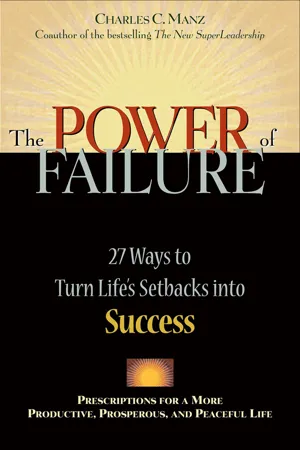
The acclaimed author and leadership expert offers inspiration and practical advice on finding the opportunities within life's obstacles.
"Failure" is one of the most dreaded words in the English language. The very idea of failing causes many of us to simply pack up and retreat without even trying. Yet it is through seeming failure that most of life's greatest successes are achieved. In
The Power of Failure, Charles Manz provides simple yet profound ways to turn what appear to be failures into the essential steppingstones of achievement.
The Power of Failure offers both inspiration and advice on how failure can provide us with the foundation for long-term success. Along with real-life stories and examples, it contains practical prescriptions for meeting some of life's most common setbacks. These lessons help us take advantage of the opportunities hidden within life's daily challenges, and show us how we can fail to succeed.
- 164 pages
- English
- ePUB (mobile friendly)
- Available on iOS & Android
eBook - ePub
About this book
Information
Topic
Personal DevelopmentSubtopic
Leadership11
Part One
Redefining Failure and Success
Failure is not something to be feared. It contains a positive challenge for successful living. Today’s failures contain the seeds of tomorrow’s greatest successes. The first step to mastering the art of failing successfully is to come to see failure and success in a whole new light.
13
1
To Succeed More, Fail More
Failure is the foundation of success,
and the means by which it is achieved.
and the means by which it is achieved.
—Lao Tzu2
An aspiring young man once asked a very prominent CEO how he could become more successful. The CEO was Tom Watson of IBM, who reportedly responded that if the young man wanted to become more successful he should do the seemingly unthinkable—fail. In fact, Watson advised that he should double his failure rate. At first glance this is an odd prescription indeed. Upon closer inspection, however, it contains a great deal of wisdom.
A failure should not be viewed as the end of the story but instead as a stepping-stone to a larger success. If someone never fails, this is a telltale sign that he is not trying anything new or challenging. Mastering new skills and growing as individuals require that we enter unfamiliar arenas that can provide us with new knowledge and capabilities. These new ventures can be as varied as learning to play the piano, speak a foreign language, water-ski, or invest in the stock market.
14
The principle remains the same—you must experience failure in order to succeed. If you expect to learn without making a mistake, you are in for an unpleasant surprise. Imagine Mozart or Beethoven trying to compose music so cautiously that they never hit a wrong note. Do you think they would have been able to compose masterpieces if they totally avoided mistakes?
In fact, Beethoven was no stranger to failure. At one stage in his music career a music teacher said that he had no talent for music. The teacher even remarked that “as a composer he is hopeless.”
The more you try to grow your knowledge and experience in new and challenging areas, the more mistakes you will have to make. Much of this potential for growth boils down to being willing to take risks. Author Carole Hyatt wrote that aggressive CEOs will tell their direct reports: “If you haven’t failed at least three times today you haven’t tried anything new.” And she adds that avoiding failure leads to avoiding risks—“a type of behavior not well suited to most businesses in today’s economy.”3 So if you want to succeed more quickly, heed the surprisingly sage advice—double your failure rate.
If you want to be more successful . . .
“double your failure rate.”
“double your failure rate.”
17
2
Be a Successful Learner by Learning from Failure
Bill Gates provided a practical perspective on the importance of learning from failure in his book Bill Gates @ the Speed of Thought, “Once you embrace unpleasant news not as negative but as evidence of a need for change, you aren’t defeated by it. You’re learning from it.”4, 5 He then went on to list many costly Microsoft product failures that provided the learning and opportunity for development of many of Microsoft’s biggest successes, mentioning the following examples:
- Many apparently wasted years working on a failed database called Omega resulted in the development of the most popular desktop database, Microsoft Access.
- Millions of dollars and countless hours invested in a joint operating system project with IBM that was discontinued led to the operating system Windows NT.
- A failed multiplan spreadsheet that made little headway against Lotus 1-2-3 provided learning that helped in the development of Microsoft Excel, an advanced graphic spreadsheet that leads the competition.
18
Clearly Bill Gates had a view of successful learning from setbacks that helped him and his company to turn many potential failures into dynamic successes.
Without a doubt one of the most powerful pillars of long-term success is learning from mistakes. The importance of learning from mistakes for achieving significant success is so widely recognized that it might almost seem unnecessary to mention. A challenging, well-lived, and successful life will be filled with both ups and downs. Growing as a person and addressing significant real-world problems means we will surely fail some of the time, but if we learn from these failures and stay the course, we will eventually succeed.
Effective learning of challenging activities largely depends on how we think about failure. Just as we develop habits in our behavior, we also develop habits in our thoughts. And many of us have powerful thought habits about failure that include negativity and self-criticism and these demoralize us. The result is that we impede the very learning that we need to help things work out better the next time around. The challenge is to manage our thoughts about failures in such a way that we learn from them and consequently increase our personal effectiveness in our work and life.
19
If we can concentrate on learning from every situation, especially those in which we seem to fail, we will continually move ahead. This effective approach might be called learning forward. How can we learn forward through failures? To begin with, view short-term failures as the building blocks for future success and concentrate on learning all you can from them rather than trying to make excuses or trying to cover up these temporary setbacks. The trick is to always move forward as you fail.
For example, golfers would choose progressively more difficult courses and try more challenging shots as they progress in their game. At first, a relatively easy course and making conservative shot selections may represent the right amount of challenge. Over time, more difficult courses and more aggressive shots (trying to shoot over the trees rather than playing it safe and going around them) can be chosen. Undoubtedly the greater challenge will bring with it more mistakes and setbacks, but learning will increase as well.
As you master this process you can purposely choose new and greater challenges to learn from throughout your life that stretch you more and more. Fail at greater and greater worthwhile challenges, and you can learn on your way to ultimate long-term success.
Setbacks are simply evidence of a
need for change and a chance to learn.
need for change and a chance to learn.
21
3
Recognize Failure as the Lifeblood of Success
We can take a variety of roads in the pursuit of success. One obvious route is to work toward a goal as unerringly as possible until it is achieved. Success is measured by our clear progress toward this end. Failure is not only left out of the equation but it is avoided above all else. It is seen as incompatible with success.
Unfortunately, this all too dominant perspective can create some real problems in terms of our ability to learn, to grow, and to take the necessary risks we need to be fully alive. In his book The Active Life, noted author Parker Palmer powerfully addresses this concern. He points out that in the West our fixation on success (or what he refers to as “instrumental action”):
22
discourages us from risk-taking because it values success over learning, and it abhors failure whether we learn from it or not . . . [it] always wants to win, but win or lose, it inhibits our learning. If we win, we think we know it all and have nothing more to learn. If we lose, we feel so defeated that learning is a hollow consolation.
And as if this telling passage weren’t enough he goes on to say:
[it] traps us in a system of praise or blame, credit or shame, a system that gives primacy to goals and external evaluations, devalues the gift of self-knowledge, and diminishes our capacity to take the risks that may yield growth6
We can choose another road (perhaps Robert Frost’s mythical road less traveled by) that brings us face to face with failure as a primary vehicle for success. On this road failure is viewed as the very lifeblood of success. Palmer’s words point to this kind of view.
Soichiro Honda, the founder of Honda Motor Company, dramatically paints a vision of this alternative route to success. After growing up in an impoverished family in which several of his siblings died of starvation, Honda encountered dramatic setbacks—including the bombing of his original piston plant in 1945 and later its complete destruction by an earthquake. His personal philosophy of success despite, or perhaps because of, his difficult past embraces failure. When receiving an honorary doctorate at the University of Michigan he said in his speech: “Many people dream of success. To me success can only be achieved through repeated failure and introspection. In fact, success represents the one percent of your work that results from the ninety-nine percent that is called failure.”7
23
Once again we come face to face with the challenging prospect that setbacks are an unavoidable part of everyday life. We all fail. And not just a little but a lot, especially if we are taking the risks and pursuing the learning of new skills that enable us to meet exciting and worthwhile challenges. We are called to accept the infusion that these challenging times can offer to the health of our journey toward success. The worthwhile journey toward a rich, meaningful, and rewarding life requires a willingness to receive a good dose of failure—the ironic lifeblood of success.
Success is the 1% that results
from the 99% we call failure.
from the 99% we call failure.
25
4
Learn the Challenging Secret to Successful Failure . . .Patience
There is a powerful but challenging secret about the relationship of short-te...
Table of contents
- Cover Page
- Title Page
- Copyright Page
- Dedication
- Preface
- Introduction: Succeeding with the Power of Failure
- Part One: Redefining Failure and Success
- Part Two: Winning through Losing
- Part Three: Coping with Failure
- Part Four: Collaborating with Failure
- Getting Started: The Power of Failure Motto
- Notes
- Index
- The Author
Trusted by 375,005 students
Access to over 1.5 million titles for a fair monthly price.
Study more efficiently using our study tools.
Frequently asked questions
Yes, you can cancel anytime from the Subscription tab in your account settings on the Perlego website. Your subscription will stay active until the end of your current billing period. Learn how to cancel your subscription
No, books cannot be downloaded as external files, such as PDFs, for use outside of Perlego. However, you can download books within the Perlego app for offline reading on mobile or tablet. Learn how to download books offline
Perlego offers two plans: Essential and Complete
- Essential is ideal for learners and professionals who enjoy exploring a wide range of subjects. Access the Essential Library with 800,000+ trusted titles and best-sellers across business, personal growth, and the humanities. Includes unlimited reading time and Standard Read Aloud voice.
- Complete: Perfect for advanced learners and researchers needing full, unrestricted access. Unlock 1.5M+ books across hundreds of subjects, including academic and specialized titles. The Complete Plan also includes advanced features like Premium Read Aloud and Research Assistant.
We are an online textbook subscription service, where you can get access to an entire online library for less than the price of a single book per month. With over 1.5 million books across 990+ topics, we’ve got you covered! Learn about our mission
Look out for the read-aloud symbol on your next book to see if you can listen to it. The read-aloud tool reads text aloud for you, highlighting the text as it is being read. You can pause it, speed it up and slow it down. Learn more about Read Aloud
Yes! You can use the Perlego app on both iOS and Android devices to read anytime, anywhere — even offline. Perfect for commutes or when you’re on the go.
Please note we cannot support devices running on iOS 13 and Android 7 or earlier. Learn more about using the app
Please note we cannot support devices running on iOS 13 and Android 7 or earlier. Learn more about using the app
Yes, you can access The Power of Failure by Charles C. Manz in PDF and/or ePUB format, as well as other popular books in Personal Development & Leadership. We have over 1.5 million books available in our catalogue for you to explore.