NEW EDITION, REVISED AND UPDATED World-renowned psychiatrist Viktor Frankl’s Man’s Search for Meaning is one of the most important books of modern times. Frankl’s personal story of finding a reason to live in Nazi concentration camps has inspired millions. In Prisoners of Our Thoughts, Dr. Alex Pattakos—whom Frankl urged to write this book—elaborates seven “core principles†based on Frankl’s philosophy and demonstrates how they can help us find meaning in our everyday lives and work . This second edition features new stories and examples of people who have applied the principles in the book or who exemplify them; new practical exercises and applications; and a new chapter, “The Meaning Difference®,†which summarizes research demonstrating the critical role of meaning in improving the quality of people’s lives, increasing happiness, promoting health and wellness, and achieving their highest potential.
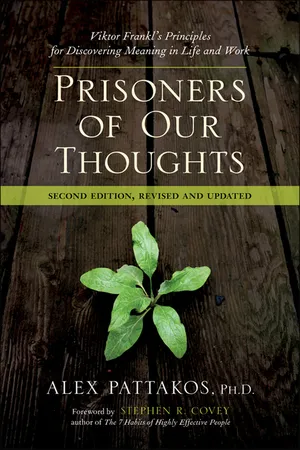
eBook - ePub
Prisoners of Our Thoughts
Viktor Frankl's Principles for Discovering Meaning in Life and Work
- 216 pages
- English
- ePUB (mobile friendly)
- Available on iOS & Android
eBook - ePub
Prisoners of Our Thoughts
Viktor Frankl's Principles for Discovering Meaning in Life and Work
About this book
Information
Topic
Crescita personaleSubtopic
Successo personale1
Life Doesn’t Just Happen to Us
Ultimately, man should not ask what the meaning of his life is, but rather must recognize that it is he who is asked. In a word, each man is questioned by life; and he can only answer to life by answering for his own life; to life he can only respond by being responsible.1
Every day Vita delivers my mail — cheerfully. It’s her trademark attitude. One day, in lousy weather, I heard her whistling as she went about making her deliveries. Instinctively I shouted out to her, “Thank you for doing such a great job.” She stopped dead in her tracks with surprise. “Thank you,” she said. “Wow, I’m not accustomed to hearing such words. I really appreciate it.”
I wanted to know more. “How do you stay so positive and upbeat about delivering mail every day?” I asked her.
“I don’t just deliver mail,” she said. “I see myself helping to connect people to other people. I help build the community. Besides, people depend on me and I don’t want to let them down.” Her response was enthusiastic and proud.
Vita’s attitude about her work reflected the words inscribed on the General Post Office building in New York City: “Neither snow nor rain nor gloom of night stays these couriers from the swift completion of their appointed rounds.” The Greek historian Herodotus wrote these words in the fifth century BC. The ancient delivery of messages from one person to another is at the very heart of our Information Age, yet these days it’s the phrase “going postal” that we’re more likely to recognize.
Fair or unfair, “going postal” has become the symbol of all the negativity a job has to offer: boredom, repetitiveness, exposure to the elements, dangerous dogs, irritated customers, and a kind of automated behavior that ultimately inspires an explosion of pent-up rage — a killing spree, retaliation against all the suffered injustice of the job.
What threatens contemporary man is the alleged meaninglessness of his life, or, as I call it, the existential vacuum within him. And when does this vacuum open up, when does this so often latent vacuum become manifest? In the state of boredom.2
No matter what our opinions might be about the stature of any career or profession, it is the person doing the job that gives the job meaning. Vita is proof that those ancient words of Herodotus are alive and well in the twenty-first century.
But Vita’s attitude goes beyond the “swift completion of her appointed rounds” (to paraphrase Herodotus). She experiences her work as serving a higher purpose. Her attitude about her job and its drudgery goes far beyond an exercise in positive thinking. Vita sees her mail delivery responsibility as a personal, life-saving mission, one that could be fulfilled only by her. She knows she is depended on, perhaps even by people who feel disdain for her work, and it means something. She brings meaning to her job, and in turn, her work becomes meaningful.
I am convinced that, in the final analysis, there is no situation that does not contain within it the seed of a meaning.3
Why is it that some people, like Vita my mail carrier, experience their work — even mundane work — with passion and commitment? Why do some people have an easier time dealing with complex and challenging situations at work and in life? Why do some people deal more easily with change? Why do some people find meaning and fulfillment in their work and everyday life, while others do not? There are no simple answers to these complex questions; but there are meaningful answers. That is the goal of this book: to illuminate the search for meaning as a path to meaning, both in our work and in our lives outside work.
This Book Is About True Freedom
We are by nature creatures of habit. Searching for a life that is both predictable and within our comfort zone, we rely on routine and, for the most part, learned thinking patterns. In effect, we create pathways in our minds in much the same way that a path is beaten through a grass field from repeated use. And because these patterns are automatic, we may believe these habitual ways of thinking and behaving to be beyond our control. Life, it seems, just happens to us. Not only do we rationalize our responses to life but we also fall prey to forces that limit our potential as human beings. By viewing ourselves as relatively powerless and driven by our instincts, the possibility that we create, or at least cocreate, our own reality becomes difficult to grasp. Instead, we lock ourselves inside our own mental prisons. We lose sight of our own natural potential and that of others.
Each of us has his own inner concentration camp … we must deal with, with forgiveness and patience — as full human beings; as we are and what we will become.4
The ways in which we hold ourselves “prisoners of our thoughts” are well documented in the work of many writers and thinkers who explore the landscape of our psychospiritual lives. Physician Deepak Chopra, in the audiotape of his book Unconditional Life, says “We erect and build a prison, and the tragedy is that we cannot even see the walls of this prison.”5
Yet we can reshape our patterns of thinking. Through our own search for meaning, we can unfreeze ourselves from our limited perspective, find the key, and unlock the door of our metaphorical prison cell.
Viktor Frankl, a psychiatrist who suffered through imprisonment in Nazi concentration camps during World War II, found meaning in spite of — and because of — the suffering all around him. His life’s work resulted in the therapeutic approach called Logotherapy, which paved the way for us to know meaning as a foundation of our existence. Frankl is quick to say, however, that such traumatic suffering is not a prerequisite for finding meaning in our lives. He means that whenever we suffer — no matter what the severity of our suffering is — we have the ability to find meaning in the situation. Choosing to do so is the path to a meaningful life.
This book explores seven core principles that I have derived from Frankl’s voluminous body of work:
1. We are free to choose our attitude toward everything that happens to us.
2. We can realize our will to meaning by making a conscious, authentic commitment to meaningful values and goals.
3. We can find meaning in all of life’s moments.
4. We can learn to see how we work against ourselves and can learn to avoid thwarting our intentions.
5. We can look at ourselves from a distance to gain insight and perspective as well as to laugh at ourselves.
6. We can shift our focus of attention when we are coping with difficult situations.
7. We can reach out beyond ourselves and make a differ ence in the world
These seven principles, which I believe form the foundation of Frankl’s thinking and approach, are available to us anytime, all the time. They can lead us to meaning, to freedom, and to deep connection to our own lives and to the lives of others in our local and global communities.
Viewing life as inherently meaningful and with unlimited potential requires a shift in consciousness. It also requires responsible action on our part for, as Frankl points out, the potential for meaning that exists in each moment of life can only be searched for and detected by each of us individually. This responsibility, he says, is “to be actualized by each of us at any time, even in the most miserable situations and literally up to the last breath of ourselves.”6
Frankl walked this path completely. By living a life with meaning right to his last breath, he showed us how his philosophy and therapeutic approach were grounded in practice. His personal experiences throughout his long life, both as a survivor of the Nazi death camps and as a revered and respected thought leader, illuminate the unlimited potential of a human being. His life gives us rich and ample evidence that the keys to freedom from life’s prison cells — real and imagined — are within, and within reach.
Whether we choose this path of liberation is a decision that only we as individuals can make and for which only we can be held responsible. When we search out and discover the authentic meaning of our existence and our experiences, we discover that life doesn’t happen to us. We happen to life; and we make it meaningful.
Humanizing Work
A meaningful life includes meaningful work. Let’s face it, most people spend at least half of their waking lives “at work” or working in some way. Yet where do most people look to find meaning in their life? The usual answer is in their personal life — in their relationships or their religious or spiritual practice. But what about their job? Can people find true meaning at work?
The transformation of work in the twenty-first century is, in many respects, a call for humanity — a new consciousness that suggests more than simply trying to strike a balance between our work and personal lives. It is a call to honor our individuality and fully engage our human spirit at work — wherever that may be. While this idea of empowering workers in body, mind, and spirit is not new, actually putting it to work is new. In some ways, technological advances have redesigned work to better accommodate human factors. What we need now is a way to elevate the human spirit at work and to integrate in a positive, meaningful way this spiritual dimension of work with our everyday life.
One of the goals of this book is to bring meaning to work and, quite frankly, to do for the domain of work what Frankl as a psychiatrist was able to do for psychotherapy. His unique approach is internationally recognized as a system of humanistic psychotherapy, and Frankl himself has been referred to by some people as the founder of humanistic medicine and psychiatry as well as of existential analysis. Logotherapy, in short, seeks to make us aware of our freedom of response to all aspects of our destiny. This humanistic view of psychotherapy helps clients to find concrete meaning in their lives. As a therapeutic system, it strengthens trust in the unconditional meaningfulness of life and the dignity of the person. By applying this philosophy to work and the workplace, we can more deeply humanize our working lives and bring deeper meaning to work itself. In turn, by bringing deeper meaning to our working lives, we can more deeply humanize and enrich the meaning of our personal — that is, nonworking — lives.
From the perspective of Logotherapy, we can find unconditional meaning in our work situations and experience the unconditional value of our colleagues as unique human beings as we do with our family members and close friends. This is not an easy task, but when we celebrate our differences as cheerfully as we celebrate our similarities, the result is a powerful synergy at work and in the workplace. Best-selling author Stephen R. Covey, who has also been influenced by Frankl’s teachings, has observed that “difference is the beginning of synergy.”7 When business leaders and managers on all levels bring this awareness to work, they are the catalysts for profound changes in the workplace — changes that enhance everyone’s ability to search for and find meaning, on the job, at home, and within our entire human experience.
Unconditional meaning, however, is paralleled by the unconditional value of each and every person. It is that which warrants the indelible quality of the dignity of man. Just as life remains potentially meaningful under any conditions, even those which are most miserable, so too does the value of each and every person stay with him or her.8
Detecting Your Path
Of course, being fully human and living an authentic life at home, at play, and at work are formidable challenges. They involve a willingness to embark down a path of self-discovery, drawing heavily upon what Frankl refers to as our “will to meaning” — that is, our inherent capacity to continually search for meaning under all circumstances. This human quest for meaning in every moment creates a path of discernment that runs through all aspects of our lives. This quest, this path is of course a process, not a product, for during our lifetime there is no final destination where everything comes to rest. This book offers guideposts along the way.
In chapter 2, Viktor Frankl’s Lifework and Legacy, we look briefly into the life and work of Dr. Frankl. As a mentor and author, he had a profound impact on my way of thinking and dramatically influenced my work and personal life. As the founder of Logotherapy, he brought powerful insights and compassion to the therapeutic world, leaving a legacy of wisdom that only increases over time.
The many pathways to meaning are explored in chapter 3, Labyrinths of Meaning, which also refers to the seven core principles of Frankl’s work introduced earlier. Each of these life-meaning principles is then more deeply explored in individual chapters: Exercise the Freedom to Choose Your Attitude (chapter 4), Realize Your Will to Meaning (chapter 5), Detect the Meaning of Life’s Moments (chapter 6), Don’t Work Against Yourself (chapter 7), Look at Yourself from a Distance (chapter 8), Shift Your Focus of Attention (chapter 9), and Extend Beyond Yourself (chapter 10).
One may say that instincts are transmitted through the genes, and values are transmitted through traditions, but that meanings, being unique, are a matter of personal discovery.9
Chapter 4, Exercise the Freedom to Choose Your Attitude, examines the logotherapeutic concept of freedom of will. This concept is best described by Frankl’s famous quote in Man’s Search for Meaning, “Everything can be taken from a man but … the last of the human freedoms — to choose one’s attitude in any given set of circumstances, to choose one’s way.”10 The key ingredient here is the responsibility for choosing our attitude, which lies solely and soundly with the self.
Chapter 5, Realize Your Will to Meaning, explores Frankl’s concept of our will to meaning and how we bring our values to life at work. Logotherapy, according to F...
Table of contents
- Cover Page
- Title Page
- Copyright Page
- Contents
- Foreword by Stephen R. Covey
- Dedication
- Preface to the Second Edition
- 1 Life Doesn’t Just Happen to Us
- 2 Viktor Frankl’s Lifework and Legacy
- 3 Labyrinths of Meaning
- 4 Exercise the Freedom to Choose Your Attitude
- 5 Realize Your Will to Meaning
- 6 Detect the Meaning of Life’s Moments
- 7 Don’t Work Against Yourself
- 8 Look at Yourself from a Distance
- 9 Shift Your Focus of Attention
- 10 Extend Beyond Yourself
- 11 Living and Working with Meaning
- 12 The Meaning Difference®
- Notes
- References
- Acknowledgments
- Index
- About the Author
Trusted by 375,005 students
Access to over 1.5 million titles for a fair monthly price.
Study more efficiently using our study tools.
Frequently asked questions
Yes, you can cancel anytime from the Subscription tab in your account settings on the Perlego website. Your subscription will stay active until the end of your current billing period. Learn how to cancel your subscription
No, books cannot be downloaded as external files, such as PDFs, for use outside of Perlego. However, you can download books within the Perlego app for offline reading on mobile or tablet. Learn how to download books offline
Perlego offers two plans: Essential and Complete
- Essential is ideal for learners and professionals who enjoy exploring a wide range of subjects. Access the Essential Library with 800,000+ trusted titles and best-sellers across business, personal growth, and the humanities. Includes unlimited reading time and Standard Read Aloud voice.
- Complete: Perfect for advanced learners and researchers needing full, unrestricted access. Unlock 1.5M+ books across hundreds of subjects, including academic and specialized titles. The Complete Plan also includes advanced features like Premium Read Aloud and Research Assistant.
We are an online textbook subscription service, where you can get access to an entire online library for less than the price of a single book per month. With over 1.5 million books across 990+ topics, we’ve got you covered! Learn about our mission
Look out for the read-aloud symbol on your next book to see if you can listen to it. The read-aloud tool reads text aloud for you, highlighting the text as it is being read. You can pause it, speed it up and slow it down. Learn more about Read Aloud
Yes! You can use the Perlego app on both iOS and Android devices to read anytime, anywhere — even offline. Perfect for commutes or when you’re on the go.
Please note we cannot support devices running on iOS 13 and Android 7 or earlier. Learn more about using the app
Please note we cannot support devices running on iOS 13 and Android 7 or earlier. Learn more about using the app
Yes, you can access Prisoners of Our Thoughts by Alex Pattakos in PDF and/or ePUB format, as well as other popular books in Crescita personale & Successo personale. We have over 1.5 million books available in our catalogue for you to explore.