Making the Hardest Decisions
As a young aid worker, Sasha Chanoff was sent to evacuate a group of refugees from the violence-torn Congo. But when he arrived he discovered a second group. Evacuating them too could endanger the entire mission. But leaving them behind would mean their certain death.
All leaders face defining moments, when values are in conflict and decisions impact lives. Why is moral courage the essential factor at such times? How do we access our own rock-bottom values, and how can we take advantage of them to make the best decisions? Through Sasha's own extraordinary story and those of eight other brave leaders from business, government, nongovernment organizations, and the military, this book reveals five principles for confronting crucial decisions and inspires all of us to use our moral core as a lodestar for leadership.
eBook - ePub
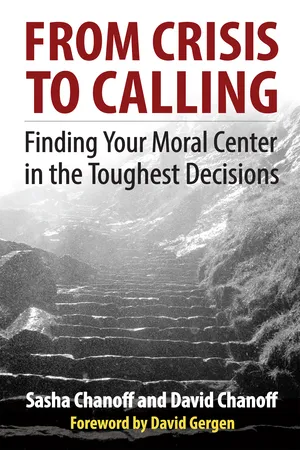
From Crisis to Calling
Finding Your Moral Center in the Toughest Decisions
- 256 pages
- English
- ePUB (mobile friendly)
- Available on iOS & Android
eBook - ePub
From Crisis to Calling
Finding Your Moral Center in the Toughest Decisions
About this book
Information

PART I
THE CONGO RESCUE MISSION
SASHA CHANOFF WAS A YOUNG FIELD OFFICER FOR THE INTERNATIONAL Organization for Migration recently arrived in Africa when he and a colleague, Sheikha Ali, were sent into the Congo on a life-and-death rescue mission. The Congo was aflame with violence. In response to events that followed the Rwandan genocide, Congo’s strongman government had launched a campaign to eradicate the country’s Tutsi minority. Many villages had been attacked. Thousands had been killed, many in atrocious ways. Amidst the waves of anti-Tutsi terror, the Clinton administration, together with a number of other governments and international humanitarian agencies, had pressured the Congolese regime into setting up a protected compound outside Kinshasa. Tutsis who could find their way there would be evacuated to UN camps in Benin and Cameroon; from there, they could be resettled in the United States after the required interviews and security checks.
The International Organization for Migration (IOM) had managed three evacuations from the Congo before the process broke down under the weight of violence, intimidation, and corruption. The Congolese had arbitrarily kept back 112 Tutsi men, women, and children from the final evacuation. With the end of the evacuations, these 112 had been left in the compound to die.
Continued pressure, though, forced the Congolese to allow one final mission to extricate those who had been left behind. Sasha and Sheikha Ali were sent in to carry out the operation. They were under strict orders to take the 112 people on their list and no others. Attempting to include anyone other than those for whom they had permission would almost certainly abort the mission and result in the deaths of the 112.
When Sasha and Sheikha arrived at the compound, they found that the International Committee for the Red Cross (ICRC) had brought in thirty-two widows and orphans the previous day, rescued from an execution center where they had been starved and brutalized for sixteen months. The women and children looked like World War II concentration camp victims. Without nutrition and medical help they were unlikely to survive more than a few days. Sasha and Sheikha had to decide what to do. Should they take those on the approved list and leave the widows and orphans to their fate? Or should they attempt to include them and risk everyone’s lives?
ONE
BE PREPARED

Confronting the Unexpected Dilemma
Sasha’s story begins here, on his and Sheikha’s first day in the Congo. They had been to the US embassy and to the Congolese so-called Ministry of Human Rights, which was anything but. At the day’s end they met with representatives of the International Committee for the Red Cross, the United Nations Refugee Agency, and with officials from other nations supporting the Tutsi rescue operation—the “contact group.” They made it clear they would only be taking the 112 people on the list and no one else. Sasha begins by describing what happened then.
I was just finishing my briefing when the man from the International Committee for the Red Cross stood up. “I understand what you said.” His voice had an edge to it. “You’re only going to take the people on your list. You say you don’t have permission for anyone else and you say you don’t have any extra seats on the plane. But now there’s a new group of people you have to take. Yesterday we brought thirty-two widows and orphans into the protection center from one of the execution prisons. They were there for sixteen months. All the adult males were killed. None of these women and children will last another week. You must put them on this flight.”
David Derthick, our boss, had warned me about the contact group players. “They’re all going to have people they’ll want you to take out,” he said. “They’ll pressure you to do it. Don’t take them! Just go in, tell them what the plan is and stop there. If you let anyone outside the list on that plane, you’ll kill the whole mission. The Congolese will flood you with fraudulent cases and you won’t have any way of saying no. The whole thing will implode and you’ll lose everybody. They’ll kill everyone who’s left. You tell them. Just the list. No one else.”
The ICRC man was still standing. “Unfortunately,” I told him, “the flight is completely full. We don’t have any more room on the plane. We simply are not able to take further cases. The list is closed. This evacuation is closed.” But as I spoke, my eyes met Sheikha’s. Widows and orphans, right out of a death camp. We never expected anything like this. What were we supposed to do now?
At seven the next morning, a beat-up black compact was waiting at the curb outside our hotel. Sheikha knew the driver, a short, fat man with a furtive look. He had worked for Sheikha and David during the earlier evacuations. We had also hired three other drivers to be on call for Immigration Department or Ministry of Human Rights officials we might need to ferry around for one reason or another. On the previous missions, if David or Sheikha needed an official’s presence or documents delivered, or if there was an offsite meeting, people often claimed they didn’t have cars—or if they did, the cars had no gas or had broken down. A money present would fix any of that, but the delays had made life difficult. We figured that if we hired cars we’d have fewer problems.
The protection center was an hour’s drive from downtown Kinshasa. We drove through a sleepy suburban area that looked upscale, with nice houses and gated yards. Kinshasa itself was so tense it felt like it might explode at any moment. But the neighborhoods out here seemed peaceful. A few people were leisurely strolling on the streets, small shops were opening, the owners setting up display stands for their goods.
We pulled off the main road onto a street bordered by walled compounds. In front of us were massive black double doors set in a high wall topped by jagged glass shards jutting into the air. Sheikha gave a little nod. “This is it, the protection center.” Guards with AK-47s stopped us. One of them peered into the car, then swung the doors open, and we drove through.
The walls surrounded an area that looked to be about two acres. A large gray building sat in the middle with tents set up around it. A lot of people were milling around, more than I expected. Many more than the 112 on our list. They were watching us; a car with visitors meant something. As we drove slowly toward the building, faces appeared at the car windows, staring in. Then somebody shouted, “Sheikha!”
It was as if an electric shock swept through the compound. People were suddenly streaming toward us, and in moments the car was surrounded. People were shouting, “Sheikha! Sheikha!” which quickly turned into a chant: “Sheikha Sheikha Sheikha Sheikha!” They were jostling the car, faces pressed close to get a look. I tried to keep my head down. I wanted to make myself as inconspicuous as possible, which was a crazy thought. With only Sheikha and me in the back seat, I was drawing as many stares as she was.
Before we left, David had told me that people would be overwhelmed when they saw us. “They’ll be so happy to see you, they’ll be crying,” he said. “They won’t be able to control themselves. It’s going to be rough, so you better prepare yourself. Most of them are sure they’re going to die there.”
I thought I was prepared, but not for this mob of deliriously excited people. Sheikha had spent many months in this center, interviewing and screening people for the earlier evacuations. Many knew her from then, and those who didn’t seemed to have instantly understood who she was and what she must be here for. Sheikha’s arrival was the absolute best news they could possibly have. No one in the compound knew that another evacuation was planned. As far as they could tell, they were in limbo, expecting sooner or later to die—probably sooner—and sure they would never see their loved ones again. But suddenly, here was Sheikha, their hope. A straw they could grasp on to. Sheikha meant another evacuation flight must be happening. Sheikha had come back to save them.
Most of these people weren’t going anywhere, though they didn’t know it yet. They were going to find out soon enough: as soon as we registered the 112 and not them. Then what? When we drove in, I had seen police around, but only a few. Nowhere near enough to control this big a crowd. How this might work out was anybody’s guess.
The car stopped. We were surrounded by chanting people and couldn’t move. We managed to shove the doors open and get out as a couple of police tried to clear a little space. People seemed almost out of their minds to see Sheikha. They were smiling, laughing, shaking her hands, reaching out to pat her on the shoulder, trying to hug her. And Sheikha was smiling back, recognizing them, saying hello, as if she was genuinely happy to be back here.
We had to find a relatively private place where we could bring people in one at a time, or one family at a time, to interview them, record their information, and take their pictures. There were a couple of tables set up on a hill nearby, and we waded through the crowd in that direction. After climbing a few feet, I turned back around and scanned the faces, wondering if I could somehow spot the thirty-two women and orphans. Nobody stood out, except for a tall man in a fedora and sunglasses who was keeping off to one side. Unlike everyone else, he didn’t seem excited or happy about Sheikha’s arrival. He just stood there and watched, looking out of place and vaguely sinister. He seemed to be watching me as well as Sheikha. I wanted to say something to her, but people were still pressing around. Across the compound the guards were swinging the big doors closed and barring them. I turned away and headed up the little hill.
At the top, an ICRC person introduced himself. The International Committee for the Red Cross was in charge here. They were running the protection center, though they seemed to have only a few people. A couple of Congolese men in suits were sitting at the tables already, obviously officials, I assumed from the Ministry of Human Rights, which, given their history of corruption and abuse, was a name right out of George Orwell. I wasn’t clear on what they were doing here, but Sheikha hardly took notice of them so I didn’t either. Looking down at the crowd at the bottom of the hill, it seemed to me like four or five hundred people. By now they had quieted down. I took the list out of my bag and read the first names: a group of three, apparently single women as there was no notation of families. I asked one of the guards to find them and bring them up.
While we were waiting, I asked Sheikha where she thought the widows and orphans might be. Sheikha glanced over at the suits and gave me a quick look that said shut up. I kicked myself for being a little slow. These were our so-called helpers from the ministry, but they were really our minders.
The guard brought the three women to our table. I wondered what they had been through and why they were alone. What had happened to their families? But we didn’t have time to start asking people about their experiences. This was Sunday. Our chartered jet was coming on Thursday. We were going to have to get the basics quickly. Name, date of birth, gender, relatives in the center. Our list had only minimal information, but from my experience in similar situations I knew that when you start asking people questions you often find that even your basic information isn’t only incomplete, it’s wrong.
We verified the first three and I took their pictures. Next was a family of six: mother, father, four children, including an infant. The parents looked nervous and surprisingly healthy. Again I wondered.
After them came two men, a father and son. Our list said they had been split off from the rest of their family during the last evacuation. Before Sheikha could ask the first question, the father started questioning her. Did she know how his wife was doing in Cameroon, where the evacuees had been sent? What about his three daughters? Security had grabbed him and his son from the line as they were waiting to board the plane. Why had they done that? His wife had tried to hold on to him, his daughters were hysterical. The soldiers had torn them apart. All this just came flowing out. What had happened to his family? Did they know he and his son were alive? They probably thought they were kept back to be killed. Was there any way he could get a message to them to tell them they were okay?
He was talking so fast he was practically incoherent. Sheikha told him that we couldn’t get his wife a message now, but that he’d be seeing her and his daughters soon. Right now we had a lot of work to do and she needed to ask him some questions. The faster we could do that, the faster everything would go. She looked him in the eyes as she said this, and there was something about her that calmed him down. Her look said: Don’t worry. We’re going to get you out of here and reunited. Everything’s under control. You’re going to be fine.
The man took a deep breath and composed himself. Then he answered her questions. When I took him and his son aside for their photos, he said under his breath, “Please hurry. This is a dangerous place.”
As we called up more individuals and families for verification, I could feel the mood shifting in the crowd below. People were supposed to stay at the bottom of the hill, but some we hadn’t called found their way up to ask if they could be included. If not, when was the next flight going to be? Could we register them for that one? We didn’t say anything. Not about this flight or any other flights. If their names were on the list we’d been given, we would interview them. About future flights, there might be one but we didn’t know. We were sorry, we simply had no information.
While this was going on, Sheikha looked calm, unruffled. I tried hard to look the same. But we both knew exactly what was going through people’s minds as they watched those called for interviews walk up the hill to our table. “That family is getting out,” they were thinking. “But what about me? What about my wife and my children?”
As more people came up and asked the same questions, we could feel the tension building. One young man looked straight at me and said, “What do you think is going to happen to me if you don’t take me out? They’re going to kill me.” He had a long face, wide eyes, fine features—the stereotypical Tutsi look. He wasn’t hysterical. His tone was calm and measured. He was quietly pleading for his life. “You know what’s going to happen to me? You need to take me out of here.”
An hour or two into the process I walked down the hill to the gray building to go to the bathroom. As I was coming back I was suddenly surrounded by four young men. They were too close, right in my face. I tensed up and looked around for the police. But they were all smiling. One of them said, “We’re El Memeyi’s nephews. Do you know him? Do you know anything about him?”
El Memeyi was one of the Tutsi leaders. He had been on an earlier evacuation that had gone to a UN refugee camp in Benin. I had met him there when I was preparing people from that evacuation for resettlement in the United States.
“Oh, my God,” I said. “I was just with El Memeyi in Benin a little while ago.”
Their eyes lit up. “Really? What’s happening with him? How is he? Tell us about him.”
“He’s fine. He and some of your other relatives will be going to the United States soon. They’re worried about you. When they heard you didn’t make it onto the last flight they didn’t know what to think.”
I was about to tell them more—I was excited to see them and wanted to fill them in about Benin. Then out of the corner of my eye I noticed that the tall man in the fedora and sunglasses was moving closer to us, obviously trying to catch what I was saying. I quickly cut off the conversation. “Everything’s fine with them, don’t worry.” The guy in the fedora gave me the creeps. I was getting a definite sense of menace from him. “Maybe we can talk later,” I said to the nephews.
Up at the tables Sheikha was by herself. Our minders had gone off for their own break. I gestured down the hill. “That guy in the hat and sunglasses, with the ratty sport jacket. Do you see him? Do you know anything about him?”
Sheikha looked. “That bastard is going to burn in hell,” she said. “He’s Interahamwe.”
I was shocked, not just by what Sheikha said but by how she said it. I had never heard her curse before.
“When they took the 112 off the buses last time, that bastard was gloating about it.”
Interahamwe! I took a moment to process what it meant that we had an Interahamwe here. Interahamwe were the Hutu Power paramilitaries who carried out the Rwandan genocide. They were mass murderers. They had had plenty of help, but they were at the heart of it. When they were finally driven out of Rwanda, they reorganized in the Congo, planning to go back into Rwanda to finish what they had started. It was their presence in eastern Congo that started the giant conflagration c...
Table of contents
- Cover Page
- Title Page
- Copyright Page
- Dedection
- Contents
- Foreword
- Preface
- INTRODUCTION The Five-Step Pathway to Moral Decision Making
- PART I The Congo Rescue Mission
- PART II Moral Decision Making
- A Note on Sources
- Acknowledgments
- Index
- About the Authors
Trusted by 375,005 students
Access to over 1.5 million titles for a fair monthly price.
Study more efficiently using our study tools.
Frequently asked questions
Yes, you can cancel anytime from the Subscription tab in your account settings on the Perlego website. Your subscription will stay active until the end of your current billing period. Learn how to cancel your subscription
No, books cannot be downloaded as external files, such as PDFs, for use outside of Perlego. However, you can download books within the Perlego app for offline reading on mobile or tablet. Learn how to download books offline
Perlego offers two plans: Essential and Complete
- Essential is ideal for learners and professionals who enjoy exploring a wide range of subjects. Access the Essential Library with 800,000+ trusted titles and best-sellers across business, personal growth, and the humanities. Includes unlimited reading time and Standard Read Aloud voice.
- Complete: Perfect for advanced learners and researchers needing full, unrestricted access. Unlock 1.5M+ books across hundreds of subjects, including academic and specialized titles. The Complete Plan also includes advanced features like Premium Read Aloud and Research Assistant.
We are an online textbook subscription service, where you can get access to an entire online library for less than the price of a single book per month. With over 1.5 million books across 990+ topics, we’ve got you covered! Learn about our mission
Look out for the read-aloud symbol on your next book to see if you can listen to it. The read-aloud tool reads text aloud for you, highlighting the text as it is being read. You can pause it, speed it up and slow it down. Learn more about Read Aloud
Yes! You can use the Perlego app on both iOS and Android devices to read anytime, anywhere — even offline. Perfect for commutes or when you’re on the go.
Please note we cannot support devices running on iOS 13 and Android 7 or earlier. Learn more about using the app
Please note we cannot support devices running on iOS 13 and Android 7 or earlier. Learn more about using the app
Yes, you can access From Crisis to Calling by Sasha Chanoff, David Chanoff, David Gergen in PDF and/or ePUB format, as well as other popular books in Politics & International Relations & Government & Business. We have over 1.5 million books available in our catalogue for you to explore.