Ugh—meetings. They're where productivity goes to die, right? There has to be a better way. According to leading consultants Dick and Emily Axelrod, there is. Using the same principles that make video games so engaging and that transformed the numbing assembly line into the dynamic shop floor, the Axelrods outline a flexible and adaptable system used to run truly productive meetings in all kinds of organizations—meetings where people create concrete plans, accomplish tasks, build connections, and move projects forward. They show how to design every aspect of a meeting—from the way you greet people at the beginning to how you sum up at the end—so that real work actually gets done. Those who have adopted this system will never go back. Neither will you.
eBook - ePub
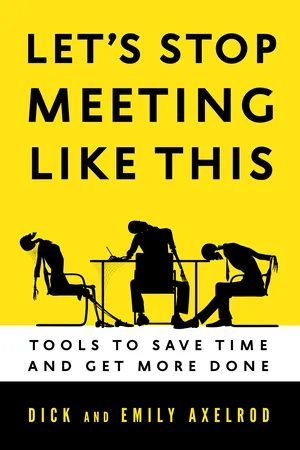
Let's Stop Meeting Like This
Tools to Save Time and Get More Done
- 168 pages
- English
- ePUB (mobile friendly)
- Available on iOS & Android
eBook - ePub
Let's Stop Meeting Like This
Tools to Save Time and Get More Done
About this book
Information
CHAPTER 1
HOW TO GET YOUR WORK DONE IN MEETINGS
If you look at the way we meet in organizations and communities across the country, you see a lot of presenters, a lot of podiums, and a lot of passive audiences. This reflects our naiveté in how to bring people together.
PETER BLOCK
Have you ever fallen asleep on an airplane? Think about it. You are sleeping in a chair bolted to an aluminum frame, a few inches separating you from sixty-five-degree-below-zero (Fahrenheit) air, six miles up in the sky, going more than five hundred miles an hour. The information people share and the decisions engineers make in meetings at Boeing make this death-defying feat commonplace.
Eric Lindblad, vice president and general manager of Boeing’s 747 program, runs many of those meetings that allow you to sleep on planes. He has strong opinions about meetings. For one, he finds spending hour upon hour in crowded conference rooms a nightmare. He hates to see conference rooms full of “wall-hangers,” people who attend a meeting with no real purpose in mind. He really gets upset when he looks around the room and sees people whose body language indicates they would rather be anywhere else in the world. “Empty inside” is how Eric describes his experience in these meetings.
Eric believes the best way to lead change is to be out on the factory floor, working with production to implement needed changes, not in a stuffy conference room. Eric’s factory floor has fuselages, wings, tails, miles of cable, and seats. These parts come together in Renton, Washington, to make the finished product: a Boeing airplane.
Eric’s frustration with meetings started when he was working on the Boeing 737. That is when he came to his belief about how to lead change. He also realized his task required building teams, sharing information, and making decisions. Eric had to find a way to both be out on the floor and hold meetings.
Eric started by doing some simple math. He multiplied the number of people in his meetings by their average hourly rate and quickly realized that meetings are a very expensive form of communication. He also concluded that habits were behind a lot of meetings—for example, “We meet every Monday morning, no matter what.”
Eric dared to rethink his meetings completely
Eric sought to change these meeting habits by developing two criteria for determining whether to hold a meeting:
1. Is there a need to share information?
2. Does the information that needs to be shared require dialogue?
The answers would determine whether or not to hold a meeting.
Making sure the “right” people attended was next. He sought to eliminate all wall-hangers from his meetings. His attendance criteria limited attendance to people who
• Had information or knowledge to share
• Had decision-making authority
• Were vital to the issue at hand
Next he set about changing the culture of meetings
Eric sought to eliminate arriving late and leaving early. In consultation with his leadership team, he required all meetings within his organization to be scheduled to start five minutes before the hour and end five minutes after, no matter the length. Why? Because he found that people were scheduling meetings back-to-back with no time for transition. This made it impossible for attendees to get from one side of a cavernous assembly building to the other and be on time for the next meeting. We suspect the same holds true even in smaller office buildings.
Then Eric completely updated his approach to meetings
What Eric did next was extraordinary. He made all his meetings voluntary. There were no mandatory meetings on Eric’s watch. He wanted people to be there not because of threat or politics but because they wanted to be there.
He actually gave people permission to leave meetings that were not valuable. When he noticed people who looked like they would rather be somewhere else, he would ask them, “Would your time be better spent doing something else?” If the answer was yes or they didn’t have a good answer to the question, Eric would excuse them from the meeting—no repercussions.
Making meetings voluntary was Eric’s way of getting meeting feedback. If people stopped showing up to a particular meeting and Eric believed there was a need to meet, he then asked what people needed to make the meeting more effective.
Eric has been using his approach to meeting effectiveness for more than ten years, starting when he was a senior manager of structures engineering for the 737 airplane. Whenever Eric takes a new assignment, he says it usually takes a month for people to believe that he is serious about his approach to meetings.
What would happen if you made all of your meetings voluntary?
You may be like Eric, feeling that too many of the meetings you lead are time-wasting, energy-sapping affairs. Most may seem like useless gatherings endured at the expense of your “real work”—meetings that sabotage your organization’s goals and product while wasting human capital. You may be ready to imitate Eric and make your meetings voluntary. Are you shuddering? It could work, but only if you take a fresh look at meetings and update your approach. If you are ready to take the plunge, then you are reading the right book.
Even if you are not ready to make your meetings voluntary, you are still reading the right book. People always decide the extent to which they will be present in a meeting. If they don’t feel like they can leave, they leave in place; their bodies are present, but their minds are absent. No matter whether you make your meetings voluntary, people will still make choices about how much of themselves they bring to a meeting and how much of themselves they leave behind. You can influence that choice. We’ll show you how.
Getting your work done in meetings
Meetings can be places where people do meaningful work, make plans, reach decisions, make commitments, and grow and develop and where everyone decides to get behind a task. Meetings can be gatherings in which people look forward to participating, even though they don’t have the time, even though the e-mails keep coming, even though no one can pick up the slack while they attend.
Changing meetings from time wasting to time valued from energy sapping to energy producing, requires a different approach to designing, leading, and contributing in meetings. It means a change in direction. It means making new choices. We invite you to learn how to
• Transform meetings into productive work experiences using the same work design principles that transformed factory work and made video games engaging
• Identify the habits that work for and against energy-producing, time-valued meetings
• Identify the critical choices that meeting designers, leaders, and contributors make that transform meetings into productive work experiences
• Create a meeting environment where everyone puts their paddle in the water
A better way to paddle this stream
Prior to the 1970s, leaders viewed factory workers as extensions of the assembly line: interchangeable parts that required little training. These workers were expected to show up and do their job—no more, no less (Terkel 1972). This mind-set created an unprecedented level of dissatisfaction that resulted in autoworkers purposely sabotaging their product’s quality by placing defects into cars.
That all changed when companies such as Ford and GM introduced Quality of Work Life initiatives that featured quality circles, joint union-management improvement activities, and self-directed work teams. For the first time, systems went into place that supported employee participation in making workplace improvements. Factory workers found new freedom when, for the first time, any worker on the line could stop the line. The result: productivity soared, quality improved, and frequent sabotage of the work virtually disappeared. People learned new skills through cross training; they learned how to work together in ways they had never worked before. In some plants, employee groups scheduled production, handled their own discipline, created their own work schedules, and often worked without direct supervision.
Today’s popular work improvement processes, such as Lean Manufacturing and Six Sigma, stand on the shoulders of these earlier efforts. Now we take for granted that workers can contribute to the organization and, as a result, generate improvement ideas that benefit everyone. Leaders did not always think that way. What we have learned is that given the opportunity, people can make significant contributions to improving their organization’s productivity.
What do the factory and meetings have in common?
As workers did on those old factory floors, people often show up at meetings with low expectations. They don’t anticipate much will happen, they participate in decisions where the outcome has been predefined, they leave feeling that their time was wasted, and then at Starbucks and in the halls they complain about their energy-sapping, time-wasting meeting experience.
Because most meetings provide the mind-numbing experience of the assembly line, most people seek to reduce the pain by eliminating the number of meetings they attend and the time they spend in them. This is a human response. However, when you seek to eliminate meetings, you also eliminate the possibility of producing the innovative thinking, quality decisions, and collaboration and cooperation that can occur only when we meet. The choice, then, is to either
• Remove the pain by eliminating meetings
• Create more productive meetings
Why meetings are so energy draining
Emily is fond of telling about her experience with the PTA. She recalls a meeting to decide on the color of the cafeteria trays. The meeting dragged on for hours. In the end, the group did decide on a color: yellow. Fifteen skilled people spent hours on an inconsequential decision. Emily, frustrated by her experience, decided never to return.
You might ask why Emily, being the good consultant that she is, didn’t help the group reach a decision more effectively. Why didn’t she step in to end such mind-numbing discussion? The reason: she didn’t care. A meeting has meaning when you know that what you are doing is important, that the outcome will make a difference to you, to others, to the organization as a whole. What difference was the color of cafeteria trays likely to make?
You spend a lot of time in meetings: informal chats and huddles with your coworkers, as well as staff meetings, town halls, and major change initiatives. Some meetings take a few minutes; others are multiday affairs. Sometimes you meet with one other person; other times you meet with hundreds. Studies show that the amount of time spent in meetings varies by organization level, ranging from 20 percent to 70 percent of a day. In the United States alone, there are 11 million meetings daily (Koehn 2013). All of us are spending more time in meetings than we did five years ago, and this trend is expected to continue (Lee 2010).
As shown in table 1.1, meetings range from informal chats involving two people to large-group, multistakeholder meetings. The larger the meeting, the greater the need for structure. (We are using “structure” here to mean the systems that guide the meeting process so that people can do their work effectively.) As you add more and different people to the conversation, variety increases, which allows learning and innovation to occur. The degree of preparation also increases as you move from informal to more formal gatherings.
You put a lot of time and effort into meetings. The problem is that the effort is often misplaced. Any meeting includes three basic roles: leader, contributor, and facilitator. In some cases, a person with a formal organizational role may have the same role in the meeting. For example, the for...
Table of contents
- Cover Page
- Title Page
- Copyright Page
- Dedication
- Contents
- Preface
- 1 How to Get Your Work Done in Meetings
- 2 The Meeting Canoe
- 3 Welcome People
- 4 Connect People to Each Other and the Task
- 5 Discover the Ways Things Are
- 6 Elicit People’S Dreams
- 7 Decide
- 8 Attend to the End
- 9 First Aid for Meetings
- 10 Meeting Basics: Five Steps to Meeting Success
- 11 Leaders: Three Steps to Meeting Effectiveness
- 12 Contributors: Three Steps to Meeting Effectiveness
- 13 Facilitators: Three Steps to Meeting Effectiveness
- 14 Our Handoff to You
- Works Cited
- Acknowledgments
- Index
- Meet the Authors
- The Axelrod Group— the Story Behind the Story
Trusted by 375,005 students
Access to over 1.5 million titles for a fair monthly price.
Study more efficiently using our study tools.
Frequently asked questions
Yes, you can cancel anytime from the Subscription tab in your account settings on the Perlego website. Your subscription will stay active until the end of your current billing period. Learn how to cancel your subscription
No, books cannot be downloaded as external files, such as PDFs, for use outside of Perlego. However, you can download books within the Perlego app for offline reading on mobile or tablet. Learn how to download books offline
Perlego offers two plans: Essential and Complete
- Essential is ideal for learners and professionals who enjoy exploring a wide range of subjects. Access the Essential Library with 800,000+ trusted titles and best-sellers across business, personal growth, and the humanities. Includes unlimited reading time and Standard Read Aloud voice.
- Complete: Perfect for advanced learners and researchers needing full, unrestricted access. Unlock 1.5M+ books across hundreds of subjects, including academic and specialized titles. The Complete Plan also includes advanced features like Premium Read Aloud and Research Assistant.
We are an online textbook subscription service, where you can get access to an entire online library for less than the price of a single book per month. With over 1.5 million books across 990+ topics, we’ve got you covered! Learn about our mission
Look out for the read-aloud symbol on your next book to see if you can listen to it. The read-aloud tool reads text aloud for you, highlighting the text as it is being read. You can pause it, speed it up and slow it down. Learn more about Read Aloud
Yes! You can use the Perlego app on both iOS and Android devices to read anytime, anywhere — even offline. Perfect for commutes or when you’re on the go.
Please note we cannot support devices running on iOS 13 and Android 7 or earlier. Learn more about using the app
Please note we cannot support devices running on iOS 13 and Android 7 or earlier. Learn more about using the app
Yes, you can access Let's Stop Meeting Like This by Dick Axelrod,Emily Axelrod, Emily Axelrod in PDF and/or ePUB format, as well as other popular books in Business & Business General. We have over 1.5 million books available in our catalogue for you to explore.