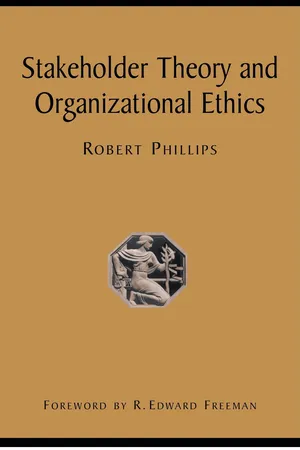
Business ethics is a staple in the news today. One of the most difficult ethical questions facing managers is, To whom are they responsible? Organizations can affect and are affected by many different constituencies-these groups are often called stakeholders. But who are these stakeholders? What sort of managerial attention should they receive? Is there a legal duty to attend to stakeholders or is such a duty legally prohibited due to the shareholder wealth maximization imperative? In short, for whose benefit ought a firm be managed?Despite the ever growing importance of these questions, there is no comprehensive, theoretical treatment of the stakeholder framework currently in print. In Stakeholder Theory and Organizational Ethics, Robert Phillips provides an extended defense of stakeholder theory as the preeminent theory of organizational ethics today. Addressing the difficult question of what the moral underpinning of stakeholder theory should be, Phillips elaborates a "principle of stakeholder fairness" based on the ideas of the late John Rawls-the most prominent moral and political philosopher of the twentieth century. Phillips shows how this principle clarifies several long-standing questions in stakeholder theory, including: Who are an organization's legitimate stakeholders? What is the basis for this legitimacy? What, if any, are the limits of stakeholder theory? What is the relationship between stakeholder theory and other moral, political, and business ethical theories?Applying research from many related disciplines, Stakeholder Theory and Organizational Ethics is an overdue response to several long-standing and fundamental points of contention within business ethics and management theory.
Business organizations are among the most powerful social entities on earth. They are the grand social institutions of our time, perhaps the sole remaining effective social institutions, expected not only to fuel free-market economies, but also to carry burdens once thought the province of government and religion (e.g., health care, child care, protection of privacy, education). Business organizations control vast resources, cross national borders, and affect every human life. Their pervasive impact on human lives rivals that of history’s most powerful czars, kings, and emperors.
Looking at the old cities of Europe gives one an idea of the movement of social power across time. The oldest of the large, elaborate buildings are religious in nature (e.g., churches and cathedrals). The second oldest of the large, elaborate buildings are governmental. The newest of the large, elaborate buildings are corporate headquarters and facilities.a To note this is to note the transfer of power through history. The church and its leaders were arguably the most powerful institution for thousands of years. Then, as the liberal notions of the Enlightenment began to replace church orthodoxy, government began to emerge as, again arguably, the most powerful institution on earth. Today, a case can be made that business firms are beginning to emerge as the most powerful institutions in the world.2
Philosophy has generally kept pace with the historical transitions of power as described. Scholasticism preceded the giants of secular moral and political philosophy. Now, as power is transferred to business institutions and other private organizations, so must our theories recognize this transition in power and begin to look more closely, explicitly, and reflectively at the morality of economic interactions and the organizations where these transactions take place.
Business organizations are even taking on larger, more complicated roles in society. As they enter new arenas such as health care and education, where tough choices and trade-offs among multiple goods are commonplace, friction between economic objectives and other worthy aims is likely to increase. Elements of business and organizational ethics are interwoven within bioethics—the latter perhaps also a contender for the title of most important area of applied ethics.
If ethics is to become an integral part of business conduct, it must be knit into organizational life. Our theories must thus begin with a consideration of organizations. Just as scholars have previously attempted to philosophically analyze (and justify) the power wielded by the state and its agents, it is essential that at least a portion of our attention be turned to a philosophical analysis of the power wielded by managers in organizations.
Political and moral theory seeks a comprehensive explanation of ethical duties between moral agents. This level of abstraction is typically comprehensive and universal; that is, the classics of moral and political philosophy generally refer to all persons in all times and places. This book attempts to provide a general explanation of the creation and existence of moral obligations within organizations and among stakeholders.b As such, it is but one brick (although an important one) in the emerging edifice of stakeholder theory.3
Stakeholder Theory
Organizations have constituencies. Furthermore, organizations are dependent upon these constituency groups for their success. This much is uncontroversial. Refer to these constituencies as stakeholders, however, and the disagreements appear ceaseless. Who are these stakeholders? How should they be managed? Is there a legal duty to attend to stakeholders or is such a duty instead legally prohibited due to the shareholder wealth maximization imperative? Should the law require stakeholders on boards of directors? For whose benefit ought the organization be managed? Should stakeholder principles be extended to the entire world in pursuit of a stakeholder society?
The debate only becomes more intense when the questions are couched in moral terms. What does the organization owe its stakeholders? Is there a moral obligation between the organization and its stakeholders? What is the source and justification of this obligation? If the organization in question is a business organization, are there moral duties of any sort or is business either immoral or amoral in nature? The generally beneficial fact that everyone is an ethicist of a sort—having opinions and considered judgments about moral topics—only fuels the considerable fire when stakeholder theory is discussed as a theory of organizational ethics. This book is an attempt to add some light to this heat.
Just as everyone is a sort of ethicist, so too is all activity in organizations, particularly business firms, shot through with fodder for moral reasoning (more on this metaphor momentarily). R. Edward Freeman (1994) has identified and described a “separation thesis” at work in discussions of business. Academics and practitioners alike seem to operate with an underlying assumption that business is business and ethics is ethics, but the two have little if anything to do with one another. Professor Freeman argues that this is the greatest obstacle to moral decision making in organizations today.4
It would have been easier five years ago to argue that accounting and finance are amoral. That is, they are neither moral nor immoral, but are instead not the sort of concepts to which application of moral ideas is appropriate. These fields of study and practice are merely tools for making decisions and are no more moral or immoral than a pen. Recent events have proven, however, clearly moral connotations to the use of these tools, just as with the use of pens. Anyone making the argument that the use of the tools of accounting and finance are amoral today would likely meet with stunned incredulity in light of recent events.
A still deeper variation of this argument, however, is even more dangerous. The assertion that the purpose of business activity is to maximize the wealth of the business’s owners—shareholders in the case of corporations—has near religious status. It is the dogma of business and is taken for granted like the air we breathe. I examine this claim at some length in later chapters. For now, it is sufficient to point out that the prescription to maximize shareholder wealth is itself a moral claim rendered using the language of moral reasoning. The utilitarian variation says that individuals working toward their own self-interest will actually benefit society as a whole. Even when extended from individuals to organizations, the rationale for maximizing owner wealth lies in the benefits that accrue to society: “A rising tide lifts all boats” is a moral argument.
In addition to the utilitarian argument is the property rights argument, which says that because the shareholders own the firm, managers bear an obligation to act consistently with shareholders’ wishes, assumed to be wealth maximization. Again, talk of property rights is moral reasoning. So, when Professor John Dienhart is asked how long ethics has been a topic of study in schools of business, his stock response is, “As long as there have been schools of business.”c Merely assuming a moral stance without reflection does not make it any less a moral argument. One issue that arises from the uncritical acceptance of the shareholder wealth maximization model as the moral foundation of business activity is that responses to immoral behavior in such contexts also take this foundation for granted. Few of the fixes that have been suggested to avoid the problems that have recently plagued U.S. firms have directly addressed the shortcomings of this model.5
An analogy to an idea in a Darwin Awards message is perhaps apt. A man is out hunting and upon trying to start his old truck to leave he realizes that he has blown a fuse. His idea for a replacement is a .22 caliber shell that is near to hand. The shell promptly fires off, wounding the man as he sits in the driver’s seat. I rather doubt the truth of the story, but it strikes me that many of the solutions proposed to repair organizational ethics are akin to trying a different size shell. The problem is more fundamental than whether the shell is a .22 or a .25. We should not be surprised that, until this more fundamental problem is addressed, firms will continue shooting themselves in the foot, or worse.d
This book suggests that organizations in the early twenty-first century are confronted with a unique set of moral issues requiring moral theory explicitly tailored to this set of issues and that stakeholder theory is a strong candidate of such a theory of organizational ethics. This book will argue that an amended principle of fair play—the principle of stakeholder fairness—provides a defensible source of moral obligations among stakeholders that has been heretofore missing in the literature on stakeholder theory. The remainder of this chapter will be devoted to a broad summary description of what is to follow.6
Chapter 2: The Limits of Stakeholder Theory
Much of the power of stakeholder theory may be attributed to its conceptual breadth. The term carries myriad connotations and thereby evokes praise or scorn from scholars and practitioners of multiple academic disciplines and backgrounds. Such breadth of interpretation, though one of stakeholder theory’s greatest strengths, is also one of its most prominent theoretical liabilities. Much of the power of stakeholder theory is a direct result of the fact that, when used unreflectively, its managerial prescriptions and implications are nearly limitless. In the hands of advocates and critics alike, stakeholder theory can be used as a basis for nearly any position that one wishes to defend or attack. Wide conceptual breadth allows critics to dress up the theory as they will in the process of attempting to lay it low. In some cases, overzealous advocates may tend to make the critic’s job easier as well. Chapter 2 elaborates a number of interpretations, critical and friendly, of stakeholder theory that do not represent the theory described in the current project. After a brief discussion of the nature of stakeholder criticism, I will argue for what stakeholder theory is NOT. With this brief summary as our roadmap, we may now proceed to describe and defend the concepts of organizational ethics in general and stakeholder theory in particular.
Chapter 3: Why Organizational Ethics?
Organizational ethics scholarship has historically consisted of attempts to directly translate the classics of moral and political theory into the context of the organization. Hence, the gamut includes utilitarian business ethics, Kantian business ethics, Aristotelian business ethics, and social contractarian business ethics. Many of these translations have been provocative, interesting, coherent, and insightful; however, many of the distinct qualities of organizations and the nuances of the moral problems that arise in organizational contexts are inadequately appreciated. Both moral and political philosophy are too broad and general to account for the obligations that arise in the myriad organizations (business and otherwise) of less than nation-state size and power. This being the case, the need arises for a normative account of organizational morality that, while grounded in the moral and political theories of the past, is tailored specifically for the organizational level of abstraction. Chapter 3 attempts to point out problems that may arise with the more or less direct translation of moral and political philosophical concepts and methodologies.7
Having suggested reasons why moral and political philosophy may be inadequate in organizational contexts, Chapter 3 goes on to suggest features that would characterize an ethics of organizations including substantive aims and conceptual independence. With the need for specific theory at the organizational level established, I argue that stakeholder theory is a good candidate. To prepare the foundation for a defense of stakeholder theory, Chapter 4 is an extended discussion of the current status of stakeholder theory as a scholarly topic.
Chapter 4: Stakeholder Theory and Its Critics
Prior to any attempt to elaborate a new stakeholder theory, it is important to have a thorough understanding of past and current thinking about the concept. Chapter 4 attempts to survey the recent work in the field relevant to the topic at hand. Among the most important and widely cited papers in the area are those that suggest a variety of distinctions and taxonomies among stakeholders and stakeholder research (e.g., Donaldson & Preston; Mitchell, Agle, & Wood; and Jones & Wicks). These taxonomies and their role in the development of stakeholder theory are briefly analyzed.8
From here the discussion moves to the topic of fiduciary duties and agency relationships. Critics charge that stakeholder theory, particularly the prescription that managers do otherwise than maximize shareholder wealth, violates legal and moral duties. Far from being morally superior to the status quo, critics charge that stakeholder theory advocates the violation of strong moral duties. Goodpaster’s (1991) explication of the “stakeholder paradox” exemplifies this critique. He argues:
It seems essential, yet in some ways illegitimate, to orient corporate decisions by ethical values that go beyond strategic stakeholder considerations to multi-fiduciary ones.2
Such arguments rely heavily on the notions of the agency and fiduciary duties of managers to share owners. Based on agency considerations, the relationships between managers and shareholders are held to be “special” and ethically different from other stakeholder relationships. The extent to which these relationships are, in fact, “special” is examined.
Chapter 4 ends with a summation of the problems with extant stakeholder research to be addressed in the remainder of the book. Among these problems are the lack of a normative justificatory framework and uncertainty regarding stakeholder identity and legitimacy. That is, much of the current thinking on stakeholder theory omits discussion of the normative, moral justification for obligations to stakeholders. In addition to the reasons provided above regarding business dogma, failure to address the normative foundation creates the problem of stakeholder identity. Though some have addressed this issue, it remains problematic that much of the extant thinking on stakeholder theory is unable to distinguish those who are from those who are not legitimate stakeholders: If everyone is a stakeholder, then the term is empty and adds no value.9
The absence of a normative framework and the problem of stakeholder identity are among the theoretical shortcomings addressed by the principle of stakeholder fairness. The principle of stakeholder fairness—and its predecessor, the principle of fair play—are examined and explicated in Chapter 5.
Chapter 5: A Principle of Stakeholder Fairness
Chapter 5 provides an answer to, why managers should care about stakeholders. Beyond the financial reasons (and the moral rationale that underlies profitability) are other moral obligations that arise in organizational contexts. This chapter defends the principle of stakeholder fairness, which states that when people are engaged in a cooperative effort and the benefits of this cooperative scheme are accepted, obligations are created on the part of the group accepting the benefi...
Table of contents
Cover Page
Title Page
Copyright Page
Foreword
Preface
Chapter 1: Stakeholder Theory and Organizational Dogma
Chapter 2: The Limits of Stakeholder Theory
Chapter 3: Why Organizational Ethics?
Chapter 4: Stakeholder Theory and Its Critics
Chapter 5: A Principle of Stakeholder Fairness
Chapter 6: Stakeholder Legitimacy
Chapter 7: Stakeholder Identity
Chapter 8: Stakeholder Theory in Practice
Notes
Bibliography
Index
About The Author
Berrett-Koehler Publishers
Trusted by 375,005 students
Access to over 1.5 million titles for a fair monthly price.
Study more efficiently using our study tools.
Frequently asked questions
Yes, you can cancel anytime from the Subscription tab in your account settings on the Perlego website. Your subscription will stay active until the end of your current billing period. Learn how to cancel your subscription
No, books cannot be downloaded as external files, such as PDFs, for use outside of Perlego. However, you can download books within the Perlego app for offline reading on mobile or tablet. Learn how to download books offline
Perlego offers two plans: Essential and Complete
Essential is ideal for learners and professionals who enjoy exploring a wide range of subjects. Access the Essential Library with 800,000+ trusted titles and best-sellers across business, personal growth, and the humanities. Includes unlimited reading time and Standard Read Aloud voice.
Complete: Perfect for advanced learners and researchers needing full, unrestricted access. Unlock 1.5M+ books across hundreds of subjects, including academic and specialized titles. The Complete Plan also includes advanced features like Premium Read Aloud and Research Assistant.
Both plans are available with monthly, semester, or annual billing cycles.
We are an online textbook subscription service, where you can get access to an entire online library for less than the price of a single book per month. With over 1.5 million books across 990+ topics, we’ve got you covered! Learn about our mission
Look out for the read-aloud symbol on your next book to see if you can listen to it. The read-aloud tool reads text aloud for you, highlighting the text as it is being read. You can pause it, speed it up and slow it down. Learn more about Read Aloud
Yes! You can use the Perlego app on both iOS and Android devices to read anytime, anywhere — even offline. Perfect for commutes or when you’re on the go. Please note we cannot support devices running on iOS 13 and Android 7 or earlier. Learn more about using the app
Yes, you can access Stakeholder Theory and Organizational Ethics by Robert Phillips in PDF and/or ePUB format, as well as other popular books in Business & Business Ethics. We have over 1.5 million books available in our catalogue for you to explore.