A revised and updated edition of the definitive guide to overturning Citizens United.
Since the Supreme Court's Citizens United ruling that the rights of things—money and corporations—matter more than the rights of people, America has faced a crisis of democracy. In this timely and thoroughly updated second edition, Jeff Clements describes the strange history of this bizarre ruling, its ongoing destructive effects, and the growing movement to reverse it.
He includes a new chapter, "Do Something!," showing how—state by state and community by community—Americans are using creative strategies and tools to renew democracy and curb unbalanced corporate power. Since the first edition, sixteen states, one-hundred-sixty members of Congress, and five hundred cities and towns have called for a constitutional amendment to overturn Citizens United, and the list is growing. This is a fight we can win!
"More relevant than ever, this updated edition of
Corporations Are Not People chronicles the remarkably vibrant, nationwide grassroots movement to 'get money out and voters in.'" —Katrina vanden Heuvel, Editor and Publisher,
The Nation
eBook - ePub
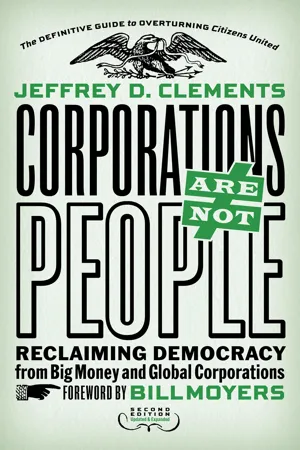
Corporations Are Not People
Reclaiming Democracy from Big Money and Global Corporations
- 264 pages
- English
- ePUB (mobile friendly)
- Available on iOS & Android
eBook - ePub
Corporations Are Not People
Reclaiming Democracy from Big Money and Global Corporations
About this book
Information
Chapter One
American Democracy Works, and Corporations Fight Back
In 1838, a quarter century before he became the nation’s sixteenth president, a twenty-nine-year-old Abraham Lincoln stepped up to speak at the Young Men’s Lyceum in Springfield, Illinois. He spoke about what was to become the cause of his life: the preservation of that great American contribution to the human story, government of, for, and by the people. He insisted that the success or failure of the American experiment was up to us. “If destruction be our lot, we must ourselves be its author and finisher. As a nation of freemen, we must live through all time, or die by suicide.”1
Lincoln’s generation of Americans, and every generation since, has faced daunting questions of whether “destruction be our lot,” and we certainly have our share today. Most people can point to a host of complex and related reasons for rising anxiety about our future. Global and national environmental crises seem relentless and increasingly related to energy, economic, military, and food crises. Our unsustainable debt and budgets—national, state, local, family, personal—seem beyond control, reflecting an economy that has not generated significant wage growth in a generation. We have been locked in faraway wars for more than a decade, at war in one form or another for a half century. Despite our victory over totalitarian communism, we spend more on our military than all other countries combined. We, the descendants of republicans with great suspicion about standing armies, now maintain a costly military empire across more than one hundred countries and a sprawling secret government that collects the communications data of everyone. Many Americans now doubt that we are, in fact, a government of the people and no longer believe that our democracy and government are working.
We can point to an array of causes, and we can point fingers at one another, but a taproot of many of these related problems is our collective failure to do what generations of Americans before us did: choose to take responsibility as citizens to manage hyperconcentrations of political power among the largest corporations and the wealthiest few. We have lost sight of the implications in a republic of the extreme wealth and power of transnational corporations. The agenda of the largest corporations and those who control them is not the agenda of the American family and the American community. Yet the corporate agenda is now dominant at home and across the world.
The Impact of Citizens United
In 2010, in Citizens United v. Federal Election Commission, the Supreme Court proclaimed that the American people are not permitted to determine how much control corporations and concentrated wealth may have over elections and lawmakers. The Court, in a 5-4 decision, ruled that a federal election law designed to prevent corporations and unions from dominating elections and government violated First Amendment free speech rights.
The impact of the Supreme Court’s folly now is beyond dispute. More money was spent by fewer donors in the 2012 election than ever before in history. As much as $10 billion in the federal election;2 billions more in state and local elections.3 “Dark money” from corporations, billionaires, and unions was run through secretive “social welfare” nonprofit corporations acting as partisan political operatives;4 foreign money was run through corporate subsidiaries and trade associations;5 and Super PACs, corporations, candidates, and operatives pretending to be “uncoordinated” unleashed saturation attack ads across the land, all to drown out other issues, candidates, ideas, and, ultimately, Americans’ faith in effective democracy.
This spending is not “free speech,” unleashed at last, nor is it a burst of democratic enthusiasm for electioneering. Instead, it is the deployment of power of, for, and by a very few.
How few? A few dozen donors contributed 60 percent of the Super PAC money, and almost all of the Super PAC money came from came from just 3,318 donors. That is 0.0011 percent of the American population.6 One billionaire global casino mogul alone contributed $93 million.7 One global oil corporation alone, Chevron, handed $2.5 million to the “Leadership PAC” of the Speaker of the House, who has promised to oppose cutting oil and gas subsidies and to block action on the climate catastrophe.
Almost all political contributions of any sort—80 percent—come from just 0.5 percent of the population. This “donor class,” interwoven with corporations and lobbying firms, are largely concentrated in New York, Washington, Los Angeles, Chicago, and Boston.8
Political domination by the few has even overwhelmed state ballot initiatives, originally intended to check concentrated corporate and wealth power. A century ago, American government was “fast becoming a plutocracy,” and an “invisible government” of large corporations overwhelmed government of the people.9 Voters acted in many states to amend state constitutions, creating the citizen ballot initiative to enable more democracy to check the special interest lock on state legislatures. People in the states intended the initiative process to ensure that “this government shall be brought back to the real control of the people.”10
Now the ideology of Citizens United has broken the check and balance of the citizen initiative. In 2012, “corporations and some of the wealthiest Americans” spent more than a billion dollars in initiatives in just eleven states, “an unprecedented explosion of money used to pass new laws and influence the public debate.”11 In the state of Washington, corporations such as Monsanto, Pepsico, Nestle, and Dupont spent more than $20 million to defeat a ballot initiative to require disclosure of genetically modified organisms (GMOs) in food. Of that $20 million, only $600 came from people or businesses in the state itself.12
Even small cities and towns have felt the impact of Citizens United. In Richmond, California, a community of 100,000 people, a single corporation—Chevron again—spent $1.2 million to control the outcome of the city council election. Richmond Mayor, Gayle McGlaughlin, says that Chevron will spend another $2 million in city elections in 2014. A Richmond citizen serving on the city council, Tom Butt, adds, “They want a city council loyal to them. I think it’s wrong for a corporation to pour that kind of money into a local election. Nobody can match that.”13
Most Americans agree, but that does not matter, according to Citizens United. Corporations and unions now have the same rights under the First Amendment as people. And if “free speech” means unlimited election spending by the powerful, that cannot be “infringed.”
The Citizens United Decision
In Citizens United, the Court struck down the federal Bipartisan Campaign Reform Act (also known as McCain-Feingold, after its Republican and Democratic sponsors). The Bipartisan Campaign Reform Act had banned electioneering spending by corporations and unions for or against specific candidates within sixty days of a federal election. The law was intended to prevent corporations and unions from bypassing election integrity and anticorruption laws dating back more than a century.14
The case is called Citizens United because a Virginia nonprofit corporation by that name sued the Federal Election Commission to challenge the corporate spending restriction in the Bipartisan Campaign Reform Act. Citizens United, the corporation, wished to use its corporate money and donations from for-profit corporations to make and distribute what the Court described as a feature-length advertisement against Hillary Clinton, who was running for president when the case began. Further, Citizens United sought to do this within the sixty-day period before an election when the law restricted corporate spending on electioneering activity. According to Citizens United, the law violated corporations’ First Amendment rights of free speech because it prevented Citizens United, the nonprofit corporation, from engaging in electioneering activity and did not allow for-profit corporations to contribute to that campaign to influence the election.15
Of course, people are free to make a feature-length advertisement attacking a powerful senator running for president if that is what people wish to do, and people may pool their money to do this. That is essential for political participation. At first blush, the background to the case seemed to warrant concern about government restrictions on the free ability of people to pool resources to advocate views.
The Court majority in Citizens United, however, was not content to leave the case at first blush. Instead, they saw an opportunity to throw out a century of law they thought too restrictive of corporations. In the end, the Citizens United decision decreed that all corporations (and all unions) have a constitutional right to spend unlimited money in any American election—federal, state, local, and judicial.
The Supreme Court had rejected this argument only a few years earlier, when Justices William Rehnquist and Sandra Day O’Connor were still on the Court. In 2003, in the case of McConnell v. Federal Election Commission, the Court ruled that the very same corporate spending provision in the McCain-Feingold law did not violate the First Amendment. In McConnell, the Court agreed that Congress may make different election spending rules for corporations than for people. The Court in McConnell followed the 1990 case of Michigan Chamber of Commerce v. Austin, in which another majority of the Court had ruled that corporate money, aggregated with advantages that come from the government, is not the same as people’s money pooled together. Corporate spending in elections can be restricted because government creates the advantages for corporations to make them effective in the economic sphere, and the same advantages pose dangers in the political sphere.
Now in Citizens United, the Court, with the additions of a new chief justice, John Roberts, and a new justice, Samuel Alito, threw out McConnell and Austin. The Citizens United Court said its earlier decisions were wrong. The Court struck down the McCain-Feingold law as a violation of free speech rights and invited billions of corporate dollars into American elections.
Justice Anthony Kennedy wrote the opinion in Citizens United for the Court. At first, Justice Kennedy’s opinion sounds like a ringing defense of free speech and American democracy. He writes that the government may not “ban speech.” Yes! All “speakers” must be allowed and no “voices” may be silenced. Yes! The government cannot restrict a “disadvantaged person or class” from speech. Yes! All “citizens, or associations of citizens,” must have a right to get their views about candidates or anything else out to the people. Of course!
But wait. Who are these “voices,” “speakers,” and “disadvantaged persons”? They are corporations, particularly global corporations with trillions of dollars in revenue and profits. And what was this onerous “ban on speech”? A rather weak law that said a corporation may not, within sixty days of an election, spend its “general treasury” money to support or attack candidates for federal office. That’s it.
The Court announced its decision on a cold January day in 2010 when most Americans were anxious about millions of job losses, angered by national debt and massive deficits deepened by corporate bailouts, and worried about our military and global strength overstretched by distant wars while China, Germany, and other economic powerhouses at peace charged ahead. Now the Supreme Court says corporations are “disadvantaged persons” with “rights” that trump and invalidate our laws?
The Initial Response
Immediately, four dissenting justices on the Court, led by eighty-nine-year-old Justice John Paul Stevens, sounded the alarm. Justice Stevens’s ninety-page dissent, among his last work before retiring, may be his greatest legacy.
Stevens, born and raised in Chicago, had enlisted in the US Navy on December 6, 1941, the day before the Japanese attack on Pearl Harbor, and received the Bronze Star for his service in World War II. He then began a twenty-five-year career as a lawyer and represented numerous corporations in antitrust cases. In 1969, Stevens led the investigation and prosecution of corrupt judges in Illinois and was hailed for his fair, honest, and determined approach. A Republican, he was appointed to the Court by President Gerald Ford in 1975. It would be difficult to find a more honest, moderate, and balanced judge.
Alarmed by the majority’s decision, Stevens took the unusual step of reading his dissent aloud in the Supreme Court’s public chamber. Although the elderly judge’s voice at times faltered, his words were unmistakable. Stevens called the Court’s action in Citizens United a “radical departure from what has been settled First Amendment law.” He blasted the Court’s conclusion that corporations, “like individuals, contribute to the discussion, debate, and the dissemination of information and ideas that the First Amendment seeks to foster.” Justice Stevens said that “glittering generality” obscured the truth about what Citizens United really meant for America, already suffering from undue influence of corporate power. Then Justice Stevens said this:
The Framers [of our Constitution] thus took it as a given that corporations could be comprehensivel...
Table of contents
- Cover Page
- Title Page
- Copyright Page
- Dedication
- Contents
- Preface to this Second Edition
- Preface to the First Edition
- Foreword: Fighting Back, by Bill Moyers
- Introduction: What’s at Stake
- 1 American Democracy Works, and Corporations Fight Back
- 2 Corporations Are Not People—and They Make Lousy Parents
- 3 If Corporations Are Not People, What Are They?
- 4 Corporations Don’t Vote; They Don’t Have To
- 5 Did Political Inequality and Corporate Power Destroy the Working American Economy?
- 6 Corporations Can’t Love
- 7 Restoring Democracy and Republican Government
- 8 Do Something
- Resources
- Notes
- Index
- About the Author
Trusted by 375,005 students
Access to over 1.5 million titles for a fair monthly price.
Study more efficiently using our study tools.
Frequently asked questions
Yes, you can cancel anytime from the Subscription tab in your account settings on the Perlego website. Your subscription will stay active until the end of your current billing period. Learn how to cancel your subscription
No, books cannot be downloaded as external files, such as PDFs, for use outside of Perlego. However, you can download books within the Perlego app for offline reading on mobile or tablet. Learn how to download books offline
Perlego offers two plans: Essential and Complete
- Essential is ideal for learners and professionals who enjoy exploring a wide range of subjects. Access the Essential Library with 800,000+ trusted titles and best-sellers across business, personal growth, and the humanities. Includes unlimited reading time and Standard Read Aloud voice.
- Complete: Perfect for advanced learners and researchers needing full, unrestricted access. Unlock 1.5M+ books across hundreds of subjects, including academic and specialized titles. The Complete Plan also includes advanced features like Premium Read Aloud and Research Assistant.
We are an online textbook subscription service, where you can get access to an entire online library for less than the price of a single book per month. With over 1.5 million books across 990+ topics, we’ve got you covered! Learn about our mission
Look out for the read-aloud symbol on your next book to see if you can listen to it. The read-aloud tool reads text aloud for you, highlighting the text as it is being read. You can pause it, speed it up and slow it down. Learn more about Read Aloud
Yes! You can use the Perlego app on both iOS and Android devices to read anytime, anywhere — even offline. Perfect for commutes or when you’re on the go.
Please note we cannot support devices running on iOS 13 and Android 7 or earlier. Learn more about using the app
Please note we cannot support devices running on iOS 13 and Android 7 or earlier. Learn more about using the app
Yes, you can access Corporations Are Not People by Jeffrey D. Clements, Bill Moyers in PDF and/or ePUB format, as well as other popular books in Politics & International Relations & Political Advocacy. We have over 1.5 million books available in our catalogue for you to explore.