eBook - ePub
Abolishing Performance Appraisals
Why They Backfire and What to Do Instead
- 360 pages
- English
- ePUB (mobile friendly)
- Available on iOS & Android
eBook - ePub
Abolishing Performance Appraisals
Why They Backfire and What to Do Instead
About this book
Performance appraisals are used in the overwhelming majority of workplaces. Yet, most organizations that use appraisal-and a similar percentage of givers and receivers of appraisal-are dissatisfied with the process. Many are beginning to deeply question whether appraisal is necessary and consistent with the work culture espoused by progressive organizations. Abolishing Performance Appraisals provides an insightful, well documented look at the flaws of appraisal-including its destructive, unintended effects-and offers practical guidance to organizations that want to move on to more progressive approaches to coaching, feedback, development, and compensation.
While many books prescribe cures for appraisal, this is the first to focus exclusively on eliminating appraisal altogether and creating alternative, non-appraisal approaches based upon progressive and healthier assumptions about people. The authors expose and dispel the widely accepted myths and false assumptions that underlie common management strategies surrounding the five key functions of appraisal-coaching, feedback, development, compensation, and legal documentation. They then offer step-by-step practical guidance on implementing alternative non-appraisal strategies that deliver the objectives of each function. And they suggest ways to give supervisors and managers the freedom to choose for themselves the most effective ways of working with people.
Filled with real-life examples, resources, tools, and detailed practical advice, Abolishing Performance Appraisals is an entirely fresh and radically different view of performance appraisal and its functions that will help people start over and discover new and more effective approaches.
Information
Topic
BetriebswirtschaftSubtopic
VerwaltungPart One
Why Appraisals Backfire: The Fatal Flaws
9 - How human organizations
- can be conceived, organized,
- and led in ways that best release
- human ingenuity and
- maximize human choice
- is one of the great conundrums
- of the (new) century…
- Fusing chaos and order
- in uncentralized systems
- is bound to be the key
- to that puzzle.
—Harlan Cleveland
1
Good Intentions That Never Deliver
11 It is not enough to change strategies, structures, and systems, unless the thinking that produced those strategies, structures, and systems also changes.
Peter Senge, The Dance of Change
It seems quite probable, as we continue to question our current practices, that most systems of performance appraisals… will be unmasked as detrimental to human spirit.
Dick Richards, Artful Work
Abolish performance appraisal. Yes, it feels uncomfortable to say that. Appraisal represents the conventional wisdom. We’ve grown accustomed to it, in spite of its inevitable flaws. Letting go of it feels like we’re going on a course to abandon people and their needs—the need for feedback, good coaching and development, the need for a measuring stick so people and the organization can know where people stand.
Our discomfort is quite natural. It stems from the truly good intentions behind appraisal. Abolishing appraisal does not mean abandoning its good intentions. It is diametrically the opposite—it is about getting serious about those intentions and finding pathways that can deliver without bringing on the perennial problems of appraisal. In this chapter, we separate the wheat from the chaff, keeping the worthy intentions of appraisal while we thresh out its structures and underlying beliefs. It is those potent beliefs and the resulting structures that ensure failure and the unintended toxic side effects.12
To bring focus and clarity to this discussion, we begin by defining what we mean by performance appraisal. After all, there are innumerable euphemisms for appraisal and many variations in form. At their extreme, the variations may make it difficult to discern whether we are talking about appraisal or something else. Next we examine the noble intentions of appraisal. Before we can intelligently discuss their flaws and what to do instead, we must be clear about what appraisals are trying to achieve. Then, we take a distant look at the outcomes and effects of appraisals. Finally, as a foundation for the remainder of the book, we examine the beliefs or underlying assumptions that cause the repeated failure of appraisal.
■ What Do We Mean by Performance Appraisal?
Confusion prevails over what appraisal is and is not. Many organizations have proclaimed that they have dropped the practice, but what they do instead is merely appraisal with a new name. The goal of this book is to truly abolish appraisal. If ultimately this is your goal as well, it is critical to understand what appraisal is and is not. T o c larify the difference between a variation of appraisal and genuine alternatives to appraisal, we start with a good working definition.
Although management textbooks provide scores of definitions for performance appraisal, a mere dictionary gets us off to a good start. Performance is defined as “the way in which someone or something func-tions.”1 Appraise comes from the Latin word pretiare, meaning to value. Hence, appraisal is a process in which we evaluate, judge, or estimate.2 Combining these definitions, we may say that performance appraisal is the process of evaluating or judging the way in which someone is functioning.
Gertrude Stein
“A Rose Is a Rose Is a Rose”
Performance appraisal is the most accepted term describing the subject of this book. It is generally interchangeable with performance evaluation, performance review, annual review, personal rating, performance rating, and the like. It also may include appraisal schemes that are called performance management, 360-degree feedback, or competency modeling. The descriptors performance review or performance evaluation are perhaps most popular in the vernacular, but human resources professionals prefer to call it performance appraisal. Using the word appraisal makes this process easily distinguishable from another unrelated process called job evaluation, a system used to rate and compare jobs (not people) for pay purposes.Throughout this book, we will simply use the term appraisal as a cauldron for all the names and variations of performance appraisal. 13
When we speak of appraisal, our focus is on processes that judge individual performance, not the performance of an organization or a business unit. Although widely varying in form, appraisal, as conventionally practiced, will nearly always contain the five distinguishing features we summarize below. If a process is missing some of these features, we would not view it as a systematic appraisal practice but rather as some other type of communication, personal development, or organizational development tool. Regardless of what it is called (see “A Rose Is a Rose”), we believe the practice of performance appraisal exists when most or all of the following features are present in a single process or tool:
- Employees’ individual work performance, behaviors, or traits are rated, judged, and/or described by someone other than the employee. In many organizations today, appraisal feedback is given by persons other than the immediate supervisor (e.g., co-workers, subordinates, internal or external customers, suppliers, or professional raters). Just because the supervisor is not the sole rater or one of the raters, the process may nonetheless constitute a form of appraisal. A tool in which the employee is the sole judge would be a developmental tool rather than a performance appraisal.
- Such ratings, judgments, and descriptions relate to a specific time period (e.g., a year, a calendar quarter) rather than a particular work product or project. A salesperson may get a written evaluation after each sales call from the trainer—feedback of this type on a work product, project, or task is an appraisal of sorts, but it is not the systematic appraisal process that is the target of this book.
- The process is systematically applied to all employees or a class of employees. Sometimes people are selectively evaluated because they are performing poorly or they are asking for special help. Selective evaluations would be an appropriate form of individual intervention and do not constitute systematic appraisal as general practice, and such is not in conflict with the goals of this book. 14
- The process is either mandatory or induced by an extrinsic incentive (e.g., eligibility for a pay raise) as opposed to a process that is purely voluntary or elective. An employee who freely chooses to seek feedback, without coercion or extrinsic incentive, is engaged in an employee development process.
- The results of ratings, judgments, or documentation are kept or preserved by someone in the organization other than the rated employee. If, for legal or other reasons, the results of the evaluative process are preserved as a record by the organization (in the H.R. department, supervisor’s records, or by someone other than the rated employee), this would be consistent with appraisal. However, if the sole purpose of the ratings, judgments, or work documentation is to provide information for the employee’s own use, and there is no requirement to file the documented evidence of the evaluation or feedback with the organization, it is a communication or development tool.
Putting these five characteristics together into a single statement, for purposes of this book we can say:
The practice of performance appraisal is a mandated process in which, for a specified period of time, all or a group of employees’ work performance, behaviors, or traits are individually rated, judged, or described by a person other than the rated employee and the results are kept by the organization.
We can illustrate this definition through a couple of examples. Some organizations have pared conventional appraisal down to a process in which all employees simply receive written feedback from supervisors or others. In this approach, the employer systematically requires employees to undergo a feedback session that culminates in a written feedback form. There are no numeric ratings or scales. The outcome of the feedback is disconnected from pay raises, promotion, or layoffs. The human resources department or supervisor keeps a record of the written feedback form. Although such a feedback mechanism would be friendlier than conventional appraisal approaches, it nonetheless is a variation of performance appraisal. Even though there are no scales or ratings, there is an evaluation or judgment, explicitly or implicitly, about the success of that employee. Such documented records, at least implicitly, would reflect upon the quality of work performed. Because the process still mandatorily imposes an evaluation by others, we label this process an appraisal. 15
By contrast, in some organizations, the responsibility for feedback has been shifted to the employee. The employee freely decides if and when to initiate and gather feedback from various sources. When collected, the results are sent only to the rated employee (or, sometimes, 360-degree models utilize a processing center that deletes the identity of contributors but makes no record of the feedback). The employee keeps all of the feedback records but may choose to share and discuss the results with others (supervisor, mentor, career counselor, etc.). Though this process partly resembles appraisal, the elective features and exclusive control by the employee would cause us to characterize it as an employee development tool.
The distinction between the above two examples may seem trivial at this juncture, but it is critical in evaluating alternatives to appraisal. Feedback may be the key action in both processes, but the absence of certain structures in the second suggests an entirely different set of beliefs and this, as we shall explain, will drive entirely different outcomes.
■ The Intentions and Purposes of Appraisal
The above definitions tell us little about the purposes of appraisal. When we ask organizations why they use appraisals, we get a variety of answers and a very long list to boot. In one form or another, the items in Figure 1.1 typically are mentioned.
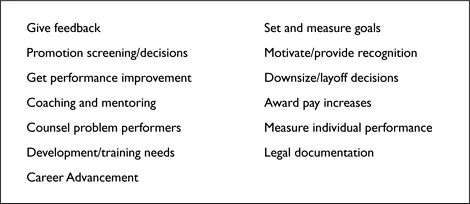
Figure 1.1 Common Responses—Why do we do appraisals? 16
Various surveys are consistent with our audience’s responses. For example, an earlier survey 2,400 members from human resources, finance, marketing, and information systems departments, taken by the American Management Association, found that 86% of the respondents said appraisal was tied to compensation decisions. Another 65% of the same respondents reported that the tool was to be used for counseling, while 64% identified training and development. Other purposes also drew high responses including: promotion (45%), staff planning (43%), and retention and discharge (30%).3
A key goal of this book is to explain why appraisals backfire. We can’t explain why until we specify the purpose of performance appraisal. In other words, What are we trying to accomplish?4 In most organizations the answer is several items in Figure 1.1. For the sake of economy and logical organization, we have taken the commonly identified purposes of appraisal and allocated them into six broadly defined functional categories, each of which we address in separate chapters. The six functional categories are:
- Improvement. The process should help both the employee and the organization to get better results, improving quality, efficiency, effectiveness, alignment, and the like (Chapter 2).
- Coaching and Guidance. In the traditional management view, appraisal provides a managerial tool and framework for coaching, counseling, and motivating employees (Chapter 4).
- Feedback and Communication. Appraisal is intended to enhance communication between the employee, supervisor, and others in the organization, including feedback on employee performance (Chapter 5).
- Compensation. By tying appraisal to compensation (salary increases, bonuses), purportedly people will work harder. In theory, the pay also will be more fair, rewarding the most deserving employees (Chapter 6).
- Staffing Decisions and Professional Development. Appraisal attempts to provide information to enable the organization to fairly and effectively select employees for promotion, layoffs, or reductions-inforce (RIFs). It’s also used to identify staffing and training needs and assist employees in their career development (Chapter 7).
- Termination and Legal Documentation. Effectively written appraisals should provide objective and impartial documentation that is necessary or useful in disciplinary and discharge decisions—ulti-mately they may be challenged by the unemployment office, civil rights agencies, and union representatives (Chapter 8). 17
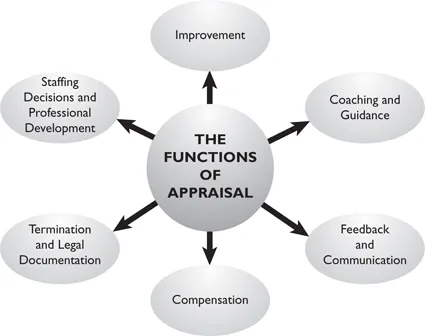
Figure 1.2 The Functions of Appraisal
We have not listed the rating process as a function of appraisal because it is not a function in and of itself, but rather a tool that is used with appraisal functions such as pay, career advancement, promotion, and determination of training needs. The process of rating, however, is so critical to the functions of appraisal that we have devoted an entire chapter to appraisal as a rating tool (Chapter 3).
■ Do Appraisals Work?
Knowing the reasons why we do appraisal, the question is—do they work? As you work your way through this book, we hope that you will see the answer for yourself. In the interest of honesty at the outset, let us say it is our fervent belief that appraisal does not work. It impedes the reception of feedback, and there is no solid evidence that it motivates people or leads to meaningful improvement. Due to its inherent design flaws, appraisal produces distorted and unreliable data about the contribution of employees. Consequently, the resulting documentation is not useful for staffing decisions and often does not hold up in court. Too often, appraisal destroys human spirit and, in the span of a 30-minute meeting, can transform a vibrant, highly committed employee into a demoralized, indifferent wallflower who reads the want ads on the weekend. 18
Our harsh censure of appraisal rests on a solid founda...
Table of contents
- Cover Page
- Title Page
- Copyright Page
- What People Are Saying About Abolishing Performance Appraisals
- Foreword
- Preface
- Preface to the Paperback Edition
- Acknowledgments
- Introduction Letting Go of a Hopeless Ritual
- Part One Why Appraisals Backfire: The Fatal Flaws
- Part Two What to Do Instead: Five Functions of Appraisal
- Part Three How to Get There: The Transition to Alternatives
- What the Sages Say On Performance Appraisal and Related Issues
- Further Reading and Resources
- Notes
- About the Authors
- Index
Trusted by 375,005 students
Access to over 1.5 million titles for a fair monthly price.
Study more efficiently using our study tools.
Frequently asked questions
Yes, you can cancel anytime from the Subscription tab in your account settings on the Perlego website. Your subscription will stay active until the end of your current billing period. Learn how to cancel your subscription
No, books cannot be downloaded as external files, such as PDFs, for use outside of Perlego. However, you can download books within the Perlego app for offline reading on mobile or tablet. Learn how to download books offline
We are an online textbook subscription service, where you can get access to an entire online library for less than the price of a single book per month. With over 1.5 million books across 990+ topics, we’ve got you covered! Learn about our mission
Look out for the read-aloud symbol on your next book to see if you can listen to it. The read-aloud tool reads text aloud for you, highlighting the text as it is being read. You can pause it, speed it up and slow it down. Learn more about Read Aloud
Yes! You can use the Perlego app on both iOS and Android devices to read anytime, anywhere — even offline. Perfect for commutes or when you’re on the go.
Please note we cannot support devices running on iOS 13 and Android 7 or earlier. Learn more about using the app
Please note we cannot support devices running on iOS 13 and Android 7 or earlier. Learn more about using the app
Yes, you can access Abolishing Performance Appraisals by Tom Coens,Mary Jenkins, Mary Jenkins in PDF and/or ePUB format, as well as other popular books in Betriebswirtschaft & Verwaltung. We have over 1.5 million books available in our catalogue for you to explore.