Taking the Florida Biology 1 End-of-Course Exam?
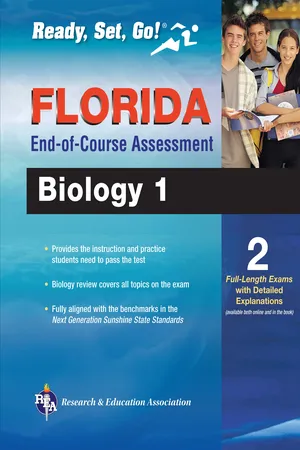
Then You Need REA's Florida Biology 1 End-of-Course Test Prep with Online Practice Exams!
If you're facing the Florida Biology 1 End-of-Course exam and are concerned about your score, don't worry. REA's test prep will help you sharpen your skills and pass this high-stakes exam.
REA's Florida Biology 1 End-of-Course test prep provides all the up-to-date instruction and practice you need to improve your skills. The comprehensive review features easy-to-follow examples that reinforce the concepts tested on the Biology 1 End-of-Course exam.
Our test prep is ideal for classroom, group, or individual study. Tutorials and targeted drills increase your comprehension. Color icons and graphics throughout the book highlight important concepts and tasks. REA's test-taking tips and strategies give you the confidence you need on test day - so you can pass the exam and graduate.
The book contains two full-length practice exams that let you test your knowledge while reinforcing what you've learned. The same two practice tests are also available online at REA's Study Center. The online tests give you the additional benefits of instant scoring, timed testing conditions, and diagnostic score reports that pinpoint your strengths and weaknesses. Each practice test comes complete with detailed explanations of answers, so you can focus on areas where you need extra review.
This book is a must for any Florida student preparing for the Biology 1 End-of-Course exam.
About the Exam
The Florida Biology I End-of-Course exam measures middle and high school student achievement of the Next Generation Sunshine State Standards. All public school students are required to pass the exam in order to receive a high school diploma.
- 336 pages
- English
- ePUB (mobile friendly)
- Available on iOS & Android
eBook - ePub
Florida Biology 1 End-of-Course Assessment Book + Online
About this book
Information
Topic
Study AidsSubtopic
Study GuidesChapter 1
The Practice of Science
Your Goals for Chapter 1
1. You should be able to design and/or evaluate a scientific investigation using evidence of scientific thinking and/or problem solving.
2. You should be able to interpret and analyze data to make predictions and/or defend conclusions.
3. You should be able to compare and/or contrast the structure and function of the compound microscope, dissecting microscope, scanning electron microscope, and/or the transmission electron microscope.
4. You should be able to evaluate the merits of scientific explanations produced by others.
5. You should be able to assess the reliability of sources of information according to scientific standards.
6. You should be able to describe how scientific inferences are made from observations and identify examples from biology.
Standards
The following standards are assessed on the Florida Biology 1 End-of-Course Assessment either directly or indirectly:
SC.912.N.1.1 Define a problem based on a specific body of knowledge, for example: biology, chemistry, physics, and earth/space science, and do the following:
1. pose questions about the natural world;
2. conduct systematic observations;
3. examine books and other sources of information to see what is already known;
4. review what is known in light of empirical evidence;
5. plan investigations;
6. use tools to gather, analyze, and interpret data (this includes the use of measurement in metric and other systems, and also the generation and interpretation of graphical representations of data, including data tables and graphs);
7. pose answers, explanations, or descriptions of events;
8. generate explanations that explicate or describe natural phenomena (inferences);
9. use appropriate evidence and reasoning to justify these explanations to others;
10. communicate results of scientific investigations; and
11. evaluate the merits of the explanations produced by others.
SC.912.N.1.4 Identify sources of information and assess their reliability according to the strict standards of scientific investigation.
SC.912.N.1.6 Describe how scientific inferences are drawn from scientific observations and provide examples from the content being studied.
SC.912.L.14.4 Compare and contrast structure and function of various types of microscopes.
LA.910.2.2.3 The student will organize information to show understanding or relationships among facts, ideas, and events (e.g., representing key points within text through charting, mapping, paraphrasing, summarizing, comparing, contrasting, or outlining).
LA.910.4.2.2 The student will record information and ideas from primary and/or secondary sources accurately and coherently, noting the validity and reliability of these sources and attributing sources of information.
MA.912.S.1.2 Determine appropriate and consistent standards of measurement for the data to be collected in a survey or experiment.
MA.912.S.3.2 Collect, organize, and analyze data sets, determine the best format for the data, and present visual summaries from the following:

Note to Students
The Nature of Science is a key foundational principle on the Florida Biology 1 EOC assessment. The benchmarks in this chapter are assessed as embedded within other benchmarks throughout the book. They serve as important information to be held in mind, and will be tested with other content. For example, Benchmark SC.912.L.15.6, “Discuss distinguishing characteristics of the domains and kingdoms of living organisms,” also assesses SC.912.N.1.3, “Recognize that the strength or usefulness of a scientific claim is evaluated through scientific argumentation, which depends on critical and logical thinking, and the active consideration of alternative scientific explanations to explain the data presented” (from Chapter 2), and SC.912.N.1.6 “Describe how scientific inferences are drawn from scientific observations and provide examples from the content being studied” (from this chapter). So those last two benchmarks will actually be assessed in Chapter 5’s section on classification. Think of the Nature of Science benchmarks as tools that are needed for...
Table of contents
- Cover Page
- Title Page
- Copyright Page
- Contents
- About Our Author
- About Our Technical Editor
- About Research & Education Association
- Foreword
- Acknowledgments
- Introduction
- Chapter 1: The Practice of Science
- Chapter 2: Cellular Biology
- Chapter 3: Plants
- Chapter 4: The Human Organism
- Chapter 5: Evolution
- Chapter 6: Heredity and Reproduction
- Chapter 7: Ecology
- Chapter 8: Matter and Energy Transformations
- Practice Test A
- Practice Test B
- Practice Test Benchmark Assessment
- Back Cover
Trusted by 375,005 students
Access to over 1.5 million titles for a fair monthly price.
Study more efficiently using our study tools.
Frequently asked questions
Yes, you can cancel anytime from the Subscription tab in your account settings on the Perlego website. Your subscription will stay active until the end of your current billing period. Learn how to cancel your subscription
No, books cannot be downloaded as external files, such as PDFs, for use outside of Perlego. However, you can download books within the Perlego app for offline reading on mobile or tablet. Learn how to download books offline
Perlego offers two plans: Essential and Complete
- Essential is ideal for learners and professionals who enjoy exploring a wide range of subjects. Access the Essential Library with 800,000+ trusted titles and best-sellers across business, personal growth, and the humanities. Includes unlimited reading time and Standard Read Aloud voice.
- Complete: Perfect for advanced learners and researchers needing full, unrestricted access. Unlock 1.5M+ books across hundreds of subjects, including academic and specialized titles. The Complete Plan also includes advanced features like Premium Read Aloud and Research Assistant.
We are an online textbook subscription service, where you can get access to an entire online library for less than the price of a single book per month. With over 1.5 million books across 990+ topics, we’ve got you covered! Learn about our mission
Look out for the read-aloud symbol on your next book to see if you can listen to it. The read-aloud tool reads text aloud for you, highlighting the text as it is being read. You can pause it, speed it up and slow it down. Learn more about Read Aloud
Yes! You can use the Perlego app on both iOS and Android devices to read anytime, anywhere — even offline. Perfect for commutes or when you’re on the go.
Please note we cannot support devices running on iOS 13 and Android 7 or earlier. Learn more about using the app
Please note we cannot support devices running on iOS 13 and Android 7 or earlier. Learn more about using the app
Yes, you can access Florida Biology 1 End-of-Course Assessment Book + Online by John Allen in PDF and/or ePUB format, as well as other popular books in Study Aids & Study Guides. We have over 1.5 million books available in our catalogue for you to explore.