REA's MAXnotes for Charlotte Bronte's Jane Eyre
MAXnotes offer a fresh look at masterpieces of literature, presented in a lively and interesting fashion. Written by literary experts who currently teach the subject, MAXnotes will enhance your understanding and enjoyment of the work. MAXnotes are designed to stimulate independent thought about the literary work by raising various issues and thought-provoking ideas and questions.
MAXnotes cover the essentials of what one should know about each work, including an overall summary, character lists, an explanation and discussion of the plot, the work's historical context, illustrations to convey the mood of the work, and a biography of the author. Each chapter is individually summarized and analyzed, and has study questions and answers.
- 104 pages
- English
- ePUB (mobile friendly)
- Available on iOS & Android
eBook - ePub
Jane Eyre (MAXNotes Literature Guides)
About this book
Information
Topic
Study AidsSubtopic
Study GuidesSECTION TWO
Jane Eyre
Chapters I – III
New Characters:
Jane Eyre: protagonist and narrator of the story, orphaned, living with the Reed family when the story begins
Mrs. Sarah Reed: widow of Jane Eyre’s uncle, mistress at Gateshead Hall
Eliza Reed: oldest daughter in the Reed family, cousin to Jane Eyre
John Reed: only son in the Reed family, a bully, cousin to Jane Eyre
Georgiana Reed: youngest daughter (the beauty) in the Reed family, cousin to Jane Eyre
Bessie: servant at Gateshead Hall
Miss Abbot: servant at Gateshead Hall
Mr. Lloyd: apothecary who treats Jane at Gateshead Hall
Summary
While Mrs. Reed and her children sit cozily by the fire, Jane is kept apart from the group and seeks refuge by reading a book in the window-seat of the breakfast room.
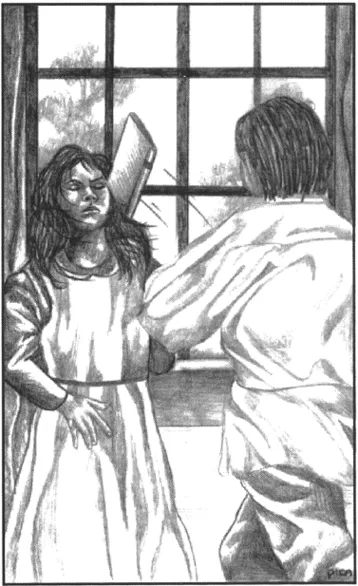
Fourteen-year-old John comes in and taunts Jane, scolds her for taking a book, and then throws it at her. Jane falls against a door and cuts her head, causing her to scream out at John that he is a “wicked and cruel boy.” John grabs her by the hair, and Jane swings at him, at which point the family enters and blames Jane for the incident. She is sent to the “Red Room.”
Bessie and Miss Abbot try to calm Jane down, reminding her that if it weren’t for Mrs. Reed, “you would have to go to the poor-house.”
The Red Room is the room where Jane’s uncle, Mr. Reed, died. Jane recollects her kind uncle and becomes very upset remembering the injustices thrust upon her. Suddenly, Jane sees a strange light, and imagines a ghost is in the room. She screams and sobs to be let out of the room, but Mrs. Reed keeps her locked in the Red Room. Jane falls to the floor, unconscious.
The next day Mr. Lloyd comes to examine her and suggests that Jane might be better off going away to school, and Mrs. Reed agrees. Overhearing a conversation between Miss Abbot and Bessie, Jane learns that her mother was disinherited for marrying a poor clergyman, and that both of her parents died of typhus when she was an infant.
Analysis
Several major themes of the novel are presented immediately: Jane Eyre’s isolation; her struggle for her own survival under adverse conditions; her quest for and recognition of true Christian love; and the linking of a plain physical appearance with a favorable inner character, and a beautiful exterior with a defective character.
Brontë cleverly echoes Jane’s feelings of isolation in the story Jane is reading, History Of British Birds. Physically separated from the family, Jane reads in her book, “the rock standing up alone in a sea of billow and spray; to the broken boat stranded on a desolate coast.” The rock symbolizes Jane’s own strength and endurance, the “desolate coast” symbolizes her bleak surroundings. Jane’s experience is again echoed in the song Bessie sings to Jane—each verse ends in the line “poor orphan child.”
Brontë introduces a writing device called the “pathetic fallacy,” which she will use throughout the novel. Pathetic fallacy suggests parallel moods in nature to reflect the emotions of the characters. An example in these chapters is the weather described by Jane in the opening paragraph, “the cold winter wind had brought with it clouds so somber, and a rain so penetrating.” Jane then sits in the window seat and tells the reader, “to the left were the clear panes of glass, protecting but not separating me from the drear November day.…I studied the aspect of that winter afternoon. Afar, it offered a pale blank of mist and cloud; near, a scene of wet lawn and storm-beat shrub, with ceaseless rain sweeping away wildly before a long and lamentable blast.” Nature is reflecting Jane’s feelings, and also foreshadows the upcoming scene.
From the very beginning of the story, Jane calls on her inner strength to overcome adversity. She is constantly reminded of her orphan status—even the servants don’t let her forget, “And you ought not to think yourself on equality with the Misses Reed and Master Reed,” Miss Abbot informs her, going on to say, “God will punish her.”
Rather than be beaten down by her struggle, Jane fights back, establishing her passionate nature. After her physical fight with John, Bessie exclaims, “Did ever anybody see such a picture of passion.” Examples of her spunk are presented when she fights back after being hit by John, yells to be let out of the Red Room (red symbolizing passion), and tells Mr. Lloyd about her unhappiness.
The theme of Jane looking for a family and love is established when Jane muses, “I was in discord in Gatehead Hall; I was like nobody there; I had nothing in harmony with Mrs. Reed or her children, or her chosen vassalage. If they did not love me, in fact, as little did I love them.”
It is in this hostile environment at Gateshead that Jane’s quest for love begins. Mrs. Reed and the Reed children represent Christians who claim to be kind and loving yet exhibit cruel, hateful behavior.
Jane is extremely conscious of her physical appearance, expressing in the very first paragraph her “physical inferiority to her cousins.” She describes her cousin Georgiana as being indulged and loved because of “her beauty, her pink cheeks, and golden curls.” Bessie and Miss Abbot also concur that Jane would be better off if she were more attractive, physically. We later see that Jane has inner beauty, while the characters who are beautiful on the outside possess a flawed personality.
The story is told from the first-person point of view, beginning when Jane is a child of ten, and ending after she has been married for ten years. This device creates an intimacy between the reader and Jane.
Study Questions
1. Where does Jane live, and with whom?
2. What is her status, and how is she treated?
3. Why is Jane off reading alone?
4. Where is she sitting?
5. What happens between Jane and John?
6. What is Jane’s reaction to being hit with the book?
7. How do we know that Mrs. Reed is an unkind woman?
8. How does Jane behave in the Red Room?
9. Why does Jane imagine a ghost or spirit?
10. How do we learn about Jane’s appearance?
Answers
1. Jane lives at Gateshead hall with her aunt through marriage, Mrs. Reed, and her three cousins, John, Eliza, and Georgiana.
2. Jane is an orphan. She is treated very cruelly by Mrs. Reed and her children.
3. Mrs. Reed will not let Jane sit with the family.
4. Jane is sitting on a window seat in the breakfast room.
5. John throws a book at Jane, causing her head to bleed.
6. Jane hits John back and screams that he is “a wicked and cruel boy.”
7. Mrs. Reed ejects Jane from the family circle, banishes her to the Red Room, and refuses to let her out when she sobs.
8. Jane reacts by working herself into a fit.
9. The Red Room is the room where Jane’s uncle, Mr. Reed, has died. Jane also sees a light on the ceiling.
10. Both Bessie and Miss Abbot discuss Jane’s plainness, and Jane compares herself unfavorably to her beautiful cousin Georgiana.
Suggested Essay Topics
1. Discuss how Jane’s passionate nature is established.
2. Characterize Mrs. Reed, John Reed, Eliza, and Georgiana.
3. Explain first-person narrative, and why it might be beneficial to the story.
4. Discuss one, or more, of the themes that Brontë has established so far.
5. Explore the symbols that Brontë uses to enhance the story.
Chapters IV–VI
New Characters:
Mr. Brocklehurst: minister of Brocklebridge Church, headmaster at Lowood School
Miss Miller: an under-teacher at Lowood School She is in charge of Jane when Jane first arrives at Lowood
Maria Temple: teacher at Lowood School
Helen Burns: student at Lowood School who befriends Jane, and then dies of tuberculosis
Miss Scatcherd: teacher at Lowood School
Summary
Jane endures a few more months at Gateshead Hall. Since her outburst, she is treated with more dislike from Mrs. Reed and is required to sleep in a small closet and take her meals alone. While the other children play, Jane is kept separate, and is hardly spoken to.
Excluded from all Christmas festivities, Jane finds solace alone with her doll; “To this crib I always took my doll; human beings must love something, and, in the dearth of worthier objects of affection, I contrived to find a pleasure in loving and cherishing a faded graven image, shabby as a miniature scarecrow. It puzzles me now to remember with what absurd sincerity I doted on this little toy, half fancying it alive and capable of sensation. I could not sleep unless it was folded in my night–gown; and when it lay there safe and warm, I was comparatively happy, believing it to be happy likewise.”
An occasional kind word, and a gentle goodnight kiss from Bessie, are her only other comforts in this hostile environment.
Mr. Brocklehurst, the headmaster of Lowood School, comes to Gateshead Hall to meet with Jane. He interrogates Jane harshly, asking, “No sight so sad as that of a naughty child, especially a naughty little girl. Do you know where the wicked go after death?” When he asks Jane if she likes the Psalms, Jane, honest as always, replies, “No sir.”
Mrs. Reed and Mr. Brocklehurst arrange for Jane to be sent to Lowood School. Mrs. Reed requests that Jane remain at Lowood even during vacations.
During her conversation with Mr. Brocklehurst, Mrs. Reed called Jane a liar, and Jane is very hurt by the remark. After Mr. Brocklehurst leaves, Jane and Mrs. Reed have a confrontation and Jane expresses her true feelings to her; “and if anyone asks me how I liked you, and how you treated me, I will say the very thought of you makes me sick, and that you treated me with miserable cruelty.”
When Mrs. Reed defends herself, calls Jane a dear and tells her to lie down, Jane replies; “I am not your dear; I cannot lie down: send me to school soon, Mrs. Reed, for I hate to live here.”
Jane is awakened at five o’clock on the morning of January 19 to travel the fifty miles to Lowood. She is greeted at Lowood by Miss Miller and Miss Temple.
At Lowood, Jane realizes quickly that this is...
Table of contents
- Cover Page
- Title Page
- Copyright Page
- Contents
- Section One: Introduction
- Section Two: Jane Eyre
- Section Three: Sample Analytical Paper Topics
- Section Four: Bibliography
- Back Cover
Trusted by 375,005 students
Access to over 1.5 million titles for a fair monthly price.
Study more efficiently using our study tools.
Frequently asked questions
Yes, you can cancel anytime from the Subscription tab in your account settings on the Perlego website. Your subscription will stay active until the end of your current billing period. Learn how to cancel your subscription
No, books cannot be downloaded as external files, such as PDFs, for use outside of Perlego. However, you can download books within the Perlego app for offline reading on mobile or tablet. Learn how to download books offline
Perlego offers two plans: Essential and Complete
- Essential is ideal for learners and professionals who enjoy exploring a wide range of subjects. Access the Essential Library with 800,000+ trusted titles and best-sellers across business, personal growth, and the humanities. Includes unlimited reading time and Standard Read Aloud voice.
- Complete: Perfect for advanced learners and researchers needing full, unrestricted access. Unlock 1.5M+ books across hundreds of subjects, including academic and specialized titles. The Complete Plan also includes advanced features like Premium Read Aloud and Research Assistant.
We are an online textbook subscription service, where you can get access to an entire online library for less than the price of a single book per month. With over 1.5 million books across 990+ topics, we’ve got you covered! Learn about our mission
Look out for the read-aloud symbol on your next book to see if you can listen to it. The read-aloud tool reads text aloud for you, highlighting the text as it is being read. You can pause it, speed it up and slow it down. Learn more about Read Aloud
Yes! You can use the Perlego app on both iOS and Android devices to read anytime, anywhere — even offline. Perfect for commutes or when you’re on the go.
Please note we cannot support devices running on iOS 13 and Android 7 or earlier. Learn more about using the app
Please note we cannot support devices running on iOS 13 and Android 7 or earlier. Learn more about using the app
Yes, you can access Jane Eyre (MAXNotes Literature Guides) by Barbara Quintero in PDF and/or ePUB format, as well as other popular books in Study Aids & Study Guides. We have over 1.5 million books available in our catalogue for you to explore.