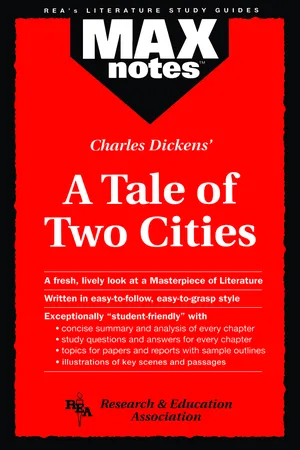
REA's MAXnotes for Charles Dickens' A Tale of Two Cities
MAXnotes offer a fresh look at masterpieces of literature, presented in a lively and interesting fashion. Written by literary experts who currently teach the subject, MAXnotes will enhance your understanding and enjoyment of the work. MAXnotes are designed to stimulate independent thought about the literary work by raising various issues and thought-provoking ideas and questions.
MAXnotes cover the essentials of what one should know about each work, including an overall summary, character lists, an explanation and discussion of the plot, the work's historical context, illustrations to convey the mood of the work, and a biography of the author. Each section of the work is individually summarized and analyzed, and has study questions and answers.
- 112 pages
- English
- ePUB (mobile friendly)
- Available on iOS & Android
eBook - ePub
Tale of Two Cities, A (MAXNotes Literature Guides)
About this book
Information
Topic
Study AidsSubtopic
Study GuidesSECTION ONE
Introduction
The Life and Work of Charles Dickens
Charles Dickens was born in Portsmouth, England, on February 7, 1812. His family moved to London in 1821, where Dickens’ father became overwhelmed by debt, ending up in debtors’ prison. Charles was forced to take a factory job at the age of 12. This first-hand experience with poverty informs much of his later writings. Dickens escaped from this world of debt, thanks to the help of some relatives who made it possible for him to get a formal education at the Wellington House Academy.
In 1834, Dickens took a job as a reporter for The Morning Chronicle; he also began publishing various sketches and essays in periodicals. Some of this early work was reprinted as Sketches by Boz (1836). With the serial publication of The Pickwick Papers in the same year, Dickens became one of the most popular authors of his time. In the midst of this sudden success, Dickens married Catherine Hogarth. The marriage was an unhappy one, finally ending in separation 23 years later.
The success of The Pickwick Papers was followed by the serial publication of Oliver Twist (1837), Nicholas Nickleby (1838-9), The Old Curiousity Shop (1840-1), and Dickens’ first historical novel, Barnaby Rudge (1841). All of these works sold remarkably well. Dickens traveled in America for the next year, returning with American Notes (1842) and A Christmas Carol (1843). Dickens spent the next few years traveling in Europe.
The autobiographical David Copperfield (1849-50) began a series of more serious novels, including Bleak House (1852-3) and Hard Times (1854), with more structured plots that directly criticized his society and government. Following the separation from his wife in 1858, Dickens published A Tale of Two Cities (1859), an historical novel dealing with the French Revolution. While working on the never-to-be-completed novel The Mystery of Edwin Drood, Dickens suffered two strokes. This second stroke led directly to his death on June 9, 1870.
Historical Background
Charles Dickens was the most popular English novelist of the Victorian Age, a time period spanning roughly from the 1820s to the end of the nineteenth century. While the revolutions in America and France had happened many years earlier, there was still great social tension in England during these times. Work conditions for the poor were horrid, often resulting in strikes that ended in violent clashes between the police and the workers.
A Tale of Two Cities can be seen as a warning to British society of the mid-nineteenth century. Dickens calls attention to the extraordinary violence of the French Revolution, while showing that the overthrow of a government by violent means inevitably leads to more killing. Many revolutionaries of his day failed to see that Dickens was more concerned with portraying the death and destruction that accompany revolution than with endorsing a working class revolt.
Indeed, Dickens’ popularity crossed all class lines. His writings were as much a topic of upper-class drawing room party conversation, as they were among the factory workers who could afford to buy the weekly serializations.
Critics were only slightly less kind to Dickens. While he was sometimes faulted for sentimentality and for relying on unbelievable plot coincidences, he was more often celebrated for his ability to create characters who seem alive and who embody a moral principle. Writers in the 1800s were looked to as moral examples, and Charles Dickens was not short on morality in his novels.
Master List of Characters
Jarvis Lorry—a lifelong bachelor and clerk at Tellson’s Bank, as well as a friend of the Manette’s and of Charles Darnay.
Lucie Manette—the daughter of Alexandre Manette. She marries Charles Darnay.
Dr. Alexandre Manette—Lucie’s father. At the novel’s beginning he is freed from 18 years of imprisonment.
Charles Darnay—a self-exiled member of French ruling class society, also known as Charles Evremonde. He marries Lucie Manette, returns to France, and is sentenced to die.
Ernest Defarge—owns a wine-shop in a Paris suburb. Along with his wife, he is a leader of the revolt in Paris.
Therese Defarge—the wife of Defarge and the co-leader of revolt. She knits names of those to be killed when the revolution comes.
Sydney Carton—the physical double of Charles Darnay who secretly does Stryver’s legal work. He heroically dies in place of Darnay.
Mr. Stryver—a lawyer who defends Darnay in England. He wants to marry Lucie Manette.
Jerry Cruncher—valet and personal messenger for Jarvis Lorry.
Miss Pross—Lucie Manette’s dedicated servant. She struggles with and kills Madame Defarge.
Monsieur the Marquis—French nobleman killed by a peasant. He is also the uncle of Charles Darnay.
Monsieur Gabelle—the Marquis’ servant who later summons Charles Darnay to England.
John Barsad—a spy who is also known as Solomon Pross, Miss Pross’ brother.
Roger Cly—he is sentenced to death as a spy in England.
Foulon—Foulon is a French nobleman killed during the revolution.
The Vengeance, the mender of roads/wood-sawyer, and various “Jacques”—various followers of the Defarges who participate in the revolt in Paris.
A tall man in a nightcap—his baby is killed by the Marquis’ coach. He murders the Marquis and is guillotined.
Mrs. Jerry Cruncher—Jerry Cruncher’s wife.
Master Jerry Cruncher—the son of Jerry Cruncher.
Little Lucie Manette—the daughter of Lucie Manette and Charles Darnay.
Woman going to guillotine—she talks with Sydney Carton as they await their deaths.
Summary of the Novel
A Tale of Two Cities is concerned with events in Paris and London before and during the French Revolution. The story focuses on Charles Darnay, the self-exiled nephew of French nobility, and his wife, Lucie Manette, daughter of Dr. Alexandre Manette. As the first of the novel’s three sections begins, Jarvis Lorry is on his way to Paris to reunite Dr. Manette with the daughter who thought he has been dead for the past 18 years. Over this time Dr. Manette has forgotten his past life; he sits in a small attic room and makes shoes. Slowly, Jarvis and Lucie Manette “recall (him) to life.”
The novel’s second section starts five years later. Lucie Manette marries Charles Darnay. Darnay confesses a secret to Dr. Manette on the eve of the wedding. This secret turns out to be that Darnay is really Charles Evremonde, a member of the French ruling class. Darnay has renounced his past and wishes to settle in England. Meanwhile, unrest is growing in the Paris suburb of St. Antoine. The center of this unrest is a wine-shop owned by the Defarges, who are shown leading the storming of the Bastille.
The final section of the novel opens with Darnay on his way to Paris at the entreaty of a former servant who is endangered. Darnay is arrested and sentenced to die. The Manettes and Lorry hurry to Paris and succeed in freeing Darnay, but he is soon arrested again. He is sentenced to the guillotine. Sydney Carton, who bears a striking resemblance to Darnay, sneaks into the prison and switches places with Darnay. Carton is on his way to the guillotine, willing to die for the love of Lucie, while Darnay, the Manettes and Lorry flee to London.
Estimated Reading Time
Like most Victorian authors, Dickens could be verbose. At roughly 400 pages, A Tale of Two Cities is actually one of his shorter novels. While the optimal way to read this novel would be to read one weekly installment at a time, this is impractical. As the novel is broken into three sections, a better reading plan would be to read the first section in one sitting, while devoting two sittings each to the final two longer sections. Total reading time should be approximately 12 hours.
SECTION TWO
Book the First:
Recalled to Life
Recalled to Life
Chapter 1: The Period
Chapter 2: The Mail
Chapter 3: The Night Shadows
New Characters:
Jerry Cruncher: messenger who becomes valet and personal messenger for Jarvis Lorry
Jarvis Lorry: lifelong bachelor and clerk at Tellson’s Bank; he is a friend of the Manette’s and Charles Darnay
Summary
The year is 1775. France is described as on the verge of revolution; England is said to be “scarcely” better. A coach is taking the mail to Dover. Jarvis Lorry is a passenger on this coach. It is late at night, and a horse is heard approaching at a quick pace. The passengers and driver fear that it is a highwayman. The coach stops; the coachman threatens to shoot the man approaching on horseback.
But it is only Jerry Cruncher with a message for Jarvis Lorry from Tellson’s Bank: “Wait at Dover for Mam’selle.” Lorry gives a message for Jerry to return with–”RECALLED TO LIFE.” The narrator reflects on the idea th...
Table of contents
- Cover Page
- Title Page
- Section One — Introduction
- Back Cover
Trusted by 375,005 students
Access to over 1.5 million titles for a fair monthly price.
Study more efficiently using our study tools.
Frequently asked questions
Yes, you can cancel anytime from the Subscription tab in your account settings on the Perlego website. Your subscription will stay active until the end of your current billing period. Learn how to cancel your subscription
No, books cannot be downloaded as external files, such as PDFs, for use outside of Perlego. However, you can download books within the Perlego app for offline reading on mobile or tablet. Learn how to download books offline
We are an online textbook subscription service, where you can get access to an entire online library for less than the price of a single book per month. With over 1.5 million books across 990+ topics, we’ve got you covered! Learn about our mission
Look out for the read-aloud symbol on your next book to see if you can listen to it. The read-aloud tool reads text aloud for you, highlighting the text as it is being read. You can pause it, speed it up and slow it down. Learn more about Read Aloud
Yes! You can use the Perlego app on both iOS and Android devices to read anytime, anywhere — even offline. Perfect for commutes or when you’re on the go.
Please note we cannot support devices running on iOS 13 and Android 7 or earlier. Learn more about using the app
Please note we cannot support devices running on iOS 13 and Android 7 or earlier. Learn more about using the app
Yes, you can access Tale of Two Cities, A (MAXNotes Literature Guides) by Jeffrey Karnicky in PDF and/or ePUB format, as well as other popular books in Study Aids & Study Guides. We have over 1.5 million books available in our catalogue for you to explore.