![]()
PART I
ESL
Intermediate Grammar
![]()
Intermediate Grammar
ESL
CHAPTER 1
Pronouns
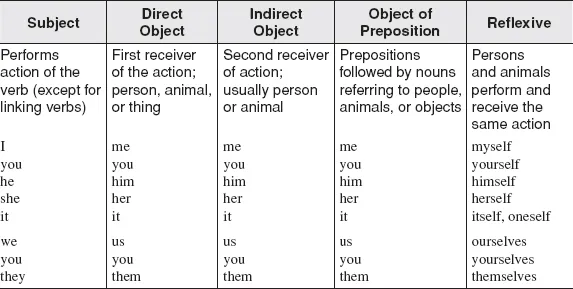
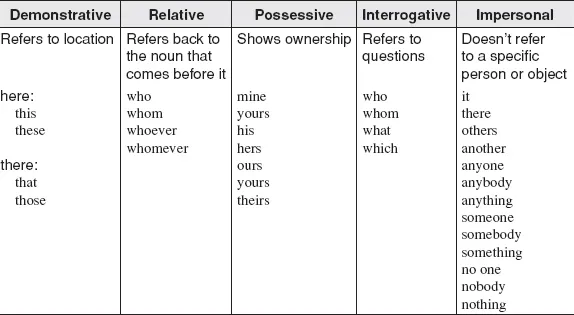
Pronouns are words that take the place of nouns and all their modifiers. They can be subjects, direct and indirect objects, interrogatives, impersonals, objects of prepositions, reflexives, demonstratives, possessives, and relatives. This chart will help you keep them in the proper order.
SUBJECT PRONOUNS
Pronouns can be subjects and perform action. Here are the pronouns used as subjects:
Use subject pronouns for the following:
a. As the subject of the verb
| He writes music. | She sings well. |
b. After than or as in comparison
| He paints better than she. | I am as tall as he. |
c. After a form of the verb be
| It is l. | The winner was she. |
In (b) if you repeat the verb, you can see that you must use the subject form.
| He paints better than she (paints). | I am as tall as he (is). |
Pronouns can be objects (receivers): direct, indirect, object of a preposition:
me | us |
you | you |
him, her, it | them |
a. Khan saw her last night in class. (direct object)
b. Give the money to them immediately. Give them the money immediately. (indirect object)
c. Sam bought for us dinner because we were working so late. (object of a preposition)
Whenever there is a compound form in a prepositional phrase, cover up the other noun and the word and, and then decide whether you need subject or object pronouns.
Give the books to Jane and
. Give Jane and her the books.
By covering up Jane and, you see that the pronoun is used as the object of the preposition to, and her would be the object form.
Pat and
saw the movie last night.
By covering up Pat and, you see that the pronoun is the subject form; therefore, I is the correct form.
EXERCISE 1
Circle the correct form of the pronoun. When you have finished, check your answers with the answer key in the back of the book.
Example: You and (he, him) will represent the class at the meeting.
Answer: You and
him) will represent the class at the meeting.
1. (She, Her) and Paul are planning on attending the concert.
2. (We, Us) girls insist on being admitted to the club.
3. Our teacher gave the extra credit to Melanie and (I, me).
4. No one saw him and (she, her) together at the game.
5. How many tickets did you buy for (we, us)?
6. I have to see (they, them) before the office closes.
7. (He, Him) travels to San Diego every spring.
8. Find the boss’s file and hand it to (him, he).
9. The boys...